Blog
Generative Engine Optimization Budget for B2B SaaS: What to Fund and What to Skip
Build a generative engine optimization budget for B2B SaaS: split fixed SEO-overlap work from monitoring tools, with sourced price ranges and kill criteria.
How a B2B SaaS site gains visibility in AI search engines: crawler access, answer-first pages, third-party mentions and monthly measurement, with sourced data.
 Ishan ManchandaNov 10, 2026

Build a generative engine optimization budget for B2B SaaS: split fixed SEO-overlap work from monitoring tools, with sourced price ranges and kill criteria.

The six metrics that matter for AI search visibility in B2B SaaS, how to separate mentions from citations, set per-engine baselines and tie results to pipeline.
How B2B SaaS teams can structure pages for Google AI Overviews: what Google documents, what CTR studies show, and where to spend effort first.
Request a quote and our experts will contact you within 24 hours with tailored solutions and pricing.
AEO for B2B SaaS
Last updated: Nov 10, 2026
By AEO for B2B SaaS Editorial Team. Last updated November 4, 2026.
Improving visibility in AI search engines means making a B2B SaaS site crawlable, easy to quote and backed by third-party mentions, so AI assistants and AI Overviews cite it when buyers ask category questions. Most of the work builds on sound search foundations. A smaller part is new: page structure for citation, off-site presence and measurement.
The problem usually shows up in one of two ways. A CEO asks ChatGPT about the category and the company is not named. Or an SEO manager sees rankings hold while clicks fall. This guide covers what to change, in what order, and how to track it, using answer engine optimization (AEO) as the working discipline. Each figure is labeled as measured or predicted, with its source. For the definition behind the discipline, see what AEO means for B2B SaaS.
Key Takeaways
- Visibility in AI search engines for a B2B SaaS site depends on five jobs: crawler access, answer-first pages, specific facts, third-party mentions and monthly measurement.
- Google's own guidance calls optimizing for generative AI search "still SEO", yet BrightEdge measured only about 17% top-10 overlap between AI Overview citations and organic rankings (Search Engine Journal, 2026).
- AI referral traffic is about 1% of sessions at most sites and conversion evidence points both ways, so a B2B SaaS team should fund the work as a visibility and measurement program, not a guaranteed revenue line.
- A fixed set of 20 or more buyer questions, checked monthly across five engines, is a proposed baseline for showing leadership where the brand stands before budget is committed.
Improving a B2B SaaS site's visibility in AI search engines takes five jobs in order: allow crawler access, put the answer first on key pages, add specific facts in tables, earn third-party mentions, and measure monthly. The need is real: 45% of B2B buyers used generative AI in a recent purchase, as reported in a reprint of a Gartner press release (BizTech Reports, 2026).

The table below summarizes the five jobs, what each one changes and why it matters.
| Step | What to change | Why it matters | Covered in |
|---|---|---|---|
| 1. Crawler access | Raw HTML, robots.txt, bot-protection rules | Engines cannot cite pages they cannot read | Readable to AI crawlers |
| 2. Answer-first pages | Direct answer under each question heading | Gives engines a passage to lift | Writing pages to get cited |
| 3. Specific facts | Tables, dated figures, named entities | Makes claims checkable and quotable | Writing pages to get cited |
| 4. Third-party mentions | Reviews, listicles, community presence | Engines cite sources beyond the vendor site | Third-party mentions |
| 5. Measurement | Fixed question set, monthly checks, referral filters | Turns a vague worry into a baseline | Measuring visibility |
Our results: The AEO for B2B SaaS site is built to run the six-item technical baseline this guide recommends: content in raw HTML, schema, sitemap, llms.txt, crawler access and Markdown copies. A public technical report on those results is planned. It will carry no citation guarantee, because no engine documents one.
Answer engine optimization (AEO) is the practice of structuring a site and its content so AI assistants and AI search features cite it when a buyer asks a question. Generative engine optimization (GEO) is an overlapping term some researchers use for the same discipline, and large language model (LLM) optimization is a third label. The terms differ more in vendor marketing than in practice. A fuller comparison sits in AEO vs SEO for B2B SaaS.
Sequence matters because later steps depend on earlier ones. A well-written page that crawlers cannot read earns nothing. A well-built site that nobody measures cannot defend its budget.
For the cluster overview, see how B2B SaaS brands get cited by AI assistants.
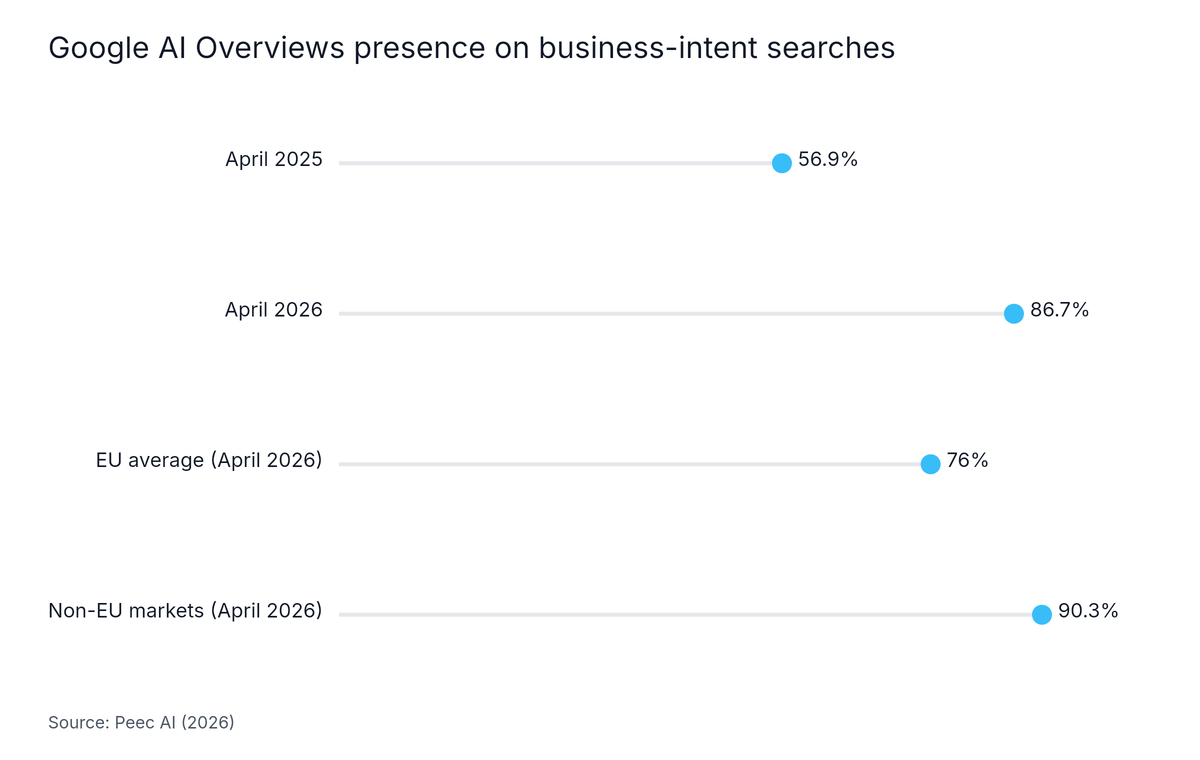
AI search visibility matters to B2B SaaS because buyers now start research in AI assistants and AI Overviews. Peec AI's tracking data shows Google AI Overviews appeared on 86.7% of business-intent searches in April 2026, up from 56.9% in April 2025 (Peec AI, 2026). A vendor missing from those answers is missing from early shortlists.
Source: Peec AI, 2026
An AI Overview is a generated summary that Google Search shows with links to the pages it drew from. The same Peec AI data puts the April 2026 EU average at 76% and non-EU markets at 90.3% (Peec AI, 2026). These are vendor figures, and the visible excerpt does not state the full sample size.
Buyers use AI to gather vendor and product information, then check it elsewhere. A Gartner survey of 645 B2B buyers, as reported in a reprint, found they used an average of seven information sources (BizTech Reports, 2026). The same Gartner survey found 69% prefer to validate AI-generated insights with sales reps (Gartner, 2026). Forrester's 2026 buying research reports that generative AI search is now the starting point for B2B buyers, who then validate through their buying network, and more than 60% use trials (Forrester, 2026).
An AI citation therefore opens the shortlist, and proof assets close it.
The evidence points both ways, which is why leadership questions the topic. The two measurements below carry stated samples and dates.
What the measurements show: An Ahrefs study published in February 2026 measured a 58% lower average click-through rate (CTR) for the top-ranking page when an AI Overview was present, across 300,000 keywords, comparing December 2023 with December 2025. Seer Interactive's 2026 research reported that CTR on results with an AI Overview rebounded 85% in the first two months of 2026. It also found informational results without one rose from 2.93% to 3.97% CTR across 901 million impressions in 2025.
Both are measurements, not forecasts. Read together, they show a sharp drop followed by a partial recovery, so a B2B SaaS team should track its own click data rather than assume either trend.
Optimizing for AI search overlaps heavily with search engine optimization (SEO), the practice of earning ranked links, but citation behavior differs from ranking. Google's May 2026 guide says the work is still SEO (Google for Developers, 2026), yet BrightEdge reported only about 17% top-10 overlap between AI Overview citations and organic rankings (Search Engine Journal, 2026).

Google's guide, published 15 May 2026, states: "From Google Search's perspective, optimizing for generative AI search is optimizing for the search experience, and thus still SEO." (Google for Developers, 2026). It adds: "Our generative AI features on Google Search are rooted in our core Search ranking and quality systems." (Google for Developers, 2026).
The same guide lists llms.txt, content chunking, AI-specific rewriting, inauthentic mentions and special structured data as unnecessary for its AI features. Search Engine Journal's coverage notes that pages must be indexed and snippet-eligible to appear in generative AI features (Search Engine Journal, 2026).
Ranking is necessary but not sufficient. The table sorts common tasks by how much they depend on existing SEO work.
| Task | SEO foundation | Extra for AI citation | Evidence level |
|---|---|---|---|
| Indexing and snippet eligibility | Yes | None | Google documentation (2026) |
| Crawlable, fast pages | Yes | Check AI crawler rules | Google documentation (2026) |
| Direct answers under headings | Partly | Core to being lifted | Practice, not proven by a sample |
| Third-party mentions | Partly (links) | Reviews, lists, communities | Vendor tracking data (2026) |
| Monthly question checks | No | New measurement routine | Proposed method |
| llms.txt file | No | Unconfirmed benefit | Not adopted by a major engine |
Teams that want a deeper contrast can read LLM optimization for B2B SaaS.
AI crawlers can cite only what they can read, so a B2B SaaS site needs key pages in raw HTML, crawler access set on purpose in robots.txt, and structured data that matches visible text. Google's May 2026 guide says "To maximize your site's visibility in generative AI search features, ensure your content is crawlable" (Google for Developers, 2026).

Crawler access is whether automated bots can fetch and read a page. It is controlled by robots.txt, bot-protection rules and server settings. Many sites block AI crawlers by accident, through a bot-protection rule nobody has reviewed.
Run this checklist on every key page. No sourced figure exists for how much each item lifts citations, so treat it as readiness, not a guarantee.
Structured data is machine-readable markup, such as Article or FAQPage schema, that describes what a page contains. Google's guide lists special structured data as unnecessary for its AI features (Google for Developers, 2026), so schema is hygiene, not a silver bullet.
llms.txt is a proposed convention that signals which content on a site is meant for AI ingestion. It is not a standard adopted by a major engine, and Google's guide, dated 15 May 2026, lists it among tactics unnecessary for Google's AI features (Google for Developers, 2026). Adding one is cheap, but it should come after the checklist above. The wider guide to getting cited by AI search engines covers differences by engine.
B2B SaaS pages earn citations when the answer comes first, facts are specific and the structure is easy to lift. Use a direct answer of 40 to 80 words under each question heading, with tables for comparisons and dated figures. Buyers use an average of seven information sources (Gartner reprint via BizTech Reports, 2026), so each page must be quotable on its own.
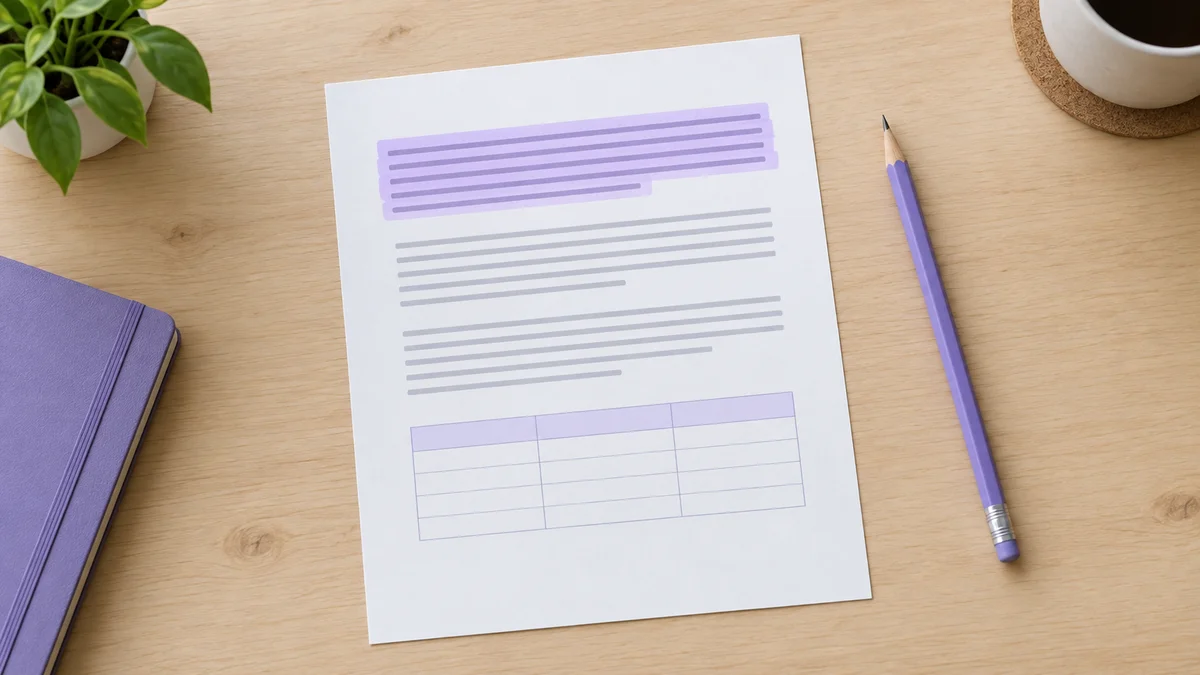
An answer-first page opens each section with a short paragraph that fully answers the heading, names its subject and carries one fact. Detail, qualifiers and links follow. Category pages that read like brochures fail this test. They answer late, bury facts in prose and give engines nothing to lift.
Forrester describes the buyer side of this: "Buyers lean on AI for speed and breadth of insight, yet they increasingly validate its output against trusted external sources." (Forrester, 2026). Pages should therefore state claims in a form that can be checked.
Start with pages that answer buyer questions during vendor comparison. The table ranks the common types by what engines need from each.
| Page type | What engines need to lift | Common mistake |
|---|---|---|
| Category and product page | One-sentence definition, who it is for | Slogans instead of a definition |
| Comparison and alternatives page | Table with concrete values | Claims without numbers |
| Pricing page | Plans, limits and prices in text | Pricing inside images or scripts |
| Integration page | Named integrations and what each does | Logo walls with no text |
| FAQ block | Complete answer in the first sentence | Answers that point elsewhere |
Product marketers carry the highest risk here, because engines describe the product from whatever the page states. Original data helps too, since a figure with a named sample is something an engine can attribute. The practical starting point for getting cited walks through the rewrite in more detail.
Third-party mentions improve AI search visibility because engines cite review sites, community threads and listicles alongside vendor pages. Peec AI's tracking found Reddit was the #1 or #2 most-cited domain on every major AI engine as of March 2026, and a #1 listicle rank lifted B2B SaaS brand visibility by up to 16.5 percentage points (Peec AI, 2026).

Peec AI's listicle study covered 5.7 million data points from nearly 200,000 AI responses across 8 engines, collected from September 2025 to March 2026. It reported a lift of up to +16.5 percentage points in B2B SaaS brand visibility for a #1 listicle rank (Peec AI, 2026). Peec AI sells AI visibility tracking, so this is vendor research and should be read as a signal, not a promise.
Earn mentions where buyers already look, and keep them honest.
Google's guide lists inauthentic mentions among tactics it considers unnecessary for its AI features (Google for Developers, 2026). Paid placements and fake reviews carry reputational risk, and no source reviewed here shows they work.
Measuring visibility in AI search engines starts with a fixed set of 20 or more buyer questions, checked monthly across five engines, recording whether the brand is cited, how it is described and which competitors appear. This is a proposed baseline method, not measured data, so treat it as a starting routine.
Source: SEO Works, 2026
Share of answer is the percentage of checked buyer questions in which a brand is cited. Track it beside the accuracy of the description, since an engine can name a product and describe it wrongly.
The table sets out a baseline that leadership can review each month.
| Metric | How to collect it | Cadence |
|---|---|---|
| Share of answer | Count questions where the brand is cited, divided by questions checked | Monthly |
| Description accuracy | Compare each engine's wording with the product page | Monthly |
| Competitors named | List vendors cited alongside the brand | Monthly |
| AI referral sessions | Filter analytics for referrers such as chatgpt.com and perplexity.ai | Monthly |
| Generative AI performance | Review the report Google points to in Search Console | Monthly |
Build the question set from the ideal customer profile, keep the wording fixed and record the date of each check. Add a "how did you hear about us" field to forms, since many AI-influenced buyers arrive through direct or branded visits.
Expect small volumes and mixed conversion evidence. Opollo's 2026 benchmark of 312 B2B technology firms, as reported by Pixis, found AI referrals are about 1% of sessions at most sites, while B2B tech firms in the dataset averaged 6.4% by January 2026 (Pixis, 2026).
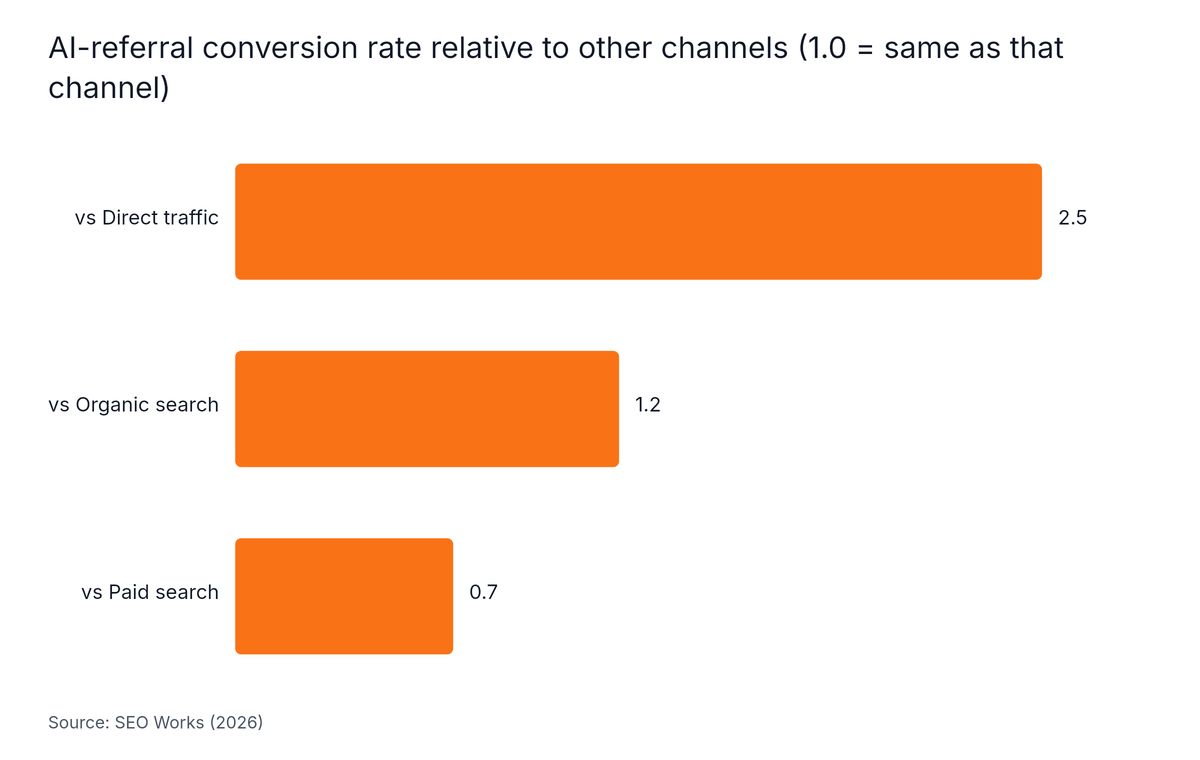
An SEO Works benchmark of 63 websites (5,001 AI-referral conversions against 155,605 organic) found organic search sent 39 times more traffic than AI assistants. AI referrals converted at 1.18 times the organic rate overall, 2.48 times the direct rate and 0.67 times the paid search rate. B2B product businesses were the exception, at 0.62 times the organic rate (SEO Works, 2026). The report is agency-published, so treat it as one data point.
Answer engine optimization (AEO) for B2B SaaS is not for teams that need a guaranteed citation, a fast payback or a single number that proves return. No engine documents a promised timeline, AI referrals are still about 1% of sessions at most sites (Opollo via Pixis, 2026), and conversion evidence points both ways.
A team with blocked crawlers, JavaScript-only pages or no analytics hygiene should fix those first. A team with no fixed buyer question set cannot judge results, so the baseline comes before any large spend. Ignoring the shift entirely carries its own cost: if a competitor becomes the default answer for the category, the shortlist forms without the company in it.
Measuring visibility in AI search engines starts with 20 or more buyer questions, checked monthly across five engines, a proposed baseline method rather than measured data. Record whether the site is cited, how the product is described and which competitors appear. Separate AI referral traffic in analytics by filtering referrers such as chatgpt.com and perplexity.ai.
A B2B SaaS site does not need an llms.txt file to be cited. It is a proposed convention, not a standard adopted by a major engine, and Google's guide of May 2026 lists it among tactics unnecessary for Google's AI features. Adding one is low cost, but it should not displace crawler access or answer-first pages.
Schema markup that matches visible page content is good hygiene for a B2B SaaS site, but it is not a silver bullet. Google's guide of May 2026 lists special structured data as unnecessary for its AI features. Use Article, FAQPage or Product markup only where the page text already says the same thing.
AI crawlers should be allowed in robots.txt for any page a B2B SaaS company wants cited. Blocking them prevents engines from reading the page, which removes the chance of a citation without a matching benefit when the page is already public. Review bot-protection rules too, since they can block crawlers unnoticed.
Ranking on page one of Google does not guarantee a citation in an AI Overview. BrightEdge reported only about 17% top-10 overlap between AI Overview citations and organic rankings (Search Engine Journal, February 2026). Pages must still be indexed and snippet-eligible, so ranking stays necessary, but it is not sufficient on its own.
Paid placements and organic citations are treated as different things in AI assistants, so buying an ad is not a route to a citation. No source reviewed here documents that ads change organic answers. A B2B SaaS team should plan paid visibility and earned citations as two separate efforts with separate measurement.
Visibility in AI search engines is built in a clear order, and most of it rests on work a B2B SaaS team already knows.
Next step: bring the questions buyers ask about the category and test them against the five jobs above. For the wider picture, read the guide to getting cited by AI search engines.
Meet with an expert
A free consultation. Bring the questions buyers ask about your category and brainstorm how to get cited.
Written by
Ishan Manchanda
Ishan Manchanda is co-founder of GrowthSpree, a B2B SaaS marketing consultancy founded in 2017 that has managed $60M+ in ad spend across 300+ B2B SaaS companies. He focuses on demand generation, go-to-market strategy and pipeline growth, and has been featured in Silicon Valley Times, SaaS Mag and the Unbounce podcast.