Request a quote and our experts will contact you within 24 hours with tailored solutions and pricing.
By AEO for B2B SaaS Editorial Team | Last updated: November 4, 2026
Semrush's large language model (LLM) optimization features are three layers of AI visibility tools, from site audit checks to a $99 prompt tracker and enterprise content optimization, that help B2B SaaS teams monitor AI citations. For marketers already paying for the platform, the question is practical: what do they cover, and what still falls to the team?
The measurement problem is real. Nearly half of marketing leaders (45%) say they cannot accurately measure brand visibility inside AI-generated answers, and only 9% have tooling that tracks every relevant metric across platforms (Semrush, 2026, vendor research). This page maps each Semrush layer to what it does, which platforms it tracks, what it costs and where gaps remain. It sits within a wider look at LLM optimization for B2B SaaS.
Key Takeaways
Semrush offers three layers of AI visibility features: Site Audit AI Search checks, the $99 a month AI Visibility Toolkit, and Enterprise AIO.
The Semrush AI Visibility Toolkit monitors mentions in a small set of platforms, and its base plan tracks 25 prompts for one domain.
Semrush Enterprise AIO stops tracking Microsoft Copilot on November 9, 2026, which shows how fragile scrape-based AI tracking can be.
A B2B SaaS team still owns page rewrites, third-party source work and attribution, because monitoring does not prove citations or pipeline.
Does Semrush Have LLM Optimization Features?
Yes. Semrush has three layers of LLM optimization features as of November 4, 2026: Site Audit AI Search checks on all plans, the standalone AI Visibility Toolkit from $99 a month (Sorank, 2026), and Enterprise AIO for content optimization. Most of it monitors AI visibility rather than writing pages, so B2B SaaS teams still own the execution.
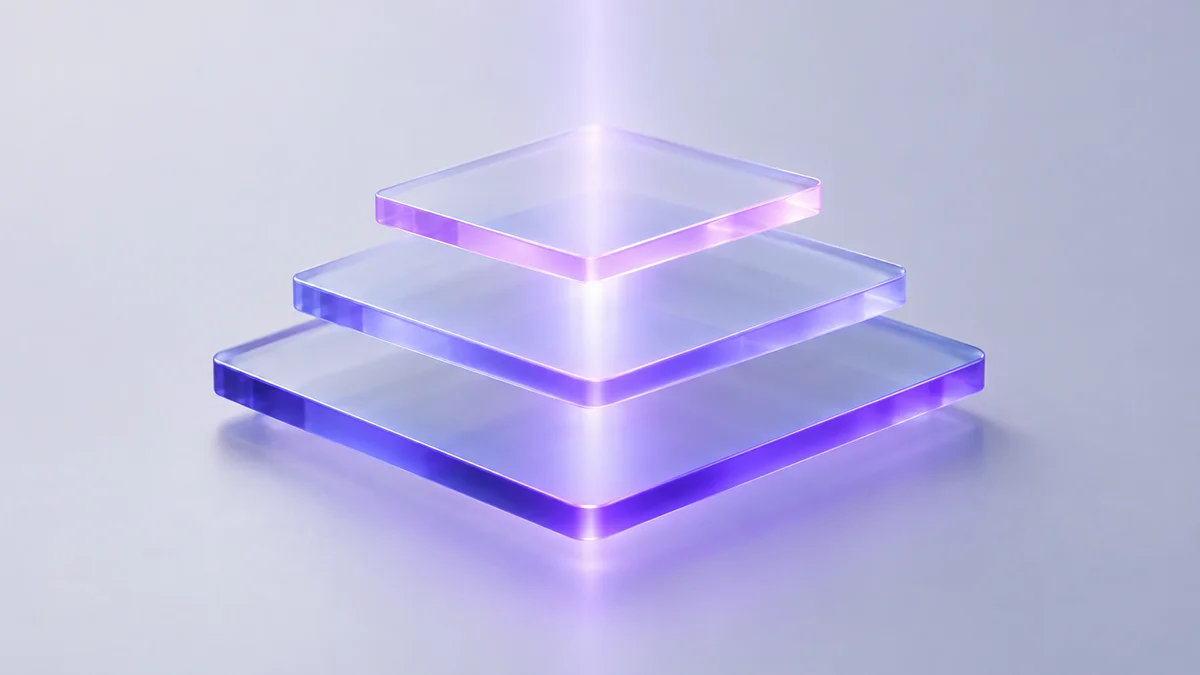
Three stacked translucent glass layers lit from within, representing three tiers of an AI visibility toolset
LLM optimization is the practice of shaping a site and its content so large language model assistants mention and cite the brand. It overlaps with answer engine optimization (AEO), which structures pages so AI assistants and AI search features cite them, and with generative engine optimization (GEO), an overlapping term for the same discipline. Readers new to the terms can start with what AEO means for B2B SaaS.
The table below separates the three layers, because Semrush's pages and most reviews blur them.
Layer
Plan
What it does
Platforms
Site Audit AI Search checks
All plans
Flags crawlability issues, such as a missing llms.txt file
Content optimization, forecasting, persona-based prompts, source and citation views
Nine platforms until Copilot ends on Nov 9, 2026
The Semrush AI Visibility Toolkit is a standalone add-on that tracks chosen prompts in AI platforms and reports whether a brand is mentioned. Semrush Enterprise AIO is the enterprise tier, adding content optimization, forecasting and persona-based prompt generation. Observation: the Site Audit checks show whether a page is technically readable. No independent evidence in the sources reviewed shows that passing them changes citation rates.
Which AI Platforms Does Semrush Track?
Semrush's base AI Visibility Toolkit tracks prompts daily in ChatGPT and Google AI Mode, per a review of its help-center documentation (Sorank, 2026), and some documents add Gemini. Semrush Enterprise AIO lists nine tracked AI platforms, falling to eight when Copilot tracking ends on November 9, 2026 (PPC Land, 2026).
A row of small glowing nodes, some lit and some dark, suggesting which AI platforms are tracked
Coverage differs by tier, and Semrush's own pages are not consistent about it. The table reflects what the sources reviewed report as of November 2026.
Tier
Platforms reported
Note
Base AI Visibility Toolkit
ChatGPT, Google AI Mode (Gemini in some documents)
Prompts tracked daily
Enterprise AIO
Nine platforms, then eight after Nov 9, 2026
Claude, Copilot and DeepSeek appear reserved for this tier
Research and crawler checks
Perplexity and Claude appear here
Not the same as prompt tracking
The Copilot change is documented. A Semrush customer notice to Enterprise AIO clients said "Recent changes to Microsoft Copilot's access requirements prevent AI visibility platforms, including Semrush Enterprise AIO" (PPC Land, 2026). Copilot's access terms now require a Microsoft account and bar bots and scrapers. Observation: that makes any platform list a moving target, so date-stamp it.
Coverage matters because visibility is uneven. Semrush's AI Visibility Index found only 36 of more than 1,200 brands hold visibility on every AI platform (PPC Land, 2026, reporting the June 2026 Index). Tracking only two platforms can miss where a B2B SaaS brand is absent.
How Much Does the Semrush AI Visibility Toolkit Cost?
The Semrush AI Visibility Toolkit starts at $99 a month for one domain and 25 tracked prompts, with no free trial (Sorank, 2026). Semrush One bundles are reported to start at $199 a month (Meev, 2026). Enterprise AIO pricing is not covered in the sources reviewed, so that tier needs a direct quote from Semrush.
A small stack of coins beside a short row of numbered tokens, representing a limited prompt budget
Cost item
Reported figure
What it means for B2B SaaS
Base toolkit
$99/month per domain
One product site per subscription
Prompt cap
25 prompts
Manually chosen, tracked daily
Free trial
None
Test through a paid month
Semrush One bundle
From $199/month
Check what the bundle adds
Reported pricing applies per domain and per sub-user, so costs scale with products and seats. The prompt cap is the tighter limit. Five buyer intents phrased three ways each uses 15 of the 25 prompts, leaving ten for competitors, regions or personas. Teams comparing tool categories can read the overview of AI search visibility tools before budgeting.
Meet with an expert: A free consultation. Bring the questions buyers ask about your category and brainstorm how to get cited.
Does Semrush Track Citations or Only Brand Mentions?
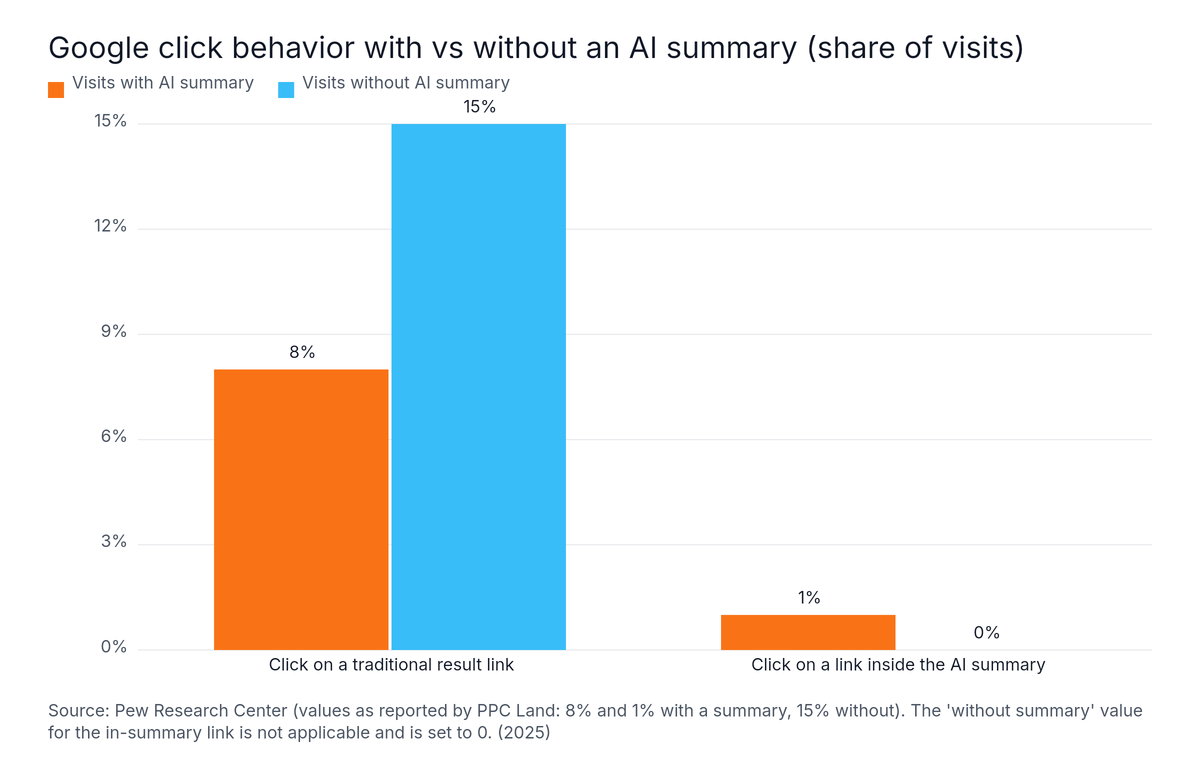
Semrush's AI Visibility Score is mention-based: it measures how often AI answers name a brand, while a citation is a linked source inside the answer. That distinction matters because Pew Research Center found users clicked a link inside an AI summary in just 1% of visits (Pew Research Center, 2025). Mentions and citations are not the same as traffic.
Grouped Bar chart: Google click behavior with vs without an AI summary (share of visits). Highest: Click on a traditional result link at 8%.
AI Visibility Score is Semrush's mention-based measure of how often AI answers name a brand. Pew's browsing data covered 900 U.S. adults and 68,879 searches in March 2025. Users who saw an AI summary clicked a traditional result in 8% of visits, against 15% without one. Pew's authors wrote: "Google users who encounter an AI summary are less likely to click on links to other websites than users who do not see one." (Pew Research Center, 2025). Pew describes this as an association, and Google disputed the methodology.
Attribution is the second gap. Semrush's own sector study found AI assistants sent only 0.48% of sessions to manufacturing and industrial sites in January to July 2026, and no clean correlation between AI traffic and mention or citation counts (PPC Land, 2026). The sector is not SaaS, but the caution carries over. Pair the score with first-party data: analytics referrals and self-reported attribution (asking buyers how they heard of you). The guide on AEO versus SEO for B2B SaaS covers what to measure beside clicks.
Our data: AEO for B2B SaaS proposes a monthly check of 20+ category questions across five engines as a measurement baseline. This is a proposed method, not a measured result. Semrush's base toolkit, at 25 prompts and two main platforms, covers only part of that baseline.
Is the Semrush AI Visibility Toolkit Enough for a B2B SaaS Team?
For a B2B SaaS team, the Semrush AI Visibility Toolkit is enough to build a monitoring baseline but not to close the gaps it finds. The toolkit reports where a brand is missing, yet it offers no content generation or source outreach list, so page changes, third-party profiles and attribution stay manual work for the team.
A magnifying glass over a tangle of lines resolving into a straight line, suggesting monitoring versus action
Why B2B SaaS teams need citation data
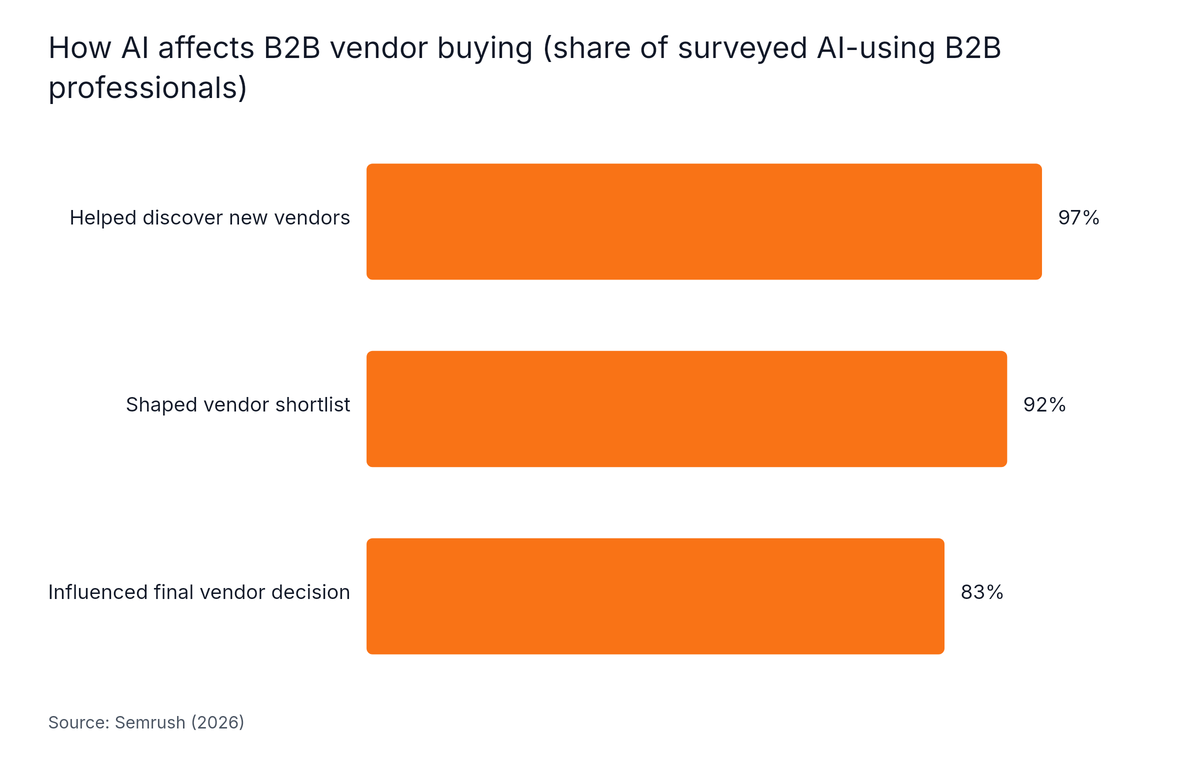
The buying stakes are high. In a Semrush survey of 600+ U.S. business professionals who use AI (fielded March to April 2026), 92% said AI shaped their vendor shortlist and 45% said significantly (Semrush, 2026, vendor research). In the same survey, 83% said AI influenced their final vendor decision and 97% said it helped them discover new vendors (Semrush, 2026). Three-quarters (75%) fully or mostly trust AI vendor recommendations (Semrush, 2026). Respondents were AI users only, so the wider buyer population will differ.
Horizontal Bar chart: How AI affects B2B vendor buying (share of surveyed AI-using B2B professionals). Highest: Helped discover new vendors at 97%.
Where B2B buyers use AI and where citations come from
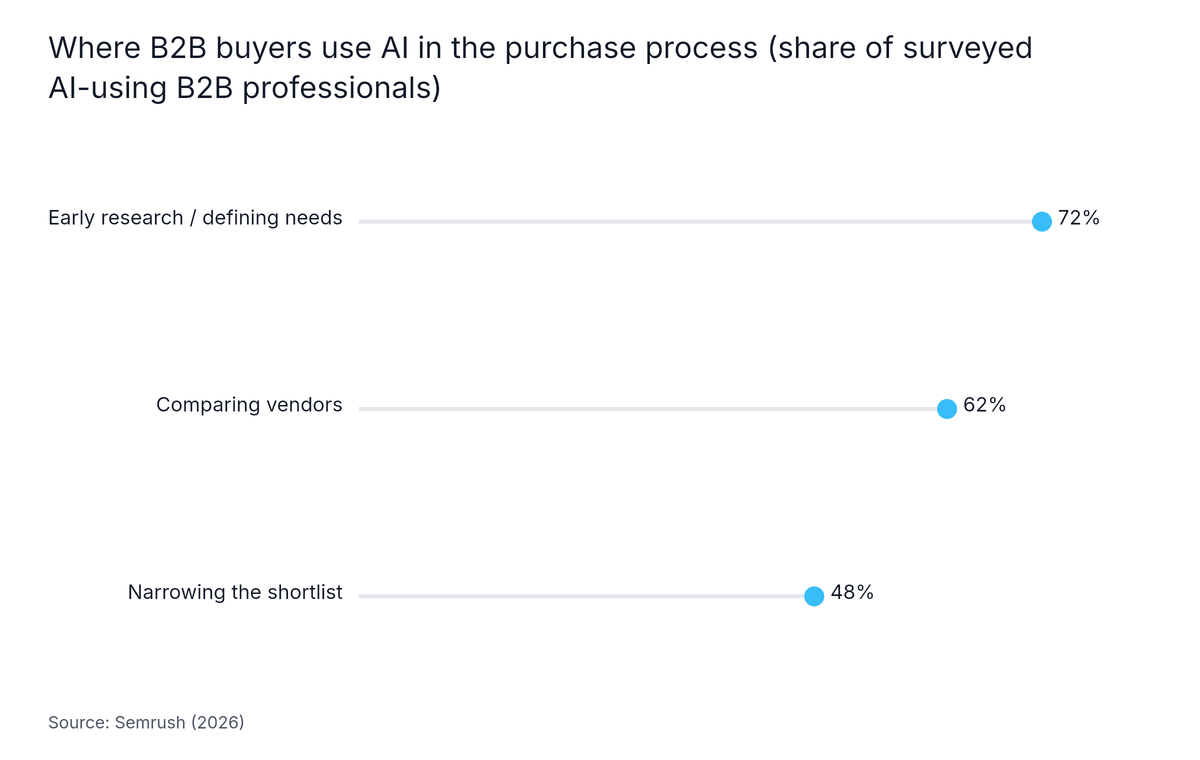
The same survey found 72% use AI for early research and defining needs, 62% for comparing vendors and 48% for narrowing the shortlist (Semrush, 2026). Early research happens before a buyer names a vendor, so a brand has to appear in answers it never prompted.
Lollipop chart: Where B2B buyers use AI in the purchase process (share of surveyed AI-using B2B professionals). Highest: Early research / defining needs at 72%.
Source type matters as well. A Semrush study of 325,000 prompts across ChatGPT Search, Google AI Mode and Perplexity (January to February 2026) found LinkedIn is the second most-cited domain at 11.03% of AI responses, behind Reddit at 11.29% and ahead of Wikipedia at 9.53% (PPC Land, 2026). A monitoring tool can show those sources, but it cannot change them. The practical starting point for getting cited covers the off-site work.
Andrew Warden, Vice President of Marketing at Adobe and former CMO of Semrush, said "The foundations of SEO are critically important in creating trust signals for AI" (Semrush, 2026). Site Audit and existing SEO work still count. The toolkit adds measurement on top.
Who Is the Semrush AI Visibility Toolkit Not Right For?
The Semrush AI Visibility Toolkit is a poor fit for teams that track many products, regions or personas on one budget, and for teams expecting proof of pipeline impact. The 25-prompt cap per domain and the lack of attribution evidence are the main limits (Sorank, 2026).
A bridge with a missing middle section over a calm gap, representing limits of a monitoring tool
These are observations from third-party reviews and Semrush's published material, not documented flaws:
Multi-product teams: each domain needs its own subscription, and 25 prompts spread thin across several product lines.
Teams needing execution help: the base toolkit reports gaps without producing content or outreach lists. Content optimization sits in the enterprise tier.
Teams needing Copilot data: Enterprise AIO ends Copilot tracking on November 9, 2026.
Teams needing ROI proof: mention counts do not establish citations, clicks or pipeline.
Teams sensitive to roadmap change: Adobe's acquisition of Semrush was reported as completed in April 2026, though the date is unverified in the sources reviewed. Adobe's own brand visibility product overlaps, and whether the products converge is not stated.
Semrush's survey figures above are vendor research from an interested party. Confirm tiers and pricing on Semrush's own pages before purchase.
Frequently Asked Questions
Does the Semrush AI Visibility Toolkit have a free trial?
No. The Semrush AI Visibility Toolkit is reported to have no free trial, according to a 2026 review of Semrush's help-center documentation. It starts at $99 a month for one domain and 25 tracked prompts. Buyers should confirm current terms on Semrush's pricing page before committing, since plans and bundles have changed several times since launch.
Did Semrush drop Copilot tracking?
Yes. Semrush told Enterprise AIO customers on October 28, 2026 that it will stop tracking Microsoft Copilot on November 9, 2026. Semrush says Copilot's access requirements now block data collection. Enterprise AIO moves from nine tracked platforms to eight. The base AI Visibility Toolkit was not reported to include Copilot.
What is the difference between the Semrush AI Visibility Toolkit and Enterprise AIO?
The AI Visibility Toolkit is a $99 a month monitoring add-on with 25 manually chosen prompts, while Enterprise AIO is the enterprise tier with content optimization, forecasting, persona-based prompt generation and wider platform coverage. In the sources reviewed, only the enterprise tier moves from reporting gaps toward helping teams close them.
Is the Semrush AI Visibility Score accurate?
The Semrush AI Visibility Score measures mentions, not verified traffic or pipeline, so its accuracy depends on what a team asks it to prove. Reviewers report that cited-page data can differ from Bing Webmaster Tools. Semrush's own sector study found no clean link between AI traffic and mention or citation counts.
Is Semrush enough for LLM optimization at a B2B SaaS company?
Semrush is enough for a monitoring baseline at a B2B SaaS company, but not for the full workflow. It can report whether AI answers mention a brand, while page rewrites, third-party profile work and pipeline attribution remain manual. Teams with many products, regions or personas will outgrow a 25-prompt cap quickly.
Conclusion
Semrush LLM optimization features cover monitoring well enough to start, and execution only at the enterprise tier. The key points for B2B SaaS teams:
Three layers exist: Site Audit checks, the $99 toolkit and Enterprise AIO.
The base toolkit tracks 25 prompts for one domain, mainly in ChatGPT and Google AI Mode.
The AI Visibility Score counts mentions, which are not citations, clicks or pipeline.
Copilot tracking ends November 9, 2026, so platform lists need dates.
Page rewrites, third-party sources and attribution stay with the team.
Next step: list the buyer questions that matter, check them by hand across several assistants, then judge whether 25 prompts is enough. A comparison of answer engine optimization tools and platforms helps with the shortlist.
Written by
Ishan Manchanda
Ishan Manchanda is co-founder of GrowthSpree, a B2B SaaS marketing consultancy founded in 2017 that has managed $60M+ in ad spend across 300+ B2B SaaS companies. He focuses on demand generation, go-to-market strategy and pipeline growth, and has been featured in Silicon Valley Times, SaaS Mag and the Unbounce podcast.
 Ishan ManchandaNov 6, 2026