What Metrics Matter for AI Search Visibility? A B2B SaaS Guide
what metrics matter for ai search visibilityhow to measure ai search visibilityai citation rate
What Metrics Matter for AI Search Visibility? A B2B SaaS Guide
The six metrics that matter for AI search visibility in B2B SaaS, how to separate mentions from citations, set per-engine baselines and tie results to pipeline.
Ishan ManchandaNov 20, 2026
Last updated: Nov 20, 2026
What Metrics Matter for AI Search Visibility? A B2B SaaS Guide
Request a quote and our experts will contact you within 24 hours with tailored solutions and pricing.
By AEO for B2B SaaS Editorial Team. Last updated November 4, 2026.
The metrics that matter for AI search visibility in B2B SaaS are citation rate, mention rate, share of voice, description accuracy, AI referral traffic and pipeline influence, each tracked per engine against a fixed set of buyer questions.
Answer engine optimization (AEO) is hard to fund without a number, and clicks no longer tell the full story. Two in three B2B professionals (66%) regularly use AI to research vendors (Semrush, 2026), yet AI referrals averaged only 1.08% of site traffic (Conductor, 2025). This guide separates metrics that show exposure from those that show revenue, explains why scores need repeated runs, and shows how to set baselines. For tooling options, see the guide to AI search visibility tools.
Key Takeaways
AI search visibility in B2B SaaS is best tracked with six metrics: citation rate, mention rate, share of voice, description accuracy, AI referral traffic and pipeline influence.
Mention rate and citation rate are separate KPIs: on Gemini, mentioned brands and cited domains can overlap as little as 30% (Semrush, 2026).
AI visibility scores need repeated runs of a fixed buyer question set, because AI answers vary from one run to the next.
Google Search Console now reports AI Overview and AI Mode impressions, but not clicks, click-through rate or queries.
What metrics matter for AI search visibility?
AI search visibility is how often and how accurately AI assistants and answer engines name or cite a B2B SaaS brand when buyers ask category questions. Six metrics cover it: citation rate, mention rate, share of voice, description accuracy, AI referral traffic and pipeline influence. Clicks alone understate exposure, since AI referrals averaged 1.08% of site traffic across 10 industries (Conductor, 2025).
Six brass measuring gauges in a row on a pale workbench, each with a different dial
The first four metrics are pre-click: they describe what AI engines say. The last two are post-click or downstream: they describe what buyers do next. The table shows how each is calculated and how often to review it.
Metric
What it measures
How to calculate
Suggested cadence
Citation rate
Answers that link or credit your domain
Cited answers divided by total answers run
Monthly, per engine
Mention rate
Answers that name your brand
Answers naming the brand divided by total answers run
Monthly, per engine
Share of voice
Your presence against competitors
Your mentions divided by all brand mentions in the set
Monthly
Description accuracy
Whether the answer describes the product correctly
Correct descriptions divided by answers that mention you
Monthly
AI referral traffic
Visits from AI assistants
Sessions from AI referrer domains in analytics
Weekly view
Pipeline influence
Demos and deals touched by AI
Self-reported attribution plus sales-call mentions
Quarterly
Pick one headline KPI and keep the rest as support. For most B2B SaaS teams, citation rate on a fixed buyer question set is the cleanest headline. It is defined by the engine's own output, not by traffic that may never arrive. Competitor figures belong in share of voice, not in the headline.
What is the difference between an AI mention and an AI citation?
An AI mention is when an answer names a brand in its text, while an AI citation is when the answer links or credits the brand's domain as a source. The two overlap less than many teams assume: on Gemini, the overlap between mentioned brands and cited domains can be as low as 30% (Semrush, 2026), so each needs its own KPI.
Two paper rings overlapping only in a small crescent on a clean desk
The 30% figure comes from Semrush's AI Visibility Index, which analyzed 126 million US prompts across ChatGPT, Gemini, Google AI Mode and AI Overviews from January to April 2026. The source is a press release reproduced by a news site, so treat it as a vendor measurement. Semrush's own release also found that only 36 brands held top-100 visibility on all four platforms (Semrush, 2026).
Three definitions keep the reporting clean:
Citation rate is the share of tracked answers in which an engine links or credits your domain as a source.
Mention rate is the share of tracked answers in which your brand name appears in the answer text.
Share of voice is your mentions as a percentage of all brand mentions across the same question set.
The two rates also have different fixes, as the table shows.
Aspect
AI mention
AI citation
What it shows
The brand is named in the answer
The domain is credited as a source
Main lever
Third-party coverage and clear entity descriptions
Page structure, direct answers and crawler access
Where to check it
Answer text
Source list or linked references
Source mix matters too. In a G2 survey of 1,076 B2B software buyers in March 2026, 45% said a citation from a review site is the single most confidence-inspiring signal in an AI answer (G2, 2026). Log which third-party domains are cited next to yours, not only whether you appear. For a view of how the disciplines differ, read AEO vs SEO for B2B SaaS.
How do you track AI referral traffic and Search Console data?
AI referral traffic is the sessions that reach a site from AI assistants, identifiable by referrers such as chatgpt.com and perplexity.ai, and it belongs in its own analytics segment. Google added a generative AI performance report to Search Console on June 3, 2026, showing impressions for AI Overviews and AI Mode (CrawlRaven, 2026).
A small glass funnel catching a few drops of water on an office desk
What AI referral traffic can and cannot tell you
Referral traffic is a small, clear signal. Conductor's 2026 AEO/GEO Benchmarks Report, covering 13,770 enterprise domains, 10 industries and 3.3 billion sessions, put AI referrals at 1.08% of site traffic (Conductor, 2025). Conductor framed the number as a signal of exposure, not the goal. A buyer can read an AI answer, remember the brand and later arrive through branded search or direct, so the session never carries an AI referrer.
To separate the channel in analytics:
List the AI assistant referrer domains your site receives, such as chatgpt.com and perplexity.ai.
Build one channel group or segment that matches those domains.
Report sessions, engaged sessions and demo requests for that segment beside organic search.
Review the referrer list every quarter, since new assistants appear.
What the Search Console report shows
The Google Search Console generative AI performance report shows impressions for AI Overviews and AI Mode, with dimensions for pages, countries, devices and dates. It has no clicks, click-through rate (CTR) or query data, and it is not available through the API (CrawlRaven, 2026).
Use it as an impressions baseline by page. Do not use it to calculate CTR or to judge which questions trigger exposure.
How many prompts and runs give a reliable AI visibility score?
A reliable AI visibility score comes from a fixed prompt set run repeatedly and aggregated at brand level, not from one answer. Academic preprints in 2026 argue that single-run or single-prompt measurements are unreliable and recommend repeated runs and campaign-level aggregation (arXiv, 2026). No source reviewed here sets a universal minimum, so teams should publish their own counts.
A row of identical white dice showing different faces on a white surface
A prompt set is a fixed list of buyer questions, worded the way buyers ask them, that is run unchanged each reporting cycle. Repeats matter because a large language model (LLM) generates answers probabilistically. The same question can name different brands on two consecutive runs. A score built from a handful of prompts can therefore move for reasons unrelated to your content.
Practical steps to reduce that noise:
Draw the prompt set from real buyer questions: category, comparison, pricing and integration questions.
Freeze the wording and add new prompts only at a planned review.
Run each prompt several times per cycle and record every result.
Aggregate at brand level, then report a range, not one decimal-point score.
Record the prompt count and run count beside every figure.
Our data: AEO for B2B SaaS proposes a monthly check of 20+ category questions across five engines as a measurement baseline, tracking citation rate, accuracy of brand descriptions and which competitors appear. It is a proposed starting point, not a statistical minimum. The method is credited to a GrowthSpree blog post (2026), which publishes no data.
Stating the sample matters more than the size. A leader reading a citation rate of X% cannot judge it. A leader reading the same figure with the prompt count, run count and engine can. For scale, Semrush's index drew on 126 million US prompts (Semrush, 2026), far beyond what one team will run.
Why do AI visibility baselines need to be set per engine?
Per-engine baselines are needed because engines behave differently: ChatGPT cites an average of 15 sources per response while Gemini cites an average of 3, based on Semrush's analysis of 126 million US prompts from January to April 2026 (Semrush, 2026). A single blended score hides those differences and can point teams at the wrong fix.
Two brass balance scales holding unequal stacks of small weights on a shelf
With 15 sources per answer, ChatGPT leaves more room for a brand to be cited than Gemini does with 3. The same citation rate means different things on each. A brand at the same level on both is competing against very different odds.
Build the baseline engine by engine:
Run the same prompt set on each engine you care about, and keep the results in separate columns.
Track citation rate and mention rate for each engine on its own.
Compare each engine against its own earlier months, not against another engine.
Add a note when an engine changes its interface or documentation.
The Semrush figures are measurements from a vendor index, and the index covers four platforms. Engines outside it need their own baselines from scratch. For the wider context, see LLM optimization for B2B SaaS.
How do you tie AI visibility to pipeline in B2B SaaS?
Tie AI visibility to pipeline by pairing pre-click metrics with downstream signals: AI referral sessions, self-reported attribution on demo forms, branded search lift and sales-call mentions. A Gartner survey of 645 B2B buyers in May 2026 found 69% prefer to validate AI-generated insights with sales reps, so AI exposure often shows up as a conversation, not a click (Gartner, 2026).
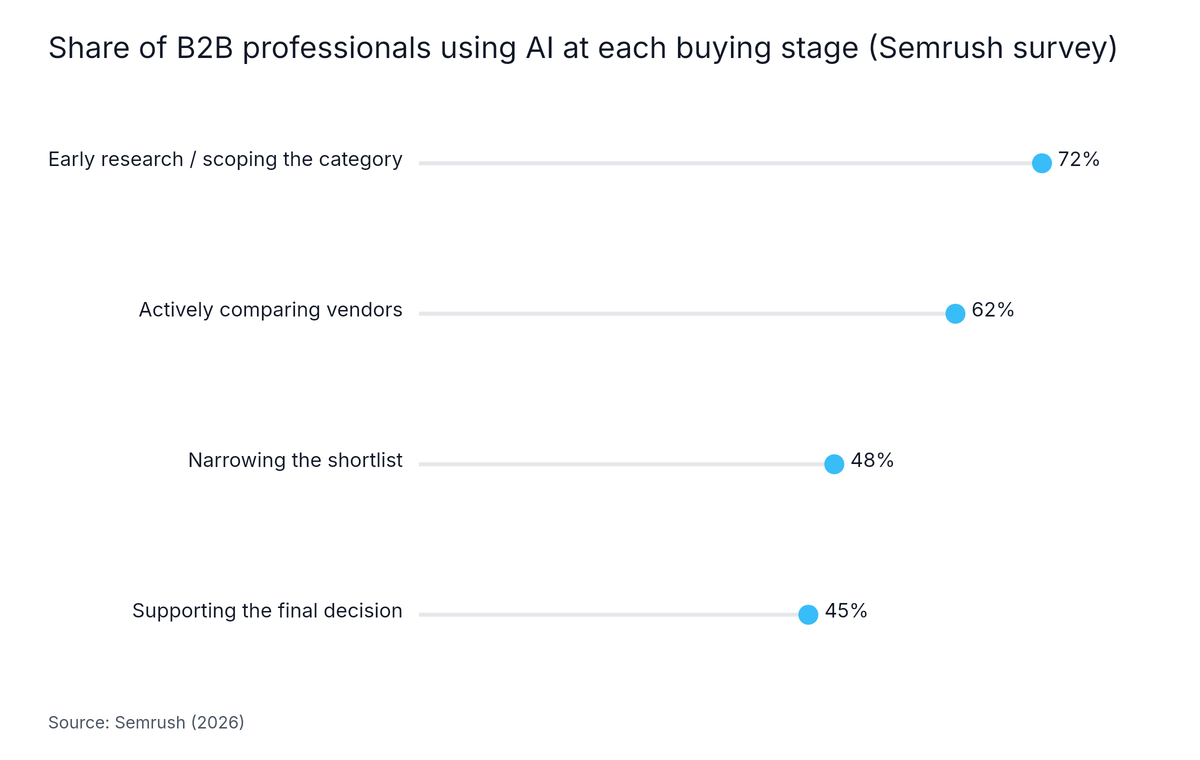
Lollipop chart: Share of B2B professionals using AI at each buying stage (Semrush survey). Highest: Early research / scoping the category at 72%.
AI use spans the whole buying process. In a Semrush survey of 600+ US business professionals, 72% use AI at the early research and scoping stage, 62% when actively comparing vendors, 48% when narrowing the shortlist and 45% when supporting the final decision (Semrush, 2026). It is a vendor survey, so read it as direction, not a census.
G2's July 2026 Buyer Behavior Report found review sites (38%) overtook AI chatbots (37%) as the top source shaping vendor shortlists for the first time, and 82% of buyers sourced software recommendations from an AI chatbot in the last 24 months (G2, 2026). AI visibility and review-site presence feed the same shortlist.
To map metrics to pipeline:
Add a "how did you hear about us" field to demo forms, with AI assistants as an option.
Ask sales to log when a prospect cites an AI answer on a first call.
Watch branded search and direct traffic for lifts after citation gains.
Report these beside AI referral sessions, labeled as influence, not proven cause.
Who is AI search visibility measurement not for?
AI search visibility measurement for B2B SaaS is not for teams that need a single precise number, a guaranteed citation, or proof of causation. AI answers vary between runs, the Search Console report shows impressions only, and most benchmarks come from vendor surveys. Even Semrush's index found mention and citation overlap as low as 30% on Gemini (Semrush, 2026), so scores need context.
Three limits are worth stating plainly:
No causal claim. A rise in citation rate after a page change is a correlation. Nothing here promises a citation or a date.
Vendor-sourced benchmarks. The Semrush and Conductor figures are vendor measurements with stated methods. Neither is an independent audit.
Unclear terminology. Answer engine optimization, generative engine optimization (GEO) and LLM optimization overlap. The metrics above apply to all three. For the naming, see what GEO is.
Teams with very few buyer questions, or sites that AI crawlers cannot read, should fix access first. A metric cannot show visibility that the technical setup prevents.
Frequently Asked Questions
What metrics matter most for AI search visibility?
The metrics that matter most for AI search visibility are citation rate and mention rate, tracked separately per engine on a fixed buyer question set, plus share of voice and description accuracy. AI referral traffic and pipeline signals show downstream effect. Conductor measured AI referrals at 1.08% of site traffic in 2025, so visibility metrics carry the exposure story that clicks miss.
What is the difference between an AI mention and an AI citation?
An AI mention is a brand name appearing in the text of an AI answer, and an AI citation is a link or source credit pointing to the brand's domain. They are distinct outcomes: Semrush's 2026 index found the overlap can be as low as 30% on Gemini. Track both, because a brand can be named without being cited, or the reverse.
Does Google Search Console show AI Overviews and AI Mode data?
Yes, partly. Google added a generative AI performance report to Search Console on June 3, 2026, showing impressions for AI Overviews and AI Mode by page, country, device and date (CrawlRaven, 2026). It has no clicks, click-through rate or query data, and it is not available through the API, so it works as an impressions baseline only.
How often should B2B SaaS teams report on AI search visibility?
A monthly full run of the fixed buyer question set is a practical reporting cadence for most B2B SaaS teams, with the headline KPI shown as a range rather than a single score. Because AI answers vary between runs, quarterly trends carry more weight than any single month's movement. This cadence is editorial guidance, not a documented standard.
How do you track AI referral traffic in analytics?
AI referral traffic can be separated in analytics by filtering sessions whose referrer matches AI assistant domains such as chatgpt.com and perplexity.ai. Build it as its own channel group so it stops hiding in referral or direct traffic. Expect a small share: Conductor's 2025 benchmark across 13,770 enterprise domains put AI referrals at 1.08% of traffic.
Conclusion
The metrics that matter for AI search visibility fall into two groups: what AI engines say about a B2B SaaS brand, and what buyers do afterward. Five points to keep:
Track citation rate and mention rate separately.
Use a fixed buyer question set, run repeatedly, with the prompt and run counts stated.
Set baselines per engine, not one blended score.
Segment AI referral traffic, and read Search Console impressions for what they are.
Report pipeline influence as influence, with self-reported attribution and sales notes.
To go deeper on the content side, read how to get cited by AI search engines. The next step is a baseline of your own, and a short conversation can help shape the question set.
Meet with an expert: A free consultation. Bring the questions buyers ask about your category and brainstorm how to get cited.
Written by
Ishan Manchanda
Ishan Manchanda is co-founder of GrowthSpree, a B2B SaaS marketing consultancy founded in 2017 that has managed $60M+ in ad spend across 300+ B2B SaaS companies. He focuses on demand generation, go-to-market strategy and pipeline growth, and has been featured in Silicon Valley Times, SaaS Mag and the Unbounce podcast.
 Ishan ManchandaNov 20, 2026