LLM Optimization Platform vs SEO Content Editor for B2B SaaS
llm optimization platform vs seo content editorllm optimization platformseo content editor
LLM Optimization Platform vs SEO Content Editor for B2B SaaS
An LLM optimization platform sits beside an SEO content editor, not in place of it. See the overlap matrix, crawler gaps, costs and decision rules for B2B SaaS.
Ishan ManchandaNov 12, 2026
Last updated: Nov 12, 2026
LLM Optimization Platform vs SEO Content Editor for B2B SaaS
Request a quote and our experts will contact you within 24 hours with tailored solutions and pricing.
By AEO for B2B SaaS Editorial Team. Last updated November 4, 2026.
A large language model (LLM) optimization platform tracks whether AI assistants cite a B2B SaaS brand, while a search engine optimization (SEO) content editor scores page copy for ranking, so most teams use them side by side.
The LLM optimization platform vs SEO content editor question usually arrives when a content lead already pays for an editor and is asked to fund a second tool. It is a fair question, because some features overlap and some editors now bundle AI tracking. This article maps what each toolset covers, where the gap is real, what the evidence says and how to decide. For definitions, see LLM optimization for B2B SaaS.
Key Takeaways
An LLM optimization platform adds citation tracking for B2B SaaS brands, while an SEO content editor scores page copy for ranking. Neither replaces the other.
Readability, keyword coverage and internal linking overlap between the two toolsets, so a second tool is not needed for those.
Many AI crawlers fetch JavaScript files without executing them, a problem an SEO content editor does not check.
Evidence that editor-level "AI scores" change citation outcomes is absent, so a 60 to 90 day test on a few pages is a safer first step than a full rollout.
A bundled AI tracker inside an existing SEO content editor is a reasonable first step for small B2B SaaS teams.
Does an LLM optimization platform replace an SEO content editor or sit alongside it?
An LLM optimization platform sits alongside an SEO content editor for most B2B SaaS teams and does not replace it. An SEO content editor scores page copy for readability, keyword coverage and internal links. An LLM optimization platform tracks whether AI assistants cite the brand, which sources they credit and what they say about the product. Some editors now bundle a basic version of that tracking.
Content lead comparing two printed page proofs marked with different highlighters at a bright desk
An SEO content editor is a writing tool that scores a draft against ranking factors such as readability, keyword and entity coverage and internal links. An LLM optimization platform is software that tracks whether AI assistants cite a brand for buyer questions, which sources they credit and how they describe the product. The overlap is real, and so is the gap.
Capability
SEO content editor
LLM optimization platform
Verdict
Readability and structure scoring
Core feature
Sometimes included
Editor covers it
Keyword and entity coverage
Core feature
Rarely the focus
Editor covers it
Internal link suggestions
Common
Rarely included
Editor covers it
Prompt and citation tracking across AI assistants
Light, tier-gated add-on in some tools
Core feature
Platform adds value
Which third-party sources AI answers credit
Not covered
Core feature
Platform adds value
Brand description accuracy and competitor mentions
Not covered
Core feature
Platform adds value
What a crawler fetched from the page
Not covered
Varies by product; often a separate technical audit
Check before buying
Google's own guidance narrows the overlap further. It says "From Google Search's perspective, optimizing for generative AI search is optimizing for the search experience, and thus still SEO." (Search Engine Journal, quoting Google, 2026). That guidance covers Google Search only. It does not address ChatGPT, Perplexity or Claude. For the wider picture, see AEO vs SEO for B2B SaaS.
Answer engine optimization (AEO) is the practice of structuring a site and its content so AI assistants and AI search features cite it when a buyer asks a question. Generative engine optimization (GEO) is an overlapping term for much the same work.
What does an SEO content editor measure that AI answers change?
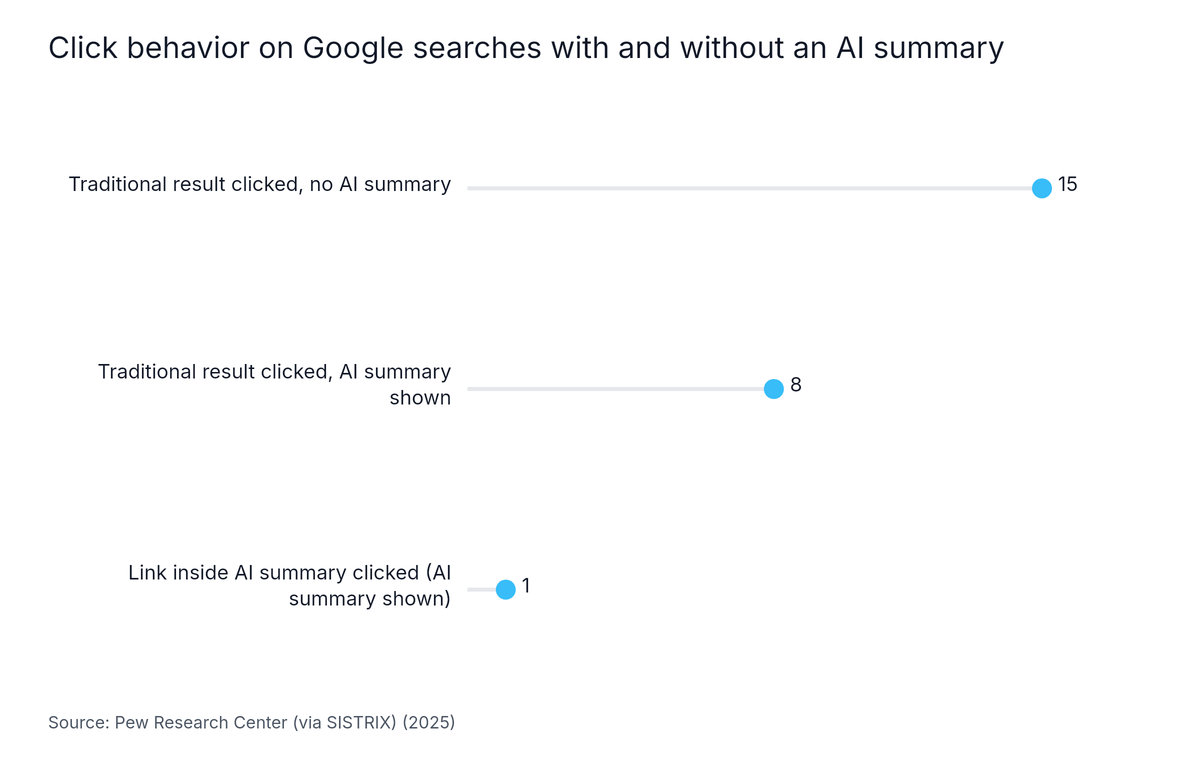
An SEO content editor measures how well a page is written to rank, but AI answers change what a ranking is worth. Pew Research Center's March 2025 browsing study of about 900 US adults found users clicked a traditional result on 8% of visits with a Google AI summary, against 15% without one (Pew Research Center, 2025).
Lollipop chart: Click behavior on Google searches with and without an AI summary. Highest: Traditional result clicked, no AI summary at 15.
The same study, covering 68,879 Google searches, found about 1% of visits included a click on a link inside the AI summary. A citation therefore often earns a mention, not a visit. Google disputed Pew's methodology, and the figures were read through secondary summaries, so treat them as one measured sample, not a settled rate.
An AI Overview is the AI-generated summary Google shows above traditional results. A page can earn a perfect editor score, hold position one and still lose clicks. An SEO content editor reports on the draft. It does not report on what the results page does with the draft.
Where does an LLM optimization platform cover what an SEO content editor cannot?
An LLM optimization platform, or a technical audit alongside it, covers crawler ingestion, which an SEO content editor leaves unchecked because it scores text, not what a bot fetched. Vercel and MERJ's December 2024 study found GPTBot and ClaudeBot fetched JavaScript files but did not execute them (Vercel, 2024).
Developer and marketer reading a server log printout together beside a laptop
Content that appears only after client-side rendering can therefore be invisible to those crawlers. The per-bot figures were confirmed through secondary summaries rather than the original page. The study is also the most recent published test found, so re-check it against current crawler documentation.
What is a crawl-to-refer ratio?
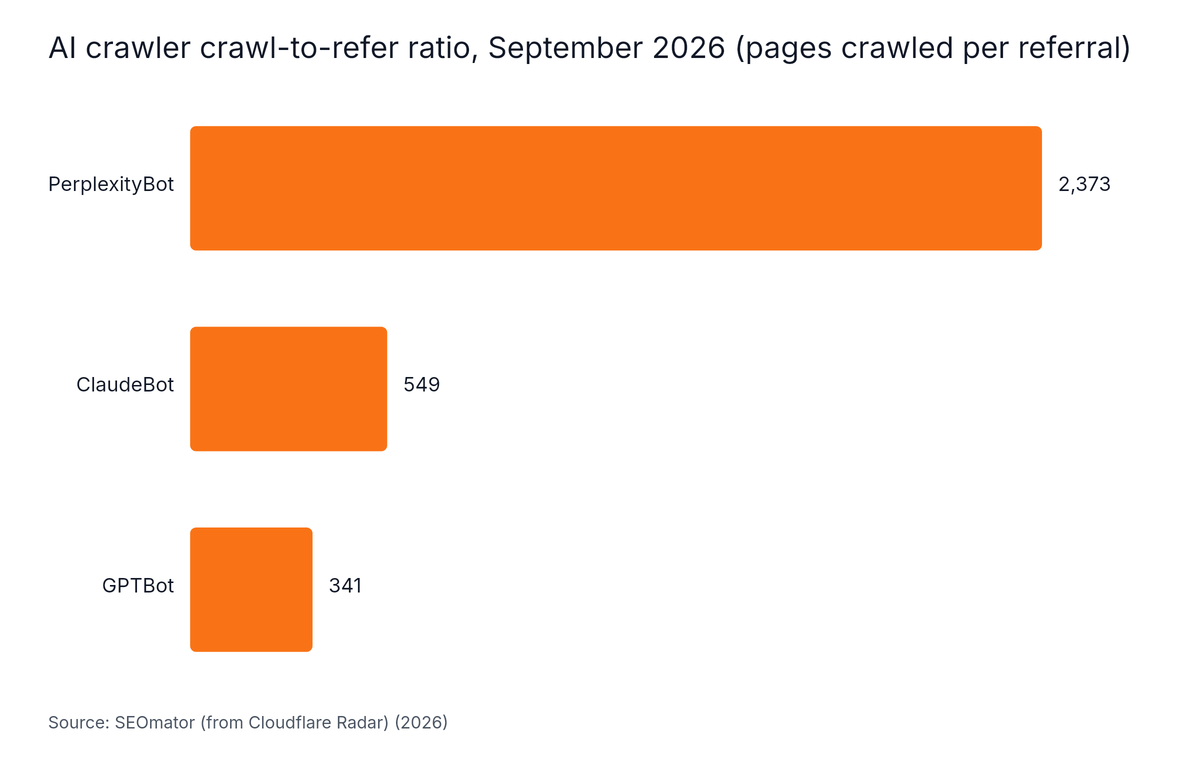
Crawl-to-refer ratio is the number of pages an AI crawler fetches for each visitor it sends back to a site. SEOmator's September 2026 report, using Cloudflare Radar data, lists PerplexityBot at 2,373:1, ClaudeBot at 549:1 and GPTBot at 341:1 (SEOmator, 2026). Other reporting windows give different ratios.
Horizontal Bar chart: AI crawler crawl-to-refer ratio, September 2026 (pages crawled per referral). Highest: PerplexityBot at 2,373.
Bot hits in server logs do not equal referrals or citations. An LLM optimization platform that separates crawling from citing helps a team avoid reading crawl volume as success. For the technical side, see the guide to getting cited by AI search engines.
What does AI visibility tracking show that an SEO content editor cannot?
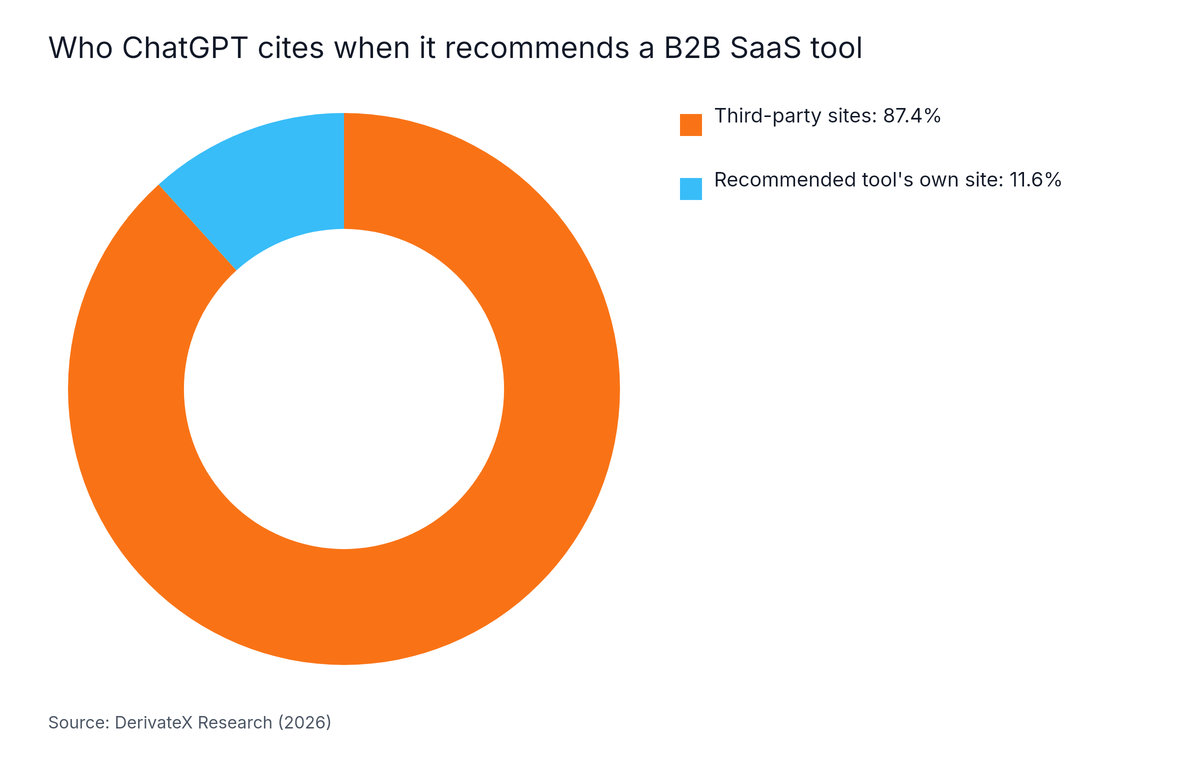
AI visibility tracking shows whether AI assistants name and cite a brand for buyer questions, which an SEO content editor cannot show because it only sees the page. A 2026 agency study of 40 B2B SaaS category prompts found ChatGPT cited the recommended tool's own site 11.6% of the time and a third party 87.4% (DerivateX Research, 2026).
Donut chart: Who ChatGPT cites when it recommends a B2B SaaS tool. Highest: Third-party sites at 87.4%.
The DerivateX result carries a lesson for scope. Tuning a page does not control most citations, because most credit goes to review sites, comparisons and other outside pages. The study is small (233 recommendations, 10 runs per prompt, web search on), so it is a direction, not a benchmark.
A second small study points the same way. AnswerManiac's Q2 2026 report found 53 of 100 B2B SaaS companies received zero citations across ChatGPT and Perplexity for 42 buyer-intent queries (AnswerManiac, 2026). It has a single author and is directional only.
Tracking answers three questions an SEO content editor cannot:
Is the brand cited for each buyer question, and on which engine?
Which outside sources do engines credit instead?
Is the product described correctly?
Our data: AEO for B2B SaaS runs the technical baseline it recommends on its own pages: content in raw HTML, schema, a sitemap, crawler access, llms.txt and Markdown copies. For measurement, AEO for B2B SaaS proposes a monthly check of 20+ category questions across five engines, recording citation rate, accuracy of brand descriptions and which competitors appear. That is a proposed method, not a measured result.
Google's Search Console also offers a Generative AI performance report, which Google's guide points to (Google Search Central, 2026). It covers Google's features only, so other engines still need a fixed question set. For a wider tool landscape, see AI search visibility tools for B2B SaaS.
Do you need both? Budget and decision rules for B2B SaaS teams
Most B2B SaaS teams need both capabilities, but not always two separate subscriptions. Surfer lists plans from $49 a month on yearly billing with tracking across five AI engines, and Clearscope from $129 a month with three (Surfer's vendor comparison, 2026). A bundled tracker may be enough early on; a dedicated platform earns a second line once AI-referred pipeline is measurable.
Marketing leader writing a budget list on a notepad next to a calculator and coffee
SEO content editor
Entry price (vendor-published, 2026)
AI engines tracked (vendor-reported)
Surfer
From $49/mo, yearly billing
Five
Clearscope
From $129/mo
Three
These are vendor list prices, not independent measurements. Confirm current pricing and engine coverage on each vendor's pricing page. This article does not rank or review tools.
The decision rules below are editorial judgment, not research findings.
Situation
Suggested step
Small team, no AI referrals visible in analytics
Use the SEO content editor's bundled AI tracker and a fixed monthly question set
Leadership asks for a citation baseline across more engines than the editor covers
Add a dedicated LLM optimization platform
Pages depend on client-side rendering
Fix raw HTML access first, before any tool
AI-referred pipeline is measurable and growing
Fund a dedicated LLM optimization platform as a second line
Who should skip a second LLM optimization platform?
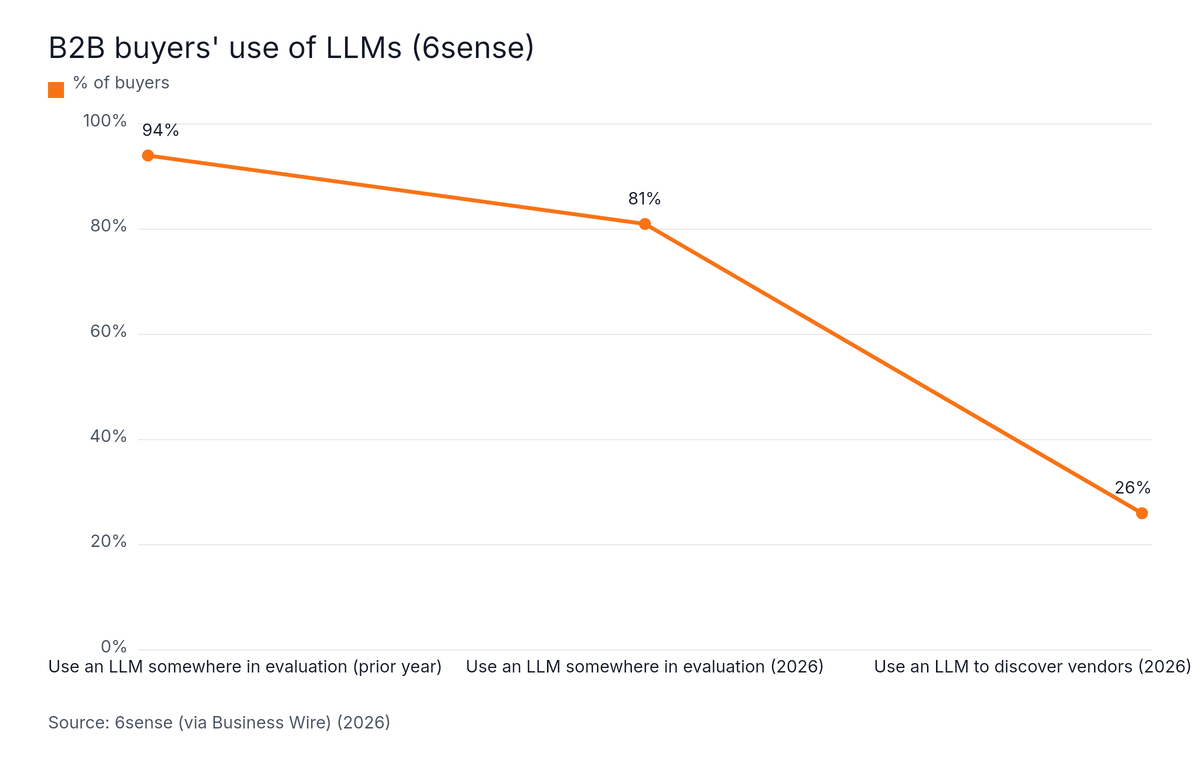
B2B SaaS teams should skip a second LLM optimization platform for now if they lack a stable buyer-question set, pages readable without JavaScript or analytics that separate AI referrals. The demand case is also mixed: 6sense's 2026 survey of 4,611 B2B buyers found 81% use an LLM somewhere in evaluation, down from 94%, and only 26% use one to discover vendors (6sense, 2026).
Line chart: B2B buyers' use of LLMs (6sense). Highest: Use an LLM somewhere in evaluation (prior year) at 94%.
Forrester's Buyers' Journey Survey 2025, as reported by Brandesis in January 2026, puts buyer AI use at 94%. The two sources differ in wording (any AI use versus LLM use in evaluation) and sample, and the Forrester figure should be verified against the original.
The same 6sense study, which is vendor-run, found the pre-contact favorite wins 82% of the time and 92% of eventual winners are on the initial shortlist (6sense, 2026). Being known before research starts matters more than any single page score.
Content team around a table reviewing a short list of test pages on printed sheets
Evidence that editor-level AI scores change citation outcomes is absent. Google's guide also cuts against some add-on tactics: "There's no requirement to break your content into tiny pieces for AI to better understand it." (Google Search Central, 2026). That guide addresses Google Search only.
A second tool is probably not worth it for:
Teams with no stable buyer-question set to track.
Teams whose key pages are not readable without JavaScript.
Teams with no way to separate AI referrals in analytics.
A practical test is to pick a handful of pages, apply changes and compare citations over 60 to 90 days. That is a suggestion, not a proven method. For a starting point, see getting cited by AI assistants.
Frequently Asked Questions
Is an LLM optimization platform the same as an SEO content editor?
No, an LLM optimization platform is not the same as an SEO content editor. An SEO content editor scores a draft for ranking factors such as readability, keyword coverage and internal links. An LLM optimization platform tracks whether AI assistants cite a brand for buyer questions, which sources they credit and how they describe the product. Some editors now bundle a lighter version of that tracking.
If I already pay for Surfer or Clearscope, do I still need a separate AI visibility tool?
Not always. A team that already pays for Surfer or Clearscope can start with the bundled AI tracking, which the vendor says covers five engines for Surfer and three for Clearscope as of 2026. A dedicated LLM optimization platform makes sense once the bundled engine list, question volume or reporting no longer answers leadership's questions about AI visibility.
Can ChatGPT, Claude and Perplexity crawlers read JavaScript-rendered pages?
Often they cannot. Vercel and MERJ's December 2024 crawler study found that GPTBot and ClaudeBot fetched JavaScript files but did not execute them. Because the finding dates from late 2024, B2B SaaS teams whose key content depends on client-side rendering should check that content in raw HTML and confirm crawler access on purpose.
Do I need llms.txt or content chunking to get cited by AI?
Neither is confirmed as necessary. llms.txt is a proposed convention, and no major engine documentation confirms it acts on the file. Google's May 2026 guide for Google Search also says there is no requirement to break content into tiny pieces. Clear answers, readable raw HTML and open crawler access matter more than either tactic.
How do I measure traffic from AI search for a B2B SaaS site?
Measure AI search with two habits: separate AI referrals in analytics and check a fixed set of buyer questions on a schedule. Filter referrers such as chatgpt.com and perplexity.ai into their own channel, review the Generative AI performance report in Google Search Console, and record monthly whether each engine cites the site and how it describes the product.
Conclusion
An LLM optimization platform and an SEO content editor do different jobs. For B2B SaaS teams, the sensible path is usually to keep the editor and add citation tracking in proportion to the evidence.
Keep the SEO content editor for readability, keywords and internal links.
Add tracking for citations, outside sources and product descriptions.
Fix raw HTML and crawler access before buying anything.
Start with a bundled tracker, and fund a dedicated LLM optimization platform when AI-referred pipeline is measurable.
Test on a few pages for 60 to 90 days before scaling.
Meet with an expert
A free consultation. Bring the questions buyers ask about your category and brainstorm how to get cited.
Written by
Ishan Manchanda
Ishan Manchanda is co-founder of GrowthSpree, a B2B SaaS marketing consultancy founded in 2017 that has managed $60M+ in ad spend across 300+ B2B SaaS companies. He focuses on demand generation, go-to-market strategy and pipeline growth, and has been featured in Silicon Valley Times, SaaS Mag and the Unbounce podcast.
 Ishan ManchandaNov 12, 2026