How to Structure B2B SaaS Content for LLM Answer Optimization
How to structure B2B SaaS pages so AI assistants cite them: answer placement, heading hierarchy, a page template and a diagnostic order for zero-citation sites.
Request a quote and our experts will contact you within 24 hours with tailored solutions and pricing.
How to Structure B2B SaaS Content for LLM Answer Optimization
LLM answer optimization is the practice of writing and structuring B2B SaaS pages so a large language model can retrieve them and lift a clear answer to a buyer question into its response, with a citation. It is also called answer engine optimization (AEO) or generative engine optimization (GEO). The stakes are real: a March 2026 survey of 1,076 buyers found 51% of B2B software buyers start research in an AI chatbot (G2, 2026). A page that answers late, buries facts in prose or never gets retrieved is missing from that shortlist. This guide covers page shape, heading hierarchy and answer placement, where the evidence says structure stops mattering, and a diagnostic order for sites with zero citations. For wider context, see LLM optimization for B2B SaaS.
Key Takeaways
LLM answer optimization for B2B SaaS works in two layers: the page must be retrieved first, then its title and paragraphs must match the buyer question.
A 40 to 80 word direct answer under each heading gives a B2B SaaS page a passage an AI assistant can lift cleanly.
FAQ blocks, schema markup and llms.txt showed no measured citation effect in the 2026 evidence reviewed here, so they are hygiene, not levers.
Earned and third-party sources account for more than 84% of AI citations in a 2026 study (Muck Rack, 2026), so on-page structure alone will not carry a B2B SaaS brand.
How do I structure B2B SaaS content so large language models use it to answer buyer questions?
Structure B2B SaaS content so a large language model can retrieve the page, match its title and paragraphs to a real buyer question, and lift a complete answer from the first lines under each heading. An October 2026 arXiv preprint (Chen and Koudas, arXiv, 2026) found that retrieval drives citation, with title and paragraph match the main on-page effect.
Light paths from many scattered points converging into one clear rectangular panel
An answer block is a 40 to 80 word paragraph directly under a heading that answers it in full. Five rules make a B2B SaaS page easy to lift from:
Write the title and H2s in the words buyers use when they ask the question.
Put an answer block under every H2, before any list, image or table.
Name the product, company or method in full in every section, so a lifted passage still makes sense alone.
Put comparisons, steps and specs in tables or lists, not paragraphs.
Show a last-updated date and date every time-bound figure.
What does the evidence say about common tactics?
Many guides treat FAQ blocks, schema and special files as citation levers. The evidence is thinner. The table sets out what the 2026 sources found.
Practice
What the evidence says
Source
Titles and paragraphs matching buyer questions
The main within-site content effect found; retrieval drives citation
arXiv preprint, October 2026
FAQ blocks and schema markup
No within-site effect found; Google lists special schema as unnecessary
arXiv preprint; Google guide, May 2026
llms.txt, Markdown copies, content chunking
Google lists them as unnecessary for its AI features
Google Search Central, May 2026
Visible dates and recent pages
Median age of dated cited pages is 3.9 months
Position Digital, 2026 (directional)
The study authors put it bluntly: "FAQ blocks and schema.org markup have no effect for any engine." (Chen and Koudas, arXiv, 2026) That is one preprint that has not been peer-reviewed. Google's own position points the same way: "From Google Search's perspective, optimizing for generative AI search is optimizing for the search experience, and thus still SEO." (Google Search Central, Search Engine Journal, 2026)
Here SEO means search engine optimization. The practical reading: structure pages for readers and for question matching, not for machines alone. For the overlap in detail, see AEO vs SEO for B2B SaaS.
Why does retrieval matter more than page structure?
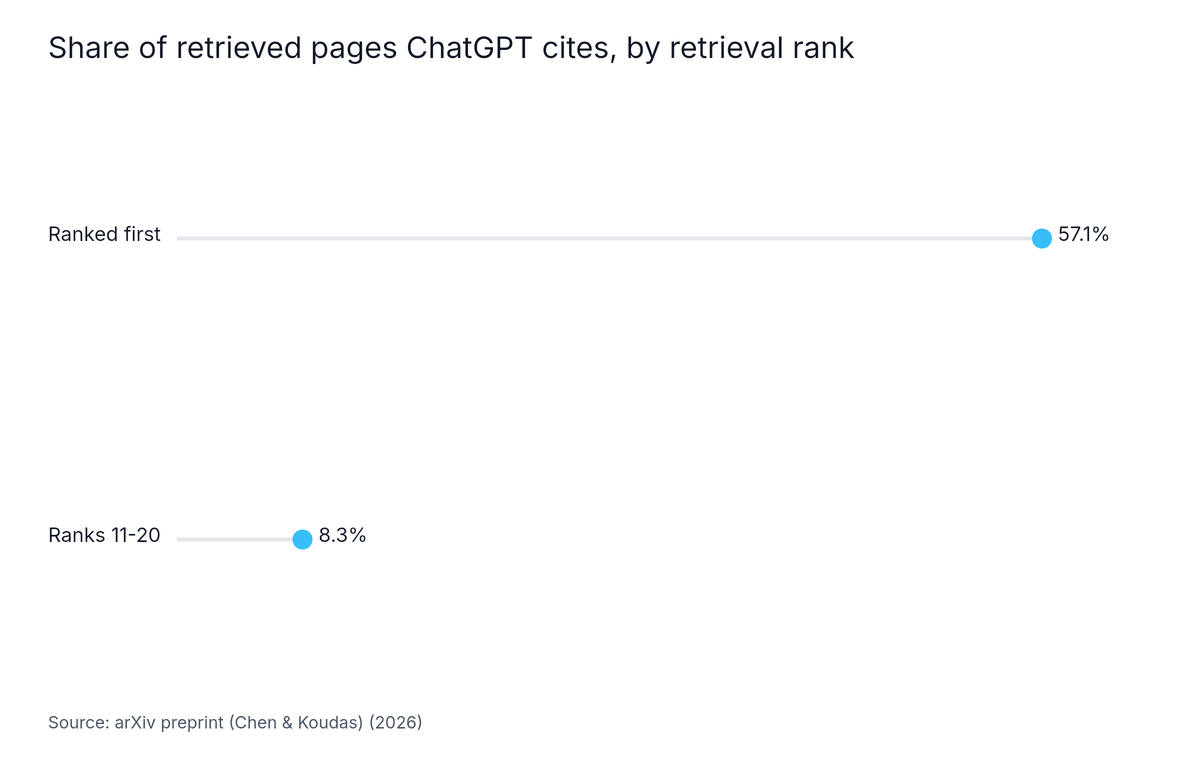
Retrieval matters more than page structure because an AI assistant can only cite a page it has already found. In an October 2026 arXiv preprint covering 158,099 ChatGPT answers, ChatGPT cited 57.1% of the pages it ranked first and 8.3% of those ranked 11 to 20 (Chen and Koudas, arXiv, 2026). A page must be retrieved before its format counts.
A funnel of glowing particles narrowing to a few bright points that pass through a gate
Retrieval is the step where an assistant fetches candidate pages from a search index before writing an answer. The Chen and Koudas arXiv preprint also found that 99% of the pages ChatGPT retrieved were absent from Google's top 50 (Chen and Koudas, arXiv, 2026). Google rank is therefore a weak proxy for citation eligibility. The authors add that ChatGPT rewrites every question anew, so a buyer's exact phrasing is not what the assistant searches for.
Lollipop chart: Share of retrieved pages ChatGPT cites, by retrieval rank. Highest: Ranked first at 57.1%.
The dataset spans two 90-day collections of answers to commercial questions, with 468,037 citations. The authors say the findings replicate in a market of small B2B vendors, though the work is a preprint. Three practical points follow:
Ranking well on Google does not make a page eligible for ChatGPT citations.
Pages should cover the many ways a buyer might phrase one question, since the assistant rewrites it.
Formatting work pays off only after crawler access and indexing are confirmed.
Which page types do AI assistants cite most for B2B software queries?
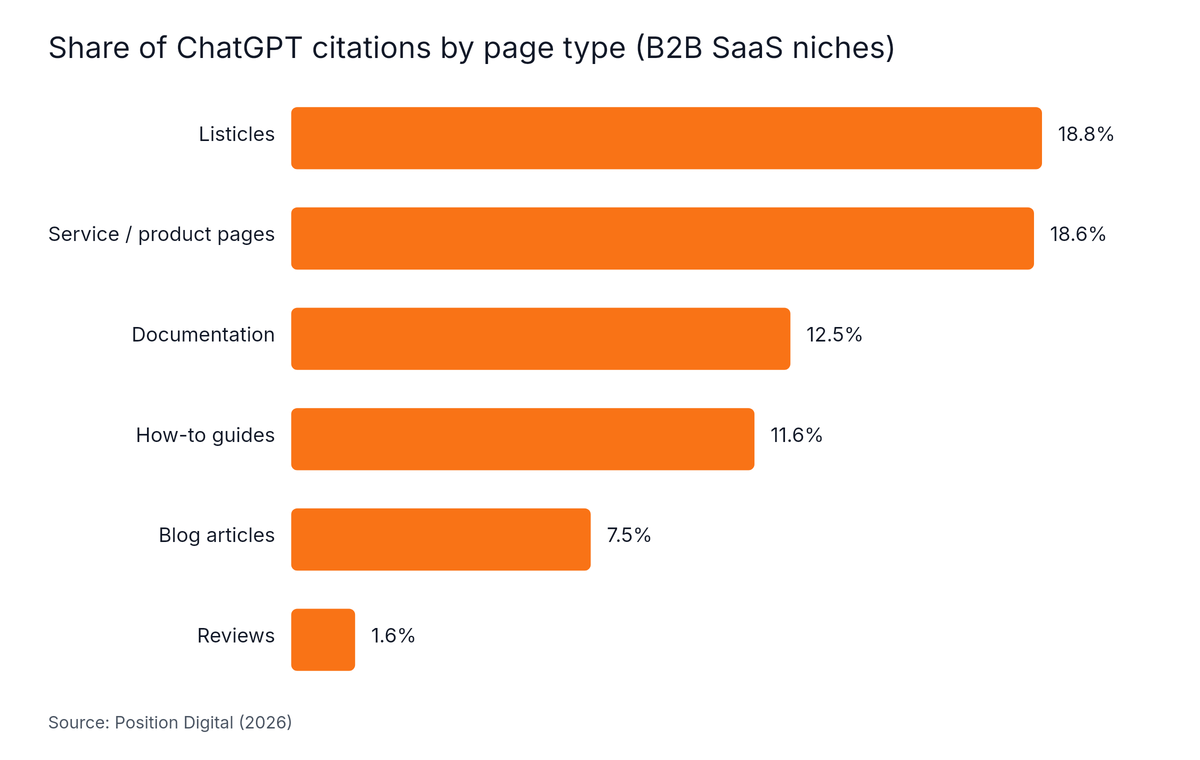
In a 321-citation analysis across seven B2B SaaS niches, listicles, service or product pages and documentation carried 49.9% of ChatGPT citations, while how-to guides carried 11.6% and reviews 1.6% (Position Digital, 2026). The sample is small and comes from an agency, so treat the split as directional.
Six horizontal bars of different lengths in violet tones on a pale background
Position Digital (2026) split the citations as listicles 18.8%, service or product pages 18.6%, documentation 12.5%, how-to guides 11.6%, blog articles 7.5% and reviews 1.6%. The table adds an editorial reading of the buyer job each type serves.
Page type
Share of ChatGPT citations (Position Digital, 2026)
Typical buyer job (editorial inference)
Listicles
18.8%
Build a shortlist
Service or product pages
18.6%
Check what a vendor does
Documentation
12.5%
Confirm integrations and capabilities
How-to guides
11.6%
Learn how to implement
Blog articles
7.5%
Understand the category
Reviews
1.6%
Validate a choice
The third column is an editorial inference, not a measured result. The measured figures are in the second column, and they come from one 321-citation sample.
Horizontal Bar chart: Share of ChatGPT citations by page type (B2B SaaS niches). Highest: Listicles at 18.8%.
Two lessons stand out. First, pages that name products and compare them are the ones assistants pull from when buyers ask for options. Second, freshness shows up in the same sample. Among cited pages that expose a date, the median age is 3.9 months and 69.7% were published within 12 months (Position Digital, 2026). Only pages that show a date are counted, so a visible date is both a reader signal and a measurable one. Teams comparing tracking options can start with AI search visibility tools for B2B SaaS.
Is there a content template structured to get cited in generative engine answers?
A citation-ready content template for B2B SaaS exists, but it shapes the page and cannot guarantee a citation. The template opens with a 40 to 80 word direct answer and uses question headings. It adds a table early, supports claims with dated figures and shows a last-updated date. Among cited pages that expose a date, 69.7% were published within 12 months (Position Digital, 2026).
Stacked translucent layers forming a page-like template with a bright top block
The page template, block by block
Block
What goes there
Why it earns its place
Title
The buyer question or primary query, with "B2B SaaS" named
Title match is the main on-page effect found
Opening answer
40 to 80 words that answer the title and name the subject in full
Gives a lifted passage that stands alone
Table in the first third
Options, specs or steps with concrete values
Gives a clean, enumerable block to quote
H2 question sections
One buyer question per H2, answer block first
Matches how buyers and assistants phrase queries
Evidence
Dated, sourced figures labeled measured or predicted
Lets a reader verify and a model quote precisely
FAQ
4 to 8 short answers to real questions
Serves readers; no measured citation effect
Byline and date
Named publisher and a last-updated date
Signals freshness and accountability
A worked example: the standards AEO for B2B SaaS sets
AEO for B2B SaaS sets these editorial standards for its pages: a 40 to 80 word direct answer at the top, each section opening with the answer to its heading, and the first H2 as the page's primary query. The standards also call for a table in the first third, a statement of whether each figure is measured or predicted, and a byline with a last-updated date. They are editorial standards, not a promise of citation. As of November 2026 no citation results from them have been published.
The template also fits Google's stated position: "There are no additional requirements to appear in AI Overviews or AI Mode, nor other special optimizations necessary." (Google Search Central, 2025) The template exists to make a good page clearer, not to add machine-only features. For a gentler starting point, see getting a company cited by AI search tools.
How do I approach LLM citation optimization when no AI assistant cites my B2B SaaS content?
Approach LLM citation optimization in order: confirm crawler access, confirm the page is indexed and readable in raw HTML, match titles to real buyer questions, then fix answer placement and format. Retrieval comes first, since ChatGPT cited 57.1% of rank-1 pages but only 8.3% of those ranked 11 to 20 (Chen and Koudas, arXiv, 2026).
A chain of linked glowing nodes in sequence, each lighting up the next
LLM citation optimization is the work of making a page eligible for, and then worth, a citation in an AI assistant's answer. The diagnostic sequence below moves from the layer most likely to be broken to the least.
Check crawler access. Review robots.txt and any bot-protection rule so the crawlers of the assistants you care about, including OpenAI's search crawler OAI-SearchBot, are allowed on purpose. Verify by fetching a key page as each crawler would.
Confirm indexing and raw HTML. Key pages should be indexed and readable without JavaScript. Verify by viewing the page source and finding the answer text.
Match buyer questions. List the questions buyers ask in your category. Check that a page title and paragraph answer each one in the buyer's words.
Fix answer placement. Move a 40 to 80 word answer directly under each heading and add a table where options are compared.
Add third-party corroboration. Earn mentions on pages other than your own, since those carry most citations (see the limits below).
Measure monthly. Fix a set of buyer questions and check each assistant on a schedule. Google's guide points site owners to a Generative AI performance report in Search Console for Google's features (Google Search Central, 2026).
Our data: AEO for B2B SaaS proposes a monthly check of 20+ category questions across five engines as a measurement baseline, tracking citation rate, accuracy of brand descriptions and which competitors appear. The method comes from a 2026 GrowthSpree blog guide. It is a method, not measured data, and no results sample exists.
The file llms.txt is a proposed file convention that lists a site's content for AI crawlers. Google's guide lists it as unnecessary for Google's AI features, so it does not belong in the first five steps. For a wider starting point, read how to get a B2B SaaS brand cited by AI assistants.
Meet with an expert: A free consultation. Bring the questions buyers ask about your category and brainstorm how to get cited.
What can content structure not do, and who is this approach not for?
Content structure cannot replace third-party corroboration or guarantee a citation. Muck Rack's 2026 study of 40M+ AI responses and 207M citations found earned and third-party sources still account for more than 84% of AI citations (Muck Rack, 2026). On-page structure alone cannot carry a B2B SaaS brand.
Limits to keep in mind
The source mix is shifting. Journalism's share of AI citations fell from 27% to 22% across four editions of the Muck Rack study (Muck Rack, 2026). A single source strategy may age badly. The study is vendor research from a PR platform with a stated method.
A citation is mostly exposure, not traffic. Pew Research Center's browsing data covers 900 U.S. adults in March 2025. Users clicked a traditional result link in 8% of visits when a Google AI summary appeared, versus 15% without one (Pew Research Center, 2025). They clicked a link inside the summary in about 1% of visits.
The evidence is young. The retrieval findings come from a preprint, and the page-type split comes from a small agency sample.
No change promises a citation or a date. Treat every step as raising eligibility, not as a guarantee.
Who this is not for
This approach suits B2B SaaS and B2B technology companies whose buyers research categories before talking to sales. Consumer brands, e-commerce stores and local businesses face different citation patterns, and the evidence here does not cover them. Teams that want tool comparisons should read AI search visibility and answer engine optimization tools.
Frequently Asked Questions
Is there a content template structured to get cited in generative engine answers?
A repeatable content template exists, though none guarantees a citation. Use a question-style title, a 40 to 80 word direct answer under each heading, a table early on, dated figures with linked sources, and a visible last-updated date. These choices help buyers and retrieval matching. A 2026 arXiv preprint found title and paragraph match to real buyer questions was the main on-page effect.
Our content is not being cited by any AI assistant: how do I approach LLM citation optimization for B2B SaaS?
LLM citation optimization for B2B SaaS starts with retrieval, not formatting. Check crawler access, raw HTML readability and indexing first, then match page titles to real buyer questions, then fix answer placement and add third-party corroboration. ChatGPT cited 57.1% of rank-1 pages but only 8.3% of those ranked 11 to 20 in a 2026 arXiv preprint.
Does FAQ or schema markup help AI assistants cite my page?
FAQ and schema markup did not help citations in the 2026 evidence reviewed. A 2026 arXiv preprint found FAQ blocks and schema markup showed no within-site effect on AI citations, and Google's May 2026 guide lists special schema as unnecessary for its AI features. Schema that matches visible content remains reasonable search hygiene, but it is not a citation lever.
Do I need an llms.txt file to get cited by ChatGPT or Google AI Overviews?
An llms.txt file is not required to be cited by ChatGPT or Google AI Overviews. Google's May 2026 guide says "You don't need to create new machine readable files, AI text files, markup, or Markdown to appear in generative AI search." (Google Search Central, DemandSphere, 2026) The llms.txt file is a proposed convention, and published engine documentation does not confirm that other assistants act on it.
Conclusion
LLM answer optimization for B2B SaaS comes down to being found first and being easy to quote second. The main points:
Retrieval drives citation, so confirm crawler access and indexing before editing formats.
Match page titles and paragraphs to the questions buyers actually ask.
Open every H2 with a 40 to 80 word answer and put comparisons in tables.
Treat FAQ blocks, schema and llms.txt as hygiene, since no measured citation effect was found.
Pair on-page work with third-party mentions, which carry most citations.
The next step: pick ten buyer questions in your category, check which pages answer each one, and fix the weakest layer in the diagnostic order above. For background on the terms, read what answer engine optimization means.
Written by
Ishan Manchanda
Ishan Manchanda is co-founder of GrowthSpree, a B2B SaaS marketing consultancy founded in 2017 that has managed $60M+ in ad spend across 300+ B2B SaaS companies. He focuses on demand generation, go-to-market strategy and pipeline growth, and has been featured in Silicon Valley Times, SaaS Mag and the Unbounce podcast.
 Ishan ManchandaNov 17, 2026