Request a quote and our experts will contact you within 24 hours with tailored solutions and pricing.
By AEO for B2B SaaS Editorial Team. Last updated: November 4, 2026.
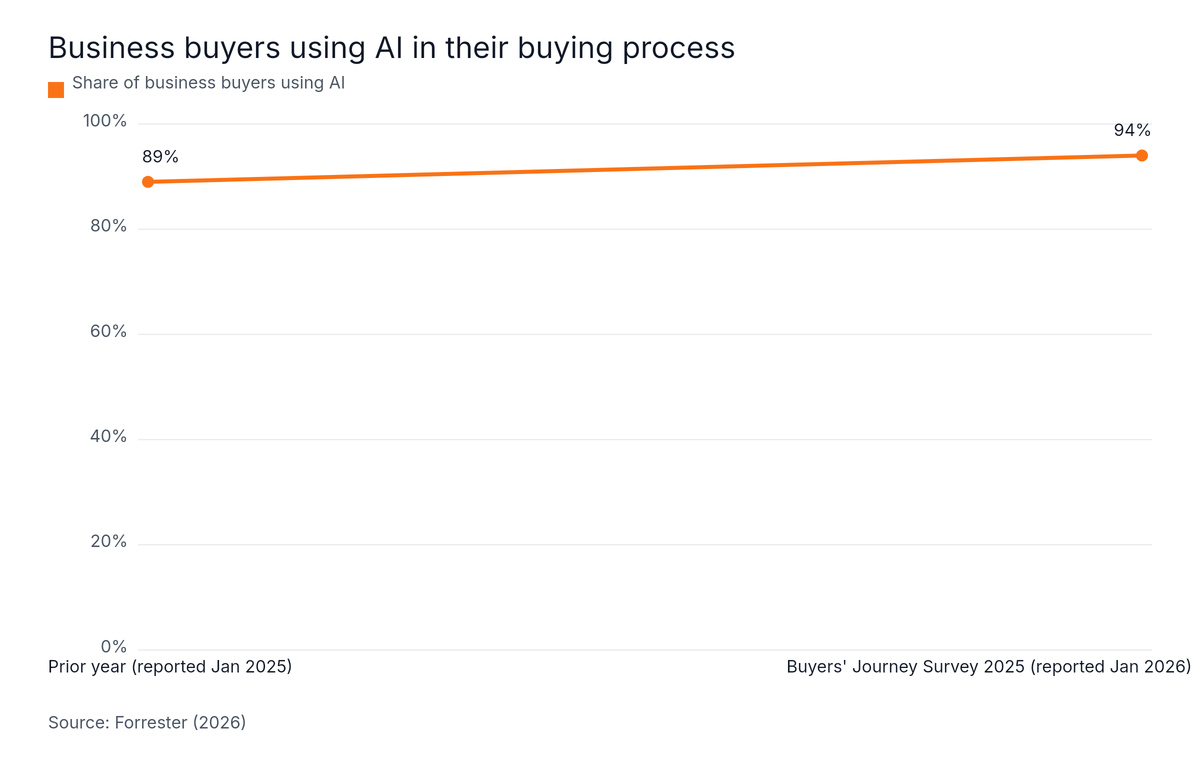
Increasing answer engine optimization (AEO) for a B2B SaaS company means making its pages easier for AI assistants to read, trust and cite, then checking each month whether buyer questions return the brand. Buyers have already moved: 94% of business buyers use AI in their buying process (Forrester, 2026). Many vendors have not followed. This guide shows how to increase answer engine optimization in a sensible order, which tactics are proven and which are myths, and how to measure progress. It sits inside the wider question of AEO vs SEO for B2B SaaS.
Key Takeaways
Answer engine optimization for B2B SaaS is mostly good search practice: crawlable pages, direct answers, specific facts and trusted mentions.
Ranking does not guarantee citation: the typical enterprise B2B brand is cited in 3% of relevant AI answers (Walker Sands, 2026).
Google says special markup and AI text files are not needed for its AI features, so spend effort on content and off-site mentions first.
A monthly check of 20 or more buyer questions across five engines gives leadership a baseline.
How to increase answer engine optimization for B2B SaaS?
To increase answer engine optimization, a B2B SaaS company works through five changes in order. Open key pages to crawlers, lead each page with the direct answer, add specific facts and tables, earn mentions on sites buyers trust, and check a fixed buyer-question list monthly. The typical enterprise B2B brand is cited in only 3% of relevant AI answers (Walker Sands, 2026).
Five stepping stones rising in sequence toward a highlighted answer card
Answer engine optimization (AEO) is the practice of structuring a site and its content so AI assistants and AI search features cite it when a buyer asks a question. Google's guide to AI features puts the relationship to search engine optimization (SEO) plainly: "From Google Search's perspective, optimizing for generative AI search is optimizing for the search experience, and thus still SEO." (Search Engine Journal, 2026)
The five-step sequence
Open the site to crawlers. Check that robots.txt and bot protection allow AI crawlers on purpose, and that key pages show their text in raw HTML.
Answer first. Put a 40 to 60 word direct answer under every heading that mirrors a buyer question.
Add specifics. Replace adjectives with figures, named integrations, prices and a table where options are compared.
Earn off-site mentions. Keep review profiles, comparison lists and community threads accurate and consistent with your own pages.
Check monthly. Run the same buyer questions across engines and log the results.
Step
What to change
How to verify it worked
1. Crawler access
robots.txt, bot rules, raw HTML text
View the page source and confirm the answer text is present
2. Answer first
Direct answer under each question heading
Read only the first paragraph: does it answer fully?
3. Specifics
Figures, tables, named entities
Count dated, sourced figures per page
4. Off-site mentions
Review, list and community profiles
Compare how each profile describes the product
5. Monthly checks
Fixed buyer-question set
Citation count and description accuracy by engine
How can brands increase visibility in AI search?
Brands increase visibility in AI search by appearing where buyers now start research and by being a source engines can verify. In a March 2026 survey of 1,076 buyers, 51% of B2B software buyers began in an AI chatbot (G2, 2026), and 69% said a chatbot led them to a different vendor than expected.
A buyer's question bubble pointing to a short list of vendor cards with one card missing
The demand side is measured, and it is large. The 69% figure comes from G2's Answer Economy report, which shows buyers acting on what assistants tell them. Forrester's 2025 Buyers' Journey Survey found 94% of business buyers use AI in buying, up from 89% a year earlier (Forrester, 2026). Twice as many buyers named generative AI or conversational search as the most meaningful source than any other source.
Line chart: Business buyers using AI in their buying process. Highest: Buyers' Journey Survey 2025 (reported Jan 2026) at 94%.
Citation is a link or named reference to a page inside an AI-generated answer. AI Overviews appear on nearly half of the results pages where enterprise B2B brands already rank. The median company ranks for nearly 9,700 keywords, and about 4,500 of those trigger AI answers (Walker Sands, 2026). Yet the typical brand is cited in only 3% of the answers it is relevant for. That sample covers enterprise B2B brands, so smaller SaaS companies may differ.
As Walker Sands' John Fairley put it, "The B2B AI Search Visibility Benchmark shows that ranking breadth alone doesn't predict citation inclusion." (Walker Sands via GlobeNewswire, 2026) Walker Sands is a B2B agency, so this is vendor research with a stated method.
What to do about it
A typical citation rate near 3% shows why an ambitious visibility target is unrealistic. Start by listing the buyer questions where a shortlist forms, then check which third-party pages the answers appear to draw on. Review platforms, community threads and comparison lists are plausible influences. That is an inference, not a documented rule. For a practical starting point, see how to get a B2B SaaS brand cited by AI assistants.
How to increase visibility in AI search engines?
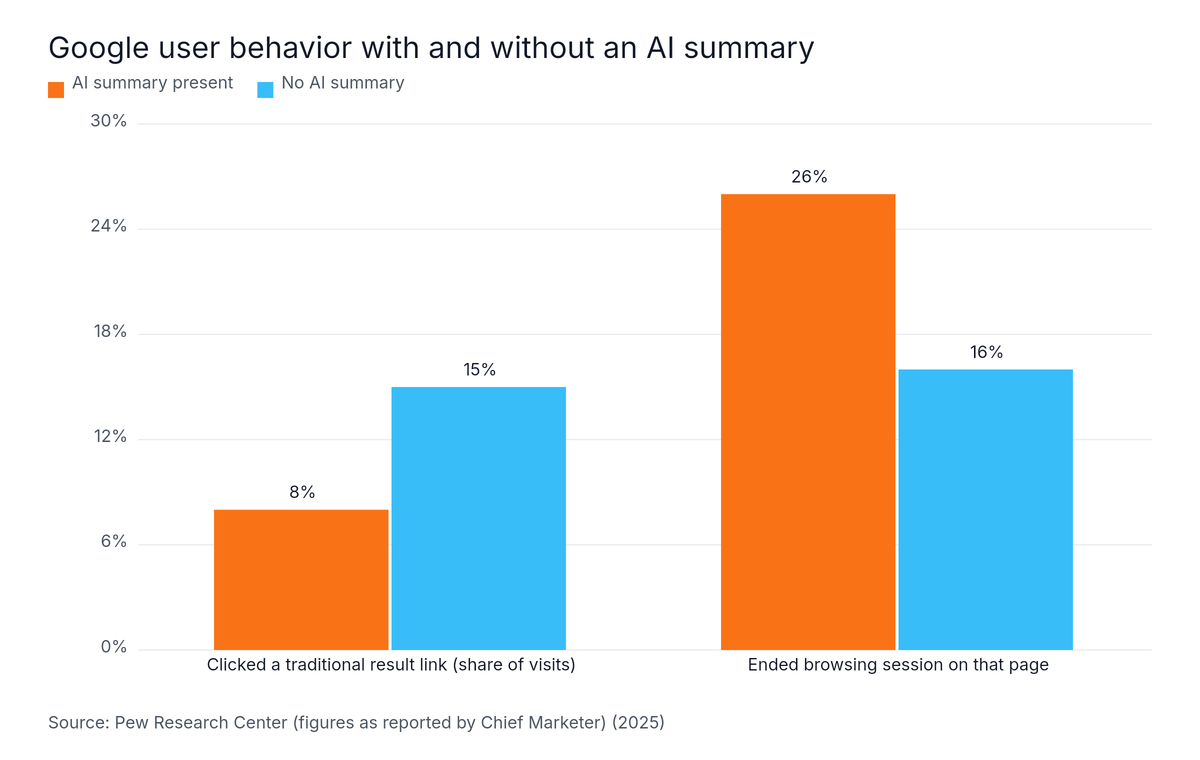
To increase visibility in AI search engines, make every key page crawlable, put a short direct answer under each heading, and state facts engines can verify. The goal is citation, not only clicks. Pew Research Center's 2025 analysis of 900 US adults found users clicked a traditional link in only 8% of visits that showed a Google AI summary (Pew Research Center, 2025).
A web page drawn as stacked blocks with a spotlight on the top answer block
Pew reported that "Users who encountered an AI summary clicked on a traditional search result link in 8% of all visits." (Pew Research Center, 2025) Users ended their browsing session on 26% of pages with an AI summary versus 16% with only traditional results. Google disputed the method, and the data covers Google behavior, not B2B traffic. A Google AI Overview is the AI-generated summary shown above traditional results on some queries.
Grouped Bar chart: Google user behavior with and without an AI summary. Highest: Ended browsing session on that page at 26%.
Measured vs predicted: Ahrefs measured a 58% lower average click-through rate (CTR) for the top-ranking page when an AI Overview appeared. The sample was 300,000 keywords, comparing December 2023 with December 2025 (Ahrefs, February 4, 2026). Seer Interactive then reported that CTR on results with an AI Overview rebounded 85% in the first two months of 2026 (Seer Interactive, April 24, 2026). It also measured informational results without an AI Overview rising from 2.93% to 3.97% CTR across 901 million impressions in 2025. All three are measurements, not forecasts. The evidence points both ways.
Proven, plausible or myth?
Many guides push schema, llms.txt and content chunking. Google's May 2026 guide calls these unnecessary for its own AI features: "You don't need to create new machine readable files, AI text files, markup, or Markdown to appear in generative AI search." (DemandSphere, 2026)
Tactic
Google AI features
ChatGPT, Perplexity and others
Crawlable pages, helpful content
Documented as the basis
Plausible, not confirmed in sources reviewed
Direct answer under each heading
Consistent with good search content
Plausible, widely recommended
llms.txt, Markdown copies
Called unnecessary by Google
Not confirmed in published documentation
Special schema for AI
Called unnecessary by Google
Not confirmed; harmless if it matches visible text
Off-site mentions and reviews
Not addressed in Google's guide
Plausible; evidence needs verifying
Buyer habits are shifting regardless: 53% of B2B software buyers find AI chatbot research more productive than traditional search, up from 36% seven months earlier (G2, 2026). For engine-specific detail, see how to get cited by AI search engines.
How to increase AI search visibility for products?
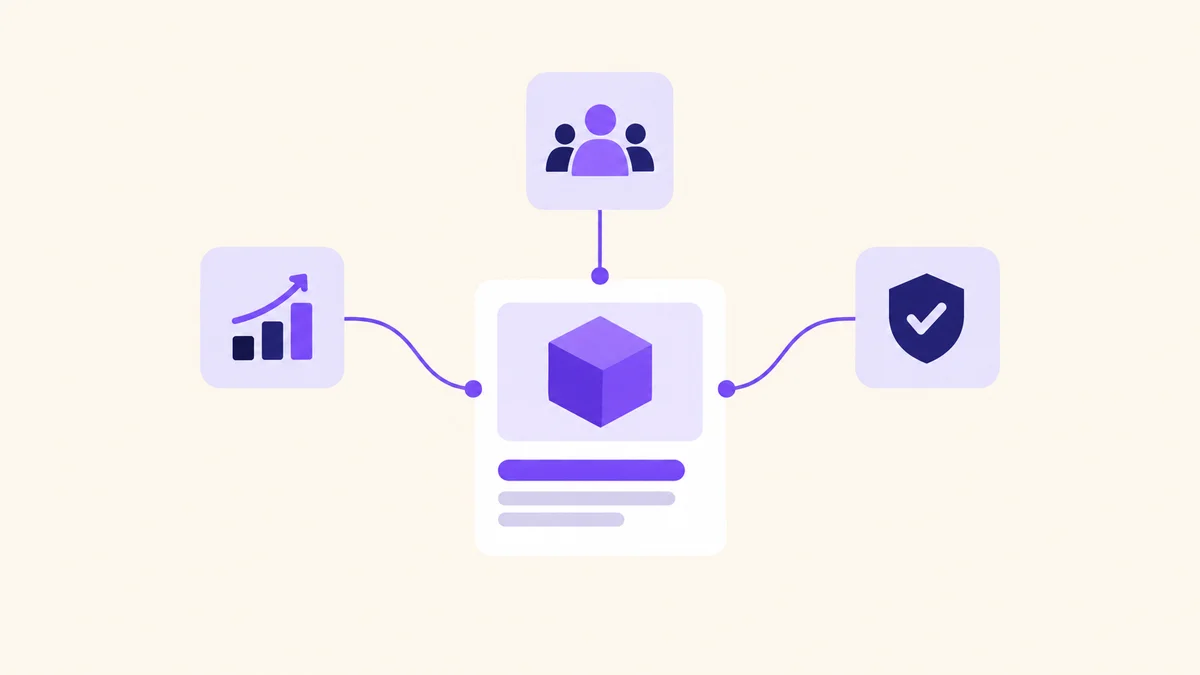
To increase AI search visibility for a SaaS product, publish one clear fact page stating what the product is, who it serves, its pricing and its integrations. Then support it with comparison pages and third-party profiles that say the same thing. In a 2026 study, 53 of 100 B2B SaaS companies received zero citations across ChatGPT and Perplexity on buyer-intent queries (AnswerManiac, 2026).
A product card connected by lines to review, pricing and comparison page tiles
That study tested 100 companies on 42 buyer-intent queries between 28 April and 12 May 2026. It is a small vendor study, so use it directionally. Several well-funded companies were among the zero-citation group.
Product-level pages to build
Canonical fact page: a plain description of the product, category, customer type, pricing model and integrations.
Comparison and alternatives pages: state differences as specifics a buyer could check.
Pricing and integration pages: put numbers and names in tables, not prose.
Third-party profiles: keep review listings consistent with the fact page. In G2's 2026 survey, 69% of buyers said an AI chatbot led them to a different vendor than they expected (G2, 2026).
Meet with an expert: A free consultation. Bring the questions buyers ask about your category and brainstorm how to get cited.
How do you measure whether answer engine optimization is working?
To measure answer engine optimization, pick 20 or more buyer questions, run each across five engines every month, and record whether the brand is cited, how it is described and which competitors appear. With 51% of B2B software buyers starting in an AI chatbot (G2, 2026), a missing brand means a missing shortlist entry.
A calendar grid with checkmarks beside a list of question lines across five columns
Our data: AEO for B2B SaaS proposes a monthly check of 20+ category questions across five engines as a measurement baseline.
Share of answer is the percentage of tested buyer questions where a brand appears in the AI-generated response. Track three columns each month: citation yes or no, accuracy of the description, and competitors named. Answers can differ between runs, so repeat each question rather than trusting a single result. This baseline is a proposed method, not a published dataset.
Add the analytics layer
Filter referral traffic for domains such as chatgpt.com and perplexity.ai so AI visits stop hiding inside other channels. Google's May 2026 guide also points site owners to a Search Console Generative AI performance report. Pair both with the monthly question log, since citations without a click leave no analytics trace. Tool options are covered in AI search visibility tools for B2B SaaS.
Limitations: who this guide is not for
Answer engine optimization (AEO) guidance for B2B SaaS has limits: no source reviewed measures how long a citation takes or promises one, and most evidence comes from vendor studies with stated samples. The AnswerManiac study covered only 100 companies (AnswerManiac, 2026), so its figures are directional signals, not proof.
Not for B2C or e-commerce teams. The evidence and examples target B2B SaaS buyers who compare vendors before talking to sales.
Not a shortcut. Microsoft Bing's guide says "Whether you call it GEO, AIO, or SEO, one thing hasn't changed: visibility is everything." (Search Engine Journal, 2025) That points to sustained work, not a trick.
Not settled science. Engine behavior outside Google's documentation is observation, and the debate over whether AEO is just SEO is open.
Frequently Asked Questions
Does structured data or schema markup help AI search visibility?
Structured data that matches visible page content is harmless and can help clarity, but Google says it is not required for its AI features. Google's guide states you do not need new machine readable files, AI text files, markup or Markdown to appear in generative AI search. Treat schema as hygiene, not as the lever that earns citations.
How long does it take to see results from answer engine optimization?
No source reviewed for this guide measures how long a change takes to produce a citation, so any fixed timeline would be invented. Engines refresh at different speeds and answers vary between runs. Set a baseline of buyer questions, recheck monthly, and judge progress from the trend across several months.
Does ranking number one on Google guarantee a brand is cited in AI answers?
Ranking number one on Google does not guarantee that a B2B SaaS brand is cited in AI answers. A 2026 Walker Sands benchmark of 828 enterprise B2B companies found the typical brand is cited in only 3% of relevant AI answers, even though the median company ranks for nearly 9,700 keywords.
How do you measure brand visibility in AI assistants?
Select 20 or more buyer questions, check each across five engines every month, and record whether the brand is cited, how the product is described and which competitors appear. Separate AI referral traffic in analytics by filtering referrers such as chatgpt.com and perplexity.ai, and repeat runs because answers vary.
Conclusion: what to do first
Increasing answer engine optimization is a sequence, not a single tactic. Start with the basics and measure before funding more.
Open key pages to crawlers and keep answer text in raw HTML.
Lead every section with a direct, specific answer.
Do not expect rankings to carry you: citation and ranking are different results.
Skip llms.txt and special markup as priorities for Google.
Build a fact page and consistent third-party profiles for each product.
Log 20 or more buyer questions monthly across five engines.
Ishan Manchanda is co-founder of GrowthSpree, a B2B SaaS marketing consultancy founded in 2017 that has managed $60M+ in ad spend across 300+ B2B SaaS companies. He focuses on demand generation, go-to-market strategy and pipeline growth, and has been featured in Silicon Valley Times, SaaS Mag and the Unbounce podcast.
 Ishan ManchandaNov 15, 2026