How to Improve Visibility in AI Search Results for B2B SaaS
how to improve visibility in ai search resultswhy is my brand not showing up in chatgpthow to improve brand visibility in ai search
How to Improve Visibility in AI Search Results for B2B SaaS
An evidence-led B2B SaaS guide to improving visibility in AI search results: what to change first, what measured data shows, and what remains unproven.
Ishan ManchandaNov 16, 2026
Last updated: Nov 16, 2026
How to Improve Visibility in AI Search Results for B2B SaaS
By AEO for B2B SaaS Editorial Team | Last updated: November 4, 2026
Improving visibility in AI search results means making a B2B SaaS company's pages readable, specific and corroborated enough that AI assistants cite them when buyers ask category questions. Buyers now ask assistants for shortlists, so a company missing from the answer is missing from the shortlist. Answer engine optimization (AEO) is the practice of structuring a site and its content so AI assistants and Google's AI features cite it. This guide lists the changes in order, shows measured figures with their samples, and separates evidence from hype. For the basics first, read .
Improving AI search visibility for a B2B SaaS company starts with crawler access and answer-first pages, not with special files or markup.
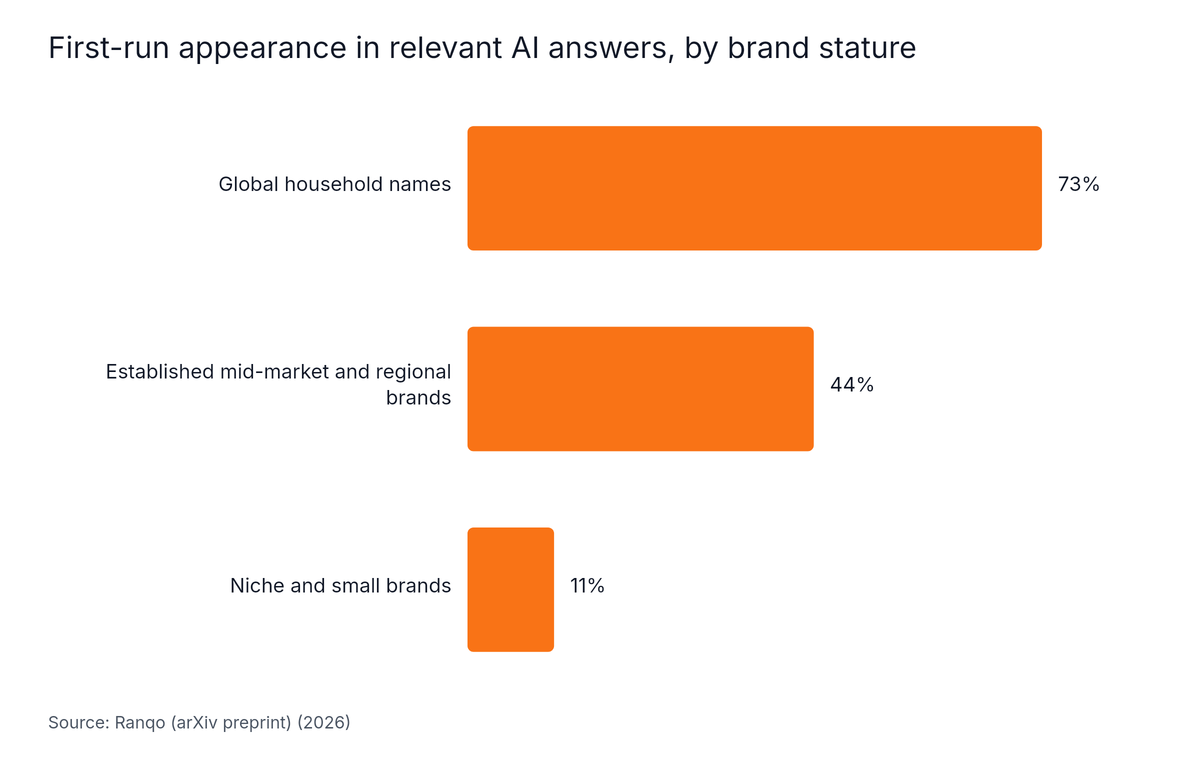
Brand stature strongly predicts appearance: a 2026 Ranqo preprint found 73% for global household names and 11% for niche brands (Ranqo, 2026).
Visibility is engine-specific and the evidence is directional: ChatGPT supplied 87.4% of measured AI referral traffic in one benchmark (Conductor via Martech Cube, 2025), so check each AI assistant separately.
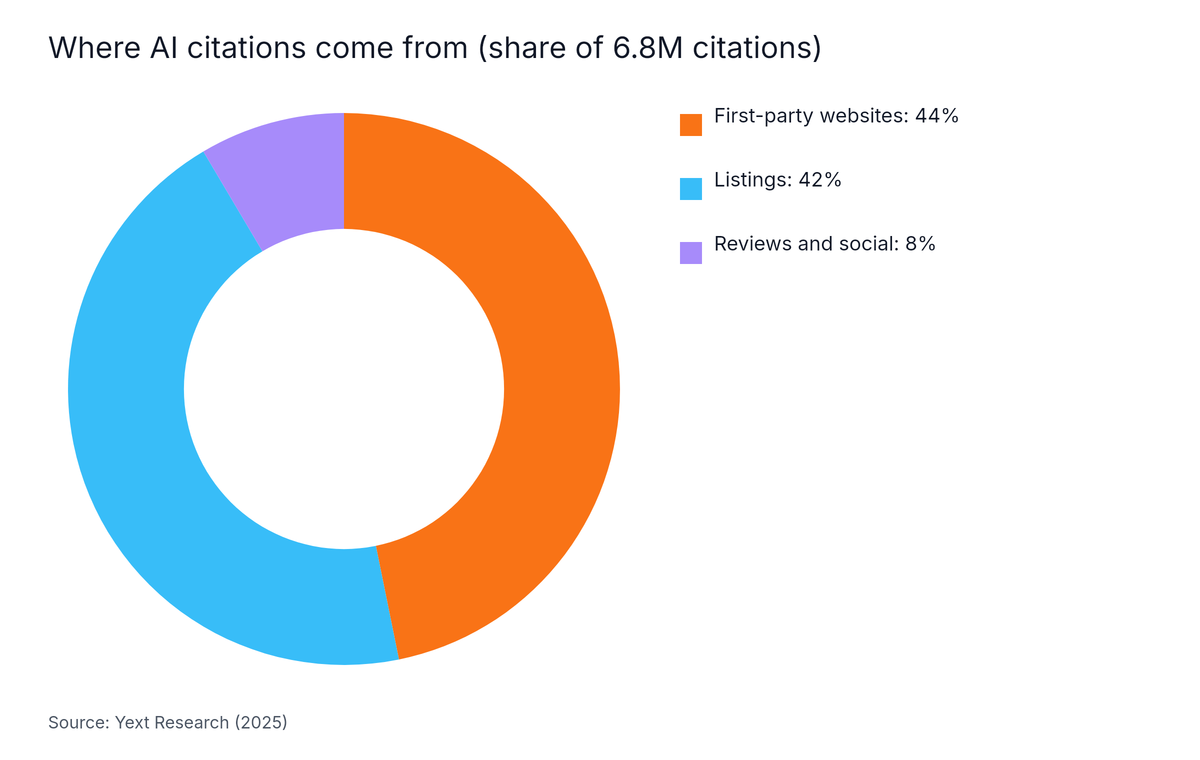
Most AI citations in one large study came from brand-managed sources, so a company's own site and listings need to be accurate (Yext Research, 2025).
No published study supports a guaranteed citation or a fixed timeline.
How to Improve Visibility in AI Search Results?
To improve visibility in AI search results, a B2B SaaS company should make key pages readable by crawlers, put direct answers first, state specific facts, and earn third-party mentions. Most of this is sound SEO, and Google documents that no special files are needed for its AI features (Google Search Central, 2025).
Five numbered paper cards laid in a row on a pale wooden desk beside a notebook
Google Search Central puts it plainly: "You don't need to create new machine readable files, AI text files, or markup to appear in these features" (Google Search Central, 2025). Its newer guide adds that "The way Google Search finds and processes your pages remains the core of how our AI systems access your data" (Google Search Central, 2026). That points to a practical order of work:
Step
What to change
Evidence status
1. Crawler access
Allow crawlers on purpose; check robots.txt, CDN and firewall rules
Google documents crawling as the base of its AI features
2. Raw HTML
Make key pages readable without JavaScript
Practical requirement: unreadable pages cannot be cited
3. Answer-first copy
Put a 40 to 80 word direct answer under each heading
Practice; no controlled outcome study found
4. Specific facts
Add figures, named entities and tables engines can lift
Practice; body-only edits alone can backfire (see below)
5. Third-party presence
Earn coverage on listicles, listings and review pages
Measured in Ranqo and Yext datasets
Search engine optimization (SEO) is the practice of earning ranked links in traditional search results. Steps 1 to 3 are largely shared with it, which is why the AEO vs SEO comparison matters for budgeting. Generative engine optimization (GEO) is an overlapping term for the same discipline, used mainly by researchers. The GEO explainer covers where the labels differ, but the checklist stays the same.
How to Improve Brand Visibility in AI Search?
Brand visibility in AI search depends first on brand stature and third-party presence, then on page quality. In a Ranqo preprint covering 100,000+ prompt responses, global household names appeared in 73% of relevant first-run answers, against 44% for mid-market brands and 11% for niche brands (Ranqo, 2026).
Horizontal Bar chart: First-run appearance in relevant AI answers, by brand stature. Highest: Global household names at 73%.
Ranqo's sample covered 100+ brands tracked from March to May 2026. The authors are a vendor, and the work is a preprint, not peer reviewed. Still, the ladder is a useful warning: a smaller B2B SaaS brand cannot assume a well-ranked site is enough.
Where do AI citations come from?
Brand-managed sources are the pages and profiles a company owns or controls, mainly its website and listings. Yext's analysis of 6.8 million AI citations found 86% came from brand-managed sources: 44% from first-party websites, 42% from listings and 8% from reviews and social (Yext Research, 2025). The queries were location searches in four consumer industries, so the split may not transfer to B2B SaaS.
Citation source
Share of 6.8M citations (Yext Research, 2025)
First-party websites
44%
Listings
42%
Reviews and social
8%
Donut chart: Where AI citations come from (share of 6.8M citations). Highest: First-party websites at 44%.
The practical reading: keep the company's own site and listings accurate and consistent, because engines appear to draw heavily on them. The guide to getting a brand cited by AI assistants covers the first pages to fix.
How to Improve Visibility on AI Search Engines?
Visibility on AI search engines improves when a B2B SaaS brand appears in the sources engines cite and is checked on each engine separately. Ranked "best-of" listicles were about 21% of all citations in a Ranqo preprint (Ranqo, 2026), and ChatGPT supplied 87.4% of measured AI referrals in Conductor's dataset (Conductor via Martech Cube, 2025).
Three glass jars filled to different levels with violet sand on a white shelf
Conductor's figure comes from the same dataset as its 1.08% traffic benchmark, and Conductor sells AEO software. Three findings shape what to do on each engine:
Listicles carry weight. A listicle is a ranked list article comparing several vendors. Getting named in credible ones is a third-party step, not a page edit.
Forums are smaller than assumed. General forums such as Reddit supplied just 2% of citations in Yext's study (Yext, 2025), again on consumer location queries.
Body-only edits are not a reliable fix. In a controlled test of 171,003 documents and 2,700 queries, body-only optimization reduced average top-20 presence by approximately 9%, top-10 presence after reranking by 16%, and final citation by 6% (arXiv critical survey of GEO, 2026). That is research-lab data, not a live engine.
What Should You Check When AI Assistants Skip Your Brand?
When AI assistants skip a B2B SaaS brand, check four things in order: unbranded buyer prompts run several times across engines, crawler access, consistent brand descriptions, and third-party coverage. Brand stature also matters: niche and small brands appeared in only 11% of relevant first-run answers in a 2026 Ranqo preprint (Ranqo, 2026).
A magnifying glass resting over a printed checklist with ticked boxes
Run unbranded buyer questions. Ask "best tools for [category]" style questions, several times per engine. Answers change between runs, so one test proves little.
Check crawler access. Confirm the crawlers named in each engine's own documentation are allowed in robots.txt and are not stopped by a CDN or bot-protection rule.
Check entity consistency. Name, category, pricing and integrations should read the same on the site, listings and profiles.
Check third-party coverage. Look for the brand in comparison lists, review sites and listings that assistants cite.
llms.txt is a proposed convention for telling AI crawlers which content is meant for ingestion. No major engine's published documentation confirms it is used, so treat it as optional, never as a fix.
How Can You Measure AI Visibility and AI Traffic?
Measuring AI visibility means checking a fixed set of buyer questions on a schedule across engines and tracking AI referrals separately in analytics. AI referral volume is small: Conductor's 2026 benchmark put it at 1.08% of website traffic across 13,770 enterprise domains (Conductor, 2025), so exposure matters more than clicks.
An open notebook with a hand-drawn grid of ticks and crosses beside a monthly wall calendar
Conductor's sample covers 10 industries, not B2B SaaS alone, so samples differ from any single company's traffic mix. No single number should anchor a budget. A simple monthly log is enough to start:
What to record
How often
Why
Brand named or not, per question and engine
Monthly
Shows presence by engine
How the product is described
Monthly
Catches inaccurate descriptions
Which competitors appear alongside
Monthly
Shows share of the shortlist
AI referral sessions, kept as their own segment
Monthly
Separates AI traffic from direct
Our data: AEO for B2B SaaS proposes a monthly baseline of 20+ category questions checked across five engines, tracking citation rate, accuracy of brand descriptions and which competitors appear. This is a proposed method, credited to a 2026 GrowthSpree blog post. It is not a measured result and carries no performance claim.
Run each question more than once. The arXiv survey describes generative search as a stochastic, partially observable pipeline, which is why answers vary between runs. The tools and platforms guide covers tracking options.
Who Is Answer Engine Optimization Not For, and What Is Still Unproven?
No published study documents a guaranteed citation or a predictable timeline for answer engine optimization (AEO) for B2B SaaS. The evidence is also uneven: the Ranqo dataset covers 100+ brands and is vendor-authored (Ranqo, 2026), so figures in this guide are directional, not benchmarks.
No timeline is documented. No published source states how long a change takes to produce a citation.
Samples differ. Yext's figures use consumer location queries; Ranqo and Conductor are vendors.
Content edits alone can fail. The arXiv survey found body-only optimization lowered citation presence in a controlled test.
Clicks are not the goal. AI referrals are a small share of traffic, so they will not replace organic search in a report.
Teams whose buyers never research categories before talking to sales will see less from this work.
Frequently Asked Questions
Why is my brand not showing up in chatgpt?
A brand usually does not show up in ChatGPT because the assistant has too little corroborating evidence about it, or cannot read its pages. In a 2026 Ranqo preprint, niche and small brands appeared in 11% of relevant first-run answers (Ranqo, 2026). Check unbranded buyer prompts, crawler access, consistent brand descriptions and third-party coverage, in that order.
Do I need llms.txt or special markup to appear in Google AI features?
Google Search Central states that site owners do not need new machine readable files, AI text files or markup to appear in its AI features (Google Search Central, 2025). Standard crawlability, indexing and helpful content remain the basis. Whether other engines act on llms.txt is not confirmed in published documentation.
Do third-party sites matter more than my own website for AI citations?
In one large study, a brand's own sources mattered most. Yext's analysis of 6.8 million AI citations found 86% came from brand-managed sources, with 44% from first-party websites and 42% from listings (Yext Research, 2025). The queries were consumer location searches, so B2B SaaS results may differ. Ranked listicles were about 21% of citations in a separate Ranqo dataset (Ranqo, 2026).
How much traffic does AI search send to B2B SaaS sites?
AI referral traffic to websites is still small. Conductor's 2026 benchmark, covering 13,770 enterprise domains across 10 industries, put AI referrals at 1.08% of all website traffic (Conductor, 2025). Samples differ between datasets, so treat that as one measurement, not a universal B2B SaaS rate. Track AI referrals as a separate segment in analytics.
Conclusion
Improving visibility in AI search results is a sequence, not a trick. Start with readable pages and crawler access, write answer-first copy with specific facts, keep the brand described consistently everywhere it appears, and earn coverage on third-party pages. Then measure.
Crawler access and raw HTML come before any content edit.
Brand stature matters: 73% for household names against 11% for niche brands (Ranqo, 2026).
Check each engine separately, with repeated runs.
Treat AI referrals as a signal, not a traffic goal.
Promise nothing on timing; none of the evidence supports it.
A free consultation is available. Bring the questions buyers ask about your category and brainstorm how to get cited: Meet with an expert. Be the answer, not the tenth blue link.
Written by
Ishan Manchanda
Ishan Manchanda is co-founder of GrowthSpree, a B2B SaaS marketing consultancy founded in 2017 that has managed $60M+ in ad spend across 300+ B2B SaaS companies. He focuses on demand generation, go-to-market strategy and pipeline growth, and has been featured in Silicon Valley Times, SaaS Mag and the Unbounce podcast.
 Ishan Manchanda