Last updated: Nov 11, 2026
How to Identify Gaps in AI Search Visibility for B2B SaaS
By AEO for B2B SaaS Editorial Team | Last updated November 4, 2026
A step-by-step method to find where AI assistants miss, misname or misdescribe your B2B SaaS brand, with prompt sets, run counts and a scoring table.
 Ishan ManchandaNov 11, 2026
Last updated: Nov 11, 2026
By AEO for B2B SaaS Editorial Team | Last updated November 4, 2026
Build a generative engine optimization budget for B2B SaaS: split fixed SEO-overlap work from monitoring tools, with sourced price ranges and kill criteria.
The six metrics that matter for AI search visibility in B2B SaaS, how to separate mentions from citations, set per-engine baselines and tie results to pipeline.
How B2B SaaS teams can structure pages for Google AI Overviews: what Google documents, what CTR studies show, and where to spend effort first.
Request a quote and our experts will contact you within 24 hours with tailored solutions and pricing.
An AI search visibility gap is a buyer question where an AI assistant leaves a B2B SaaS brand out, cites its page without naming it, or describes it incorrectly, and teams find these gaps by testing a fixed set of questions.
Buyers already ask assistants first. Forrester reports that 94% of business buyers use AI in their buying process, up five points from 89% a year earlier (2026). Rankings alone do not show what those answers say. Ahrefs measured a 58% lower average click-through rate (CTR) for top-ranking pages with an AI Overview across 300,000 keywords (February 2026), while Seer Interactive reported a rebound in 2026. This guide shows a search engine optimization (SEO) manager how to find the gaps, how many checks make a reading trustworthy, and how to rank fixes. It builds on what answer engine optimization (AEO) means.
Key Takeaways
- An AI search visibility gap is a buyer question where an AI assistant omits, misnames or misdescribes a B2B SaaS brand.
- Classify every answer as absent, cited but not named, or mentioned but wrong, so each gap has a distinct fix.
- Weight gaps by buying stage: questions near the shortlist and final decision matter most.
- SISTRIX found that 20-55% of prompts with a brand mention change every week, so one run proves nothing (2026).
- Check off-site sources and crawler access, because content edits alone cannot close every gap.
An AI search visibility gap is any buyer question where an AI assistant leaves your B2B SaaS brand out, cites your page without naming you, or describes you incorrectly. G2 reports that 51% of B2B software buyers start research in an AI chatbot, up from 29% in April 2025 (March 2026 survey). Finding gaps means running fixed buyer questions across engines, logging each answer, and classifying it.
The method has the same shape as an SEO gap analysis, but the unit changes from a keyword ranking to an answer. Rankings tell you where a link sits. An audit of answers tells you whether the assistant says your name, links your page and gets the facts right.
An AI citation is an instance where an AI answer links to or lists a page as a source. An AI mention is an instance where an assistant names a brand in its answer text. The two can differ, so the audit logs both.
Sorting each answer into one of three types turns a pile of screenshots into a work list.
| Gap type | What you see in the answer | Likely cause to investigate | First check |
|---|---|---|---|
| Absent | Competitors appear, your brand and pages do not | Page answers late, or crawlers cannot read it | Crawler access and answer placement |
| Cited, not named | Your page is a source, but the text names someone else | Facts on the page lack a clear brand association | Entity naming on the page |
| Mentioned, but wrong | Your brand appears with outdated or false details | Conflicting facts across pages and third-party sites | Pricing, integration and comparison pages |
Our data: AEO for B2B SaaS proposes a monthly check of 20+ category questions across five engines as a measurement baseline, tracking citation rate, accuracy of brand descriptions and which competitors appear. This is a proposed method, not a measurement, and no sample supports it (method credited to the GrowthSpree blog, 2026).
For a wider view of fixes, see how to get a B2B SaaS brand cited by AI assistants.
B2B SaaS teams identify gaps in AI search visibility by mapping buyer questions to buying stages and testing each one. A Semrush survey of 600+ US business professionals found that 66% regularly use AI to research vendors and solutions (2026). Test questions from early research to final decision, then weight the gaps that sit closer to purchase.

B2B differs from general search because buyers research categories and compare vendors before they speak to sales. In the same Semrush survey, 84% of B2B professionals said they use AI for work, and 69% of those users do so daily (2026; publication month approximate).
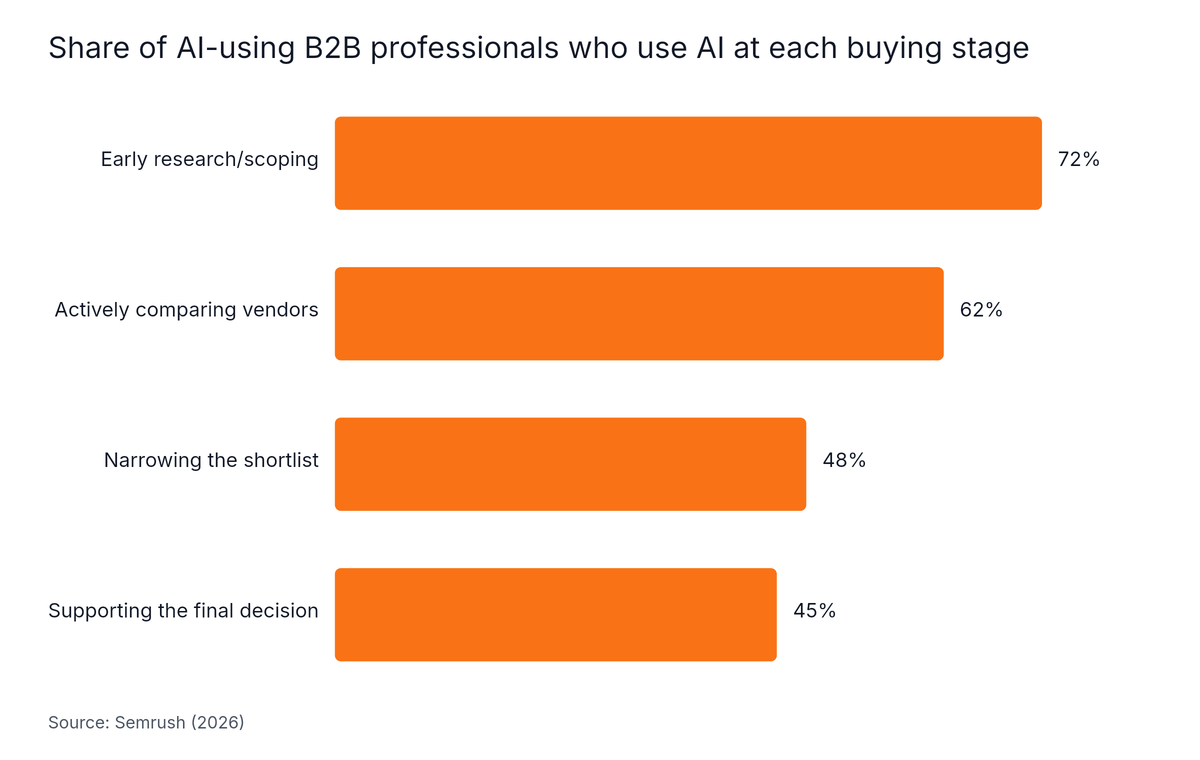
Source: Semrush, 2026
The chart shows the share of AI-using B2B professionals who use AI at each buying stage, per Semrush (2026): 72% for early research or scoping, 62% for actively comparing vendors, 48% for narrowing the shortlist and 45% for supporting the final decision. Use at every stage means gaps at every stage are real.
Write questions that match how buyers phrase each stage of the journey.
| Buying stage | Example buyer question | What a gap here means |
|---|---|---|
| Early research | "What is the best way to handle X in a B2B SaaS team?" | Buyers define the problem without you |
| Vendor comparison | "How does product A compare with product B?" | Buyers weigh you without your facts |
| Shortlist | "Which vendors should I consider for X?" | You are missing from the shortlist |
| Final decision | "Is product A worth it for a team of 50?" | Pricing or fit details are absent or wrong |
Forrester puts the direction plainly: "Buyers will spend more and more of their buying process with AI answer engines and less time engaging directly with vendors." (Forrester, 2026). For a view of how a single engine treats sources, see how to get cited by Gemini AI.
A reliable AI visibility audit uses a broad prompt set and repeated runs, because single checks mislead. SISTRIX analyzed 10,826 daily measurement series and found that 20-55% of prompts where a brand is mentioned change every week, while net mentions typically move only 4-10% (2026). More prompts give a steadier reading than repeating a few.

Prompt churn is the share of prompts whose brand mentions change from one week to the next. It explains why a manual spot check on Monday can contradict the same check on Friday. SISTRIX states: "It can be measured reliably, just not in the way many tools and guides suggest." (SISTRIX, 2026). The firm is a software vendor. Its sample covers ChatGPT, AI Overviews, AI Mode and Perplexity.
SISTRIX recommends repeated sampling, rolling 2-4 week windows and broad prompt sets (October 2026). Turn that into working rules:
A prompt set is a fixed list of buyer questions, grouped by buying stage, that is run repeatedly across engines. Keeping it fixed is what makes month-to-month movement meaningful. Tracking tools can automate the runs, but the same caution about single-run scores applies. LLM optimization covers how this work differs from classic SEO.
Score each gap on three factors: how often it appears across repeated runs, how close the buyer question sits to purchase, and how many engines show it. Gartner reports that 69% of B2B buyers validate AI insights with sales reps (May 2026), so buyers bring AI answers into sales conversations. Fix the frequent, late-stage, multi-engine gaps first.

Give each factor a score of 1 to 3, add them up, and sort. The scale is an editorial working rubric, not a published benchmark.
| Gap example | Repeat rate across runs | Buying stage | Engines affected | Priority |
|---|---|---|---|---|
| Absent from "which vendors for X" | Most runs (3) | Shortlist (3) | Several (3) | First fix |
| Wrong pricing in comparison answer | Most runs (3) | Final decision (3) | One (1) | Fix soon |
| Not named in early-research answer | Some runs (2) | Early research (1) | Several (3) | Plan next |
| Missing once in a single run | One run (1) | Early research (1) | One (1) | Watch only |
Sales calls and self-reported attribution fields on forms give a second check on what assistants tell buyers. If reps keep hearing a wrong claim, log it as a mentioned-but-wrong gap.
Then connect the fix to the page type. Absent gaps usually call for direct answers and structure on category and comparison pages. Wrong-detail gaps call for one consistent set of facts. A broader view of the overlap with SEO helps decide which existing pages to change first.
Off-site and technical checks for AI search visibility include review sites, communities and crawler access. G2's 2026 Buyer Behavior Report found review sites (38%) overtaking AI chatbots (37%) as the top influence on buyer shortlists (July 2026). If an AI assistant cannot read your pages, or trusted sites describe you poorly, content fixes alone will not close the gap.

G2's report frames the test as "whether AI includes you in the shortlist, represents you accurately" (G2, 2026). Compare your review profiles, community threads and analyst mentions against the competitors that appear in answers.
Confirm that key pages load in raw HTML and that AI crawlers are allowed in robots.txt on purpose. Then use Google's data. The Search Console Generative AI report launched June 3, 2026. Version one shows impressions in AI Overviews and AI Mode, with no clicks, queries or position data (Quattr, 2026).
Clicks need separate reading. Pew Research Center data, as reported by SISTRIX (2025), shows that 8% of users clicked a traditional result when an AI Overview appeared, versus 15% without one. That came from a March 2025 analysis of nearly 70,000 searches, and Google disputed the methodology.
A July 2026 randomized study of 1,065 US desktop Chrome users found a 39.8% cut in outbound organic clicks, per PPC Land (2026). The original study was not retrieved.
The AI search visibility gap audit is built for B2B SaaS marketing and SEO teams whose buyers research categories before talking to sales, not for consumer, e-commerce or local sellers. It is a diagnostic, not a guarantee: SISTRIX found 20-55% weekly prompt churn across 10,826 series (2026), so findings carry noise and need repeated runs.
Keep these limits in view:
An AI mention is when an assistant names your brand in its answer text. An AI citation is when the answer links to or lists your page as a source. A brand can be mentioned without being cited, or cited without being named, so a visibility audit should log both separately.
Run the same fixed set of buyer questions on a regular schedule and read results over rolling windows, not single days. SISTRIX recommended repeated sampling and rolling 2-4 week windows in 2026 because single-run checks are unreliable. Monthly reporting built on repeated runs is a practical rhythm for most B2B SaaS teams.
Partly. Google launched Generative AI performance reports in Search Console on June 3, 2026, showing impressions in AI Overviews and AI Mode separately from blue links. Version one shows impressions only, with no clicks, queries or position data, so it covers Google's features but not ChatGPT or Perplexity.
A first-place ranking and an AI citation are decided separately, so one does not guarantee the other. An assistant may draw on review sites, communities or other pages, or may not read your page at all if crawler access is blocked. Testing buyer questions directly shows which case applies.
Finding AI search visibility gaps is a repeatable routine, not a one-time check. Keep these points in hand:
Start with the shortlist-stage questions, since those decide whether buyers ever see your name. For the wider picture, read what separates AEO from traditional SEO.
Meet with an expert: A free consultation. Bring the questions buyers ask about your category and brainstorm how to get cited.
Written by
Ishan Manchanda
Ishan Manchanda is co-founder of GrowthSpree, a B2B SaaS marketing consultancy founded in 2017 that has managed $60M+ in ad spend across 300+ B2B SaaS companies. He focuses on demand generation, go-to-market strategy and pipeline growth, and has been featured in Silicon Valley Times, SaaS Mag and the Unbounce podcast.