Blog
How to Optimize Your Brand's Visibility in AI Search (B2B SaaS)
Measure how often AI assistants cite your B2B SaaS brand, read the benchmarks, and fix the pages and sources that decide who gets named in AI answers.
Learn how to get cited by AI chatbots like ChatGPT and Perplexity. See what each engine documents, what studies observe, and what B2B SaaS teams can act on.
 Ishan ManchandaNov 4, 2026
Measure how often AI assistants cite your B2B SaaS brand, read the benchmarks, and fix the pages and sources that decide who gets named in AI answers.
Get your B2B SaaS site cited by Gemini AI in 2026: answer-first content, structured data, entity signals, freshness, and how to track citation share.
Generative engine optimization (GEO) for B2B SaaS: what it is, how it differs from SEO, which brands invest in it, and how to improve AI search visibility.
Request a quote and our experts will contact you within 24 hours with tailored solutions and pricing.
Last updated: Nov 4, 2026
By AEO for B2B SaaS Editorial Team. Last updated 4 November 2026. OpenAI documentation read on 4 November 2026.
Getting cited by AI chatbots means earning a link or named reference in a ChatGPT or Perplexity answer, which for B2B SaaS depends on crawler access, third-party presence and answer-ready pages. The engines differ more than most guides admit. ChatGPT's share of measurable B2B AI referrals fell to 62.6% in March and April 2026, against 89% eight months earlier (Goodie, 2026). Buyers now reach vendors through several engines. This guide covers answer engine optimization (AEO) at the engine level. It separates what OpenAI documents from what studies observe, so B2B SaaS teams know what they can act on. For the wider view, see what AEO means for B2B SaaS.
Key Takeaways
- Getting cited by AI chatbots starts with crawler access: OpenAI states that sites opted out of OAI-SearchBot will not appear in ChatGPT search answers.
- ChatGPT and Perplexity cite largely different domains, with only 11% shared in Profound's 2026 analysis, so each engine needs its own checks.
- Neither OpenAI nor Perplexity publishes ranking weights, so most citation tactics for B2B SaaS are observed patterns, not documented rules.
- Citation sets drift heavily from month to month, so a B2B SaaS team needs a fixed buyer-question set checked on a schedule.
AI chatbots cite pages they can crawl, retrieve and quote cleanly. For B2B SaaS, that means allowing each engine's search crawler, writing answer-first pages with specific facts, earning third-party mentions, and checking results monthly. Across 52 B2B SaaS categories, earned media made up 61 percent of AI citations and brand-owned content 29 percent (Salienz, 2026).

Answer engine optimization (AEO) is the practice of structuring a B2B SaaS site and its content so AI assistants and AI search choose to cite it. A citation is a source link or named reference inside an AI-generated answer. Salienz is a vendor, and its figure comes from a May 2026 run of roughly 350,000 articles. Read it as directional.
Five steps apply to every engine:
This page covers the engine-specific layer. For page structure, read how to get cited by AI search engines. For the SEO overlap, see AEO vs SEO for B2B SaaS.
OpenAI documents which crawler controls ChatGPT search, while neither OpenAI nor Perplexity publishes ranking weights. OpenAI's crawler documentation, read on 4 November 2026, states: "Sites that are opted out of OAI-SearchBot will not be shown in ChatGPT search answers, though can still appear as navigational links." (OpenAI Developers, 2026) Perplexity's own documentation was not retrieved, so its source choices below are observation.

OAI-SearchBot is the OpenAI crawler that controls whether a site can appear in ChatGPT search answers. PerplexityBot is the crawler Perplexity uses for its search index. Check Perplexity's live crawler pages before acting on anything about it.
The table separates four kinds of claim. Documented means the engine's own page states it. Reported means a secondary source describes it. Observed means a third-party study measured it. Not documented means no source in this review covers it.
| Claim | Status | Source |
|---|---|---|
| OAI-SearchBot access decides whether a site appears in ChatGPT search answers | Documented | OpenAI crawler documentation, read 4 November 2026 |
| Any public site can appear in ChatGPT search; disallowed pages can surface as a bare link and title; ChatGPT adds utm_source=chatgpt.com | Documented | OpenAI Publishers and Developers FAQ, updated late October 2026 |
| OpenAI advises against blocking OAI-SearchBot | Documented (FAQ wording to re-check) | OpenAI Publishers and Developers FAQ, updated late October 2026 |
| GPTBot (training) is separate from OAI-SearchBot (search) | Reported; verify in live OpenAI documentation | Not quoted in this review |
| ChatGPT-User, which fetches pasted URLs, differs from OAI-SearchBot | Reported by a third party | Similarweb, October 2026 |
| PerplexityBot behavior and robots.txt handling | Unverified: Perplexity documentation not retrieved |
Blocking one crawler may not block another, so check each by name. Review these items:
Perplexity does not publish how it ranks sources in the material reviewed here, so what is known comes from third-party observation. Reddit led Perplexity at 6.6% of citations (Profound, 2025), and Company Pages made up 59% of the LinkedIn content Perplexity cited (Semrush, 2026).

Profound's data is a vendor analysis of citations across ChatGPT, Google AI Overviews and Perplexity from August 2024 to June 2025. Semrush studied 325,000 unique prompts and 89,000 LinkedIn URLs across ChatGPT Search, Google AI Mode and Perplexity in January and February 2026. Both datasets show patterns. Neither shows a rule.
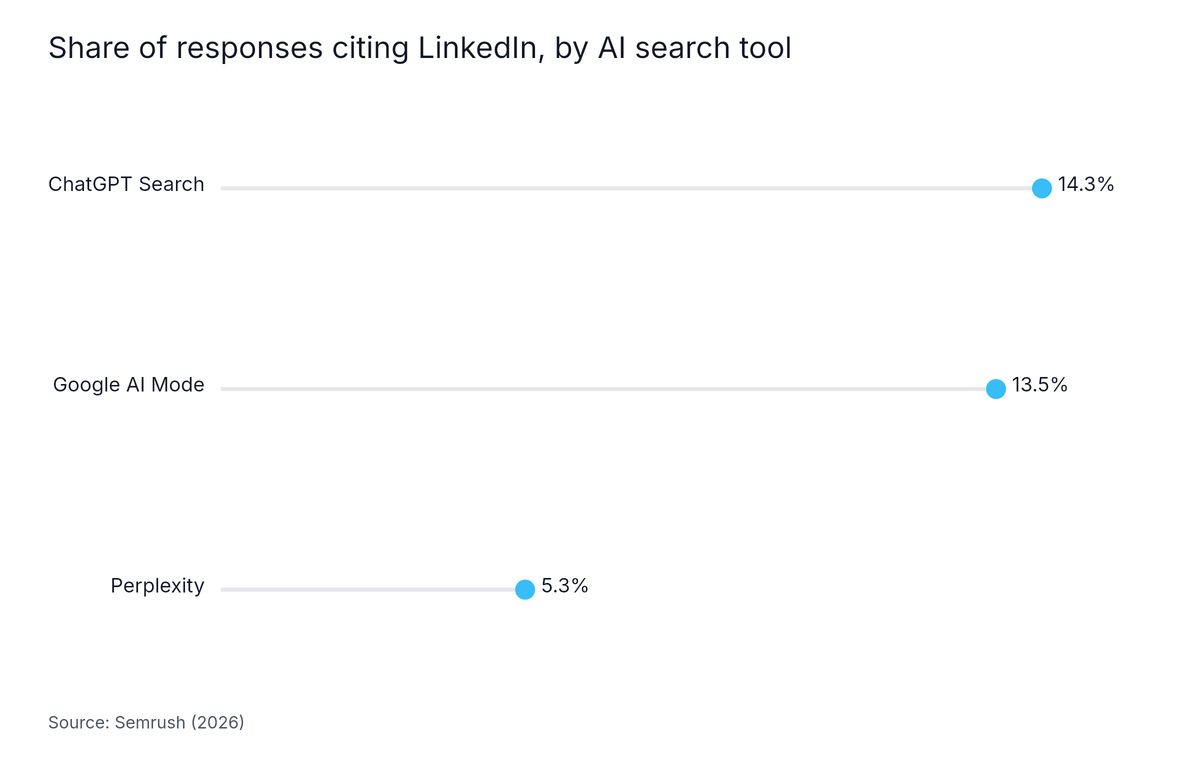
ChatGPT Search and Google AI Mode leaned the other way on LinkedIn. They cited individual creators more often, at 59% (Semrush, 2026). A company profile therefore matters more for Perplexity than for the other two.
Source: Semrush, 2026
The chart shows Perplexity citing LinkedIn in just 5.3% of responses, against 13.5% on Google AI Mode and 14.3% on ChatGPT Search (Semrush, 2026). A tactic that works on one engine does not carry over to the others.
These steps are inferences from observed patterns. No source promises that any of them produces a citation.
Generative engine optimization (GEO) is the practice of shaping content so large language model (LLM) answers cite it. For ChatGPT, GEO starts with OAI-SearchBot access, which OpenAI documents. Beyond that, Similarweb reports that the top recommended brand earns up to a 14.6% click-through rate (CTR) against 2.3% for footnote citations (2026, upstream sample not named).
Eligibility comes first. OpenAI's FAQ (updated October 2026) says any public site can appear in ChatGPT search. What ChatGPT prefers after that is observed, not documented. In Profound's data, Wikipedia was ChatGPT's most-cited source at 7.8% of total citations (Profound, 2025).
Similarweb's newsletter does not name the study behind its CTR figures, so verify them before relying on them. The direction still helps. A footnote link drives fewer clicks than being named as the recommendation.
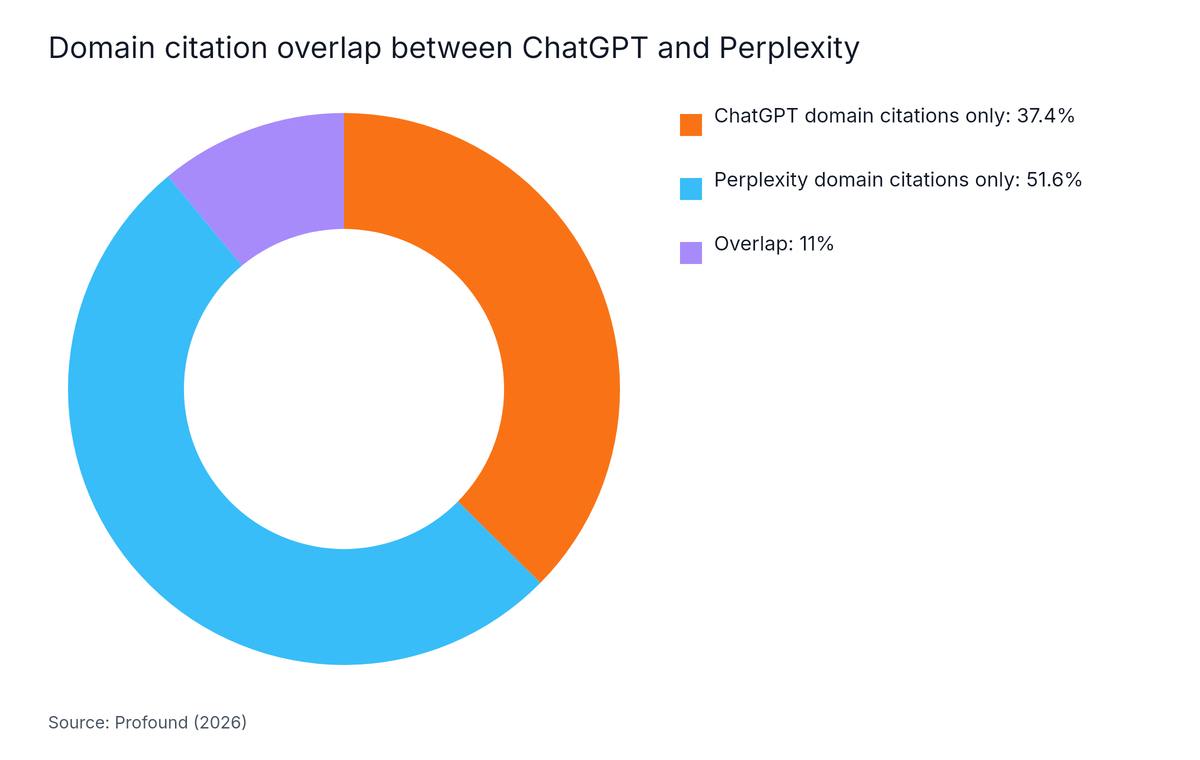
ChatGPT and Perplexity cite largely different sources: in Profound's overlap analysis (2026), 37.4% of domains were cited only by ChatGPT, 51.6% only by Perplexity and 11% by both. B2B SaaS teams therefore need engine-specific work, not one strategy applied to both.
Source: Profound, 2026
Profound is a vendor, and the retrieved page does not state its sample size. Treat the split as directional. The table pulls together the observed differences.
| Factor | ChatGPT | Perplexity | Status |
|---|---|---|---|
| Most-cited source | Wikipedia, 7.8% of citations | Reddit, 6.6% of citations | Observed (Profound, 2025) |
| Responses citing LinkedIn | 14.3% (ChatGPT Search) | 5.3% | Observed (Semrush, 2026) |
| LinkedIn content type cited | Individual creators | Company Pages | Observed (Semrush, 2026) |
| Search crawler | OAI-SearchBot | PerplexityBot | Documented by OpenAI; unverified for Perplexity |
| Share of AI referral traffic | 74.78% | 7.23% | Observed (SE Ranking, 2026) |
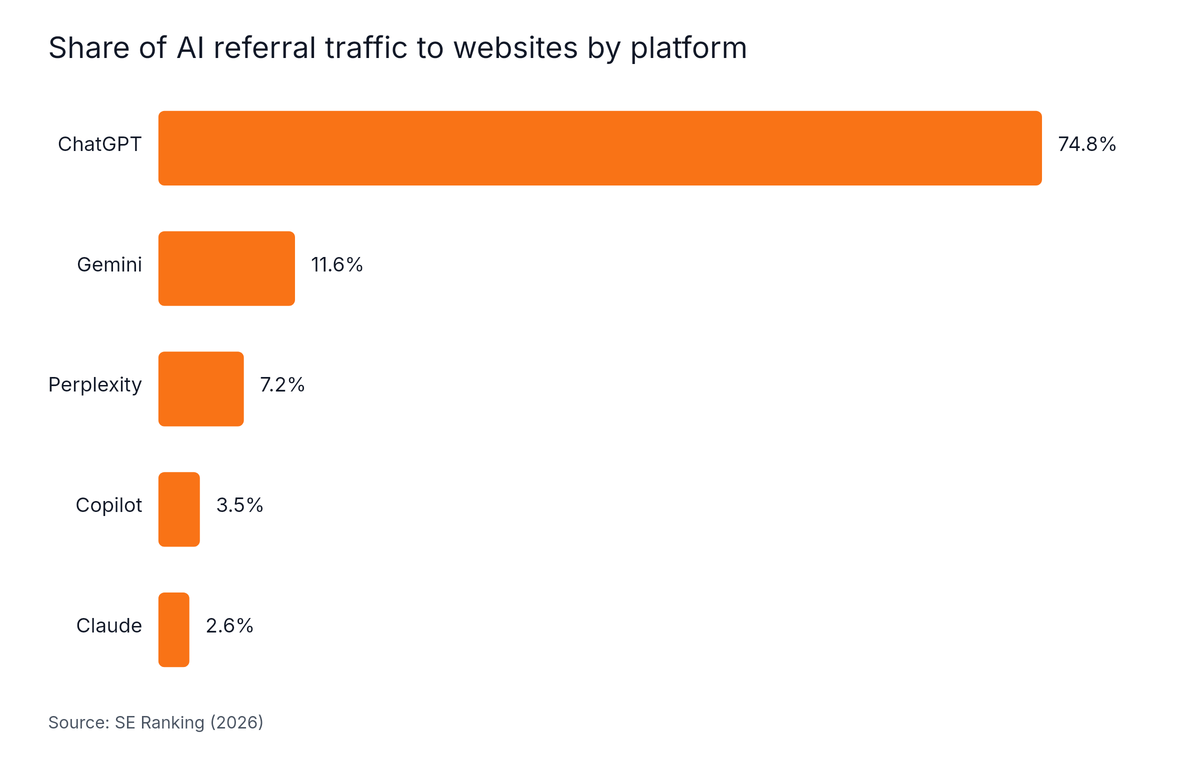
Referral share also shapes priorities. SE Ranking (2026) puts ChatGPT first at 74.78% of AI referral traffic, with Gemini at 11.56%, Perplexity at 7.23%, Copilot at 3.51% and Claude at 2.62%. Estimates vary by study, so check GA4 for the site's own split.
Source: SE Ranking, 2026
Measuring AI chatbot citations requires a fixed set of buyer questions run repeatedly, because citation sets drift: Profound's tracking found 54.1% drift on ChatGPT and 40.5% on Perplexity from June to July (Profound, 2025). A single check misleads. Monthly repeat runs that record cited and mentioned separately give a usable baseline.

Citation drift is the share of an engine's cited sources that change between two measurement periods. Profound is a vendor, the sample size is not stated, and the year comes from page metadata.
This workflow is a practical suggestion, not measured data:
A citation is only half the picture, because AI answers change what happens to clicks. A team that tracks citations alone cannot tell whether a cited page still earns visits. Track citations, AI referrals and clicks side by side. The evidence on clicks points both ways.
Our data: The evidence compiled by AEO for B2B SaaS holds two measurements and one prediction. Measured: Ahrefs found that an AI Overview correlated with a 58% lower average click-through rate for the top-ranking page across 300,000 keywords, comparing December 2023 with December 2025 (published February 2026). Measured: Seer Interactive reported that click-through rates on results with an AI Overview rebounded 85% in the first two months of 2026, and that informational results without one rose from 2.93% to 3.97% across 901 million impressions in 2025. Predicted: Gartner's February 2024 forecast of a 25% drop in search engine volume by 2026 is a prediction, not a measurement.
Engine-specific citation advice has hard limits. A July 2026 survey of 45 generative engine optimization studies (arXiv, 2026) found no stable cross-platform technique, and gains depend on a source already being retrieved. Several figures in this guide come from single vendors, so treat every tactic as a test, not a guarantee.
The survey's author writes: "Commercial audits further reveal low source overlap, substantial run-to-run variability, and persistent fidelity gaps." (Martinez, arXiv, 2026)
Proxies do not fix this. A preprint reported by Search Engine Journal tested 80 questions on the GPT-5.5 Instant setting. Google results plus OpenAI's API recovered only 26.2% of the pages ChatGPT cited, and 48.7% of the sites behind them (Search Engine Journal, 2026). Direct prompt testing is needed.
This page is not for B2C, e-commerce or local businesses. It cannot promise a citation or a timeline either. For how this differs from search engine optimization (SEO), read LLM optimization for B2B SaaS.
Perplexity AI cites pages its crawler can read and that sit on sources it favors. Allow PerplexityBot, write answer-first pages, and earn mentions on third-party sites. In Semrush's study (2026), Company Pages made up 59% of the LinkedIn content Perplexity cited, so a maintained company profile is worth having.
ChatGPT search can only cite pages it is allowed to surface, so keep OAI-SearchBot allowed in robots.txt. Then publish specific answer-first pages. Proxies are weak guides: a preprint reported in 2026 found Google results plus OpenAI's API recovered only 26.2% of the pages ChatGPT cited (Search Engine Journal, 2026), so test prompts directly.
Getting cited in ChatGPT and Perplexity answers needs separate checks, because only 11% of cited domains overlapped in Profound's analysis (2026). Allow both search crawlers, write answer-first pages, and earn third-party mentions. Then test a fixed question set on each engine, since neither publishes ranking weights.
ChatGPT search and Perplexity search both need crawler access first, then pages worth quoting. Priorities differ by traffic: SE Ranking's vendor study (2026) put ChatGPT at 74.78% of AI referral traffic and Perplexity at 7.23%. Check your own GA4 split before deciding how much effort each engine deserves.
Answer engine optimization for B2B SaaS starts with crawler access, then answer-first pages and third-party presence. Allow each assistant's search crawler, put a direct answer at the top of each page, and add figures and tables. Salienz (2026) reported that earned media made up 61 percent of AI citations across 52 B2B SaaS categories.
AI answer engines cite pages they can crawl and quote cleanly, but their citation sets move. Profound (2025) found 54.1% drift on ChatGPT and 40.5% on Perplexity from June to July. Check crawler access, put the answer first, earn mentions on review sites and forums, and repeat a fixed buyer-question set monthly.
Content gets cited by AI chatbots when crawlers can read it and an answer can lift it cleanly. Put the answer first and name the product, category and price in plain text. Similarweb (2026) reported that being the recommended brand in ChatGPT earns up to a 14.6% CTR, against 2.3% for footnote citations.
Generative engine optimization differs by engine because observed source preferences differ. Profound (2025) showed Wikipedia as ChatGPT's most-cited source and Reddit as Perplexity's. Semrush (2026) found Perplexity cited LinkedIn in 5.3% of responses, against 14.3% for ChatGPT Search, so one tactic rarely carries over.
Getting cited by AI chatbots is a crawler-access problem first, a content-structure problem second and a third-party presence problem third. Keep these points in view:
Start by auditing crawler access, then run a fixed buyer-question set on both engines this month. For the broader plan, see how to get a B2B SaaS brand cited by AI assistants.
A free consultation. Bring the questions buyers ask about your category and brainstorm how to get cited. Meet with an expert
Written by
Ishan Manchanda
Ishan Manchanda is co-founder of GrowthSpree, a B2B SaaS marketing consultancy founded in 2017 that has managed $60M+ in ad spend across 300+ B2B SaaS companies. He focuses on demand generation, go-to-market strategy and pipeline growth, and has been featured in Silicon Valley Times, SaaS Mag and the Unbounce podcast.
© 2026 AEO for B2B SaaS All rights reserved.


| Check Perplexity's live pages |
| Earned media outweighs brand-owned pages in citations | Observed | Salienz, 2026 |
| Ranking weights for either engine | Not documented | Neither engine publishes them |