Request a quote and our experts will contact you within 24 hours with tailored solutions and pricing.
Comprehensive GEO and SEO Consulting Services for B2B SaaS: What to Ask Before You Hire
By AEO for B2B SaaS Editorial Team. Last updated: November 4, 2026.
Comprehensive GEO and SEO consulting services for B2B SaaS combine standard search engine optimization (SEO) with generative engine optimization (GEO), the work of earning mentions and citations in AI answers, and should be judged on deliverables, measurement and honesty.
Buyers who reach this stage have usually decided they need outside help. The harder job is telling a consultant who understands answer engines from one who has renamed an SEO retainer. This guide lays out what a real scope contains, where it overlaps with SEO (see AEO vs SEO for B2B SaaS), what to ask on a shortlist call, how to measure results, and when to skip it. Every figure is labeled by source type and sample.
Key Takeaways
A credible GEO and SEO consultant for B2B SaaS shows a fixed prompt set, a baseline, multi-engine coverage and a monthly report, and refuses to promise any citation outcome.
Google's official guidance calls optimizing for generative AI search "still SEO", so much of GEO work is SEO fundamentals under a new label.
Genuinely new GEO work centers on third-party sources, consistent brand descriptions and tracking several engines separately.
AI visibility tracking tools start near $99 a month and rise into the thousands, on top of consulting fees.
GEO consulting is a poor fit when buyers do not research vendors online or when basic crawlability is broken.
What should you ask a consultant who covers both GEO and SEO for a B2B SaaS site?
A buyer vetting comprehensive GEO and SEO consulting services for a B2B SaaS site should ask how the consultant builds a fixed prompt set, covers several engines, separates mentions from citations, measures pipeline, and what they refuse to promise. Strong answers are specific and testable. Weak answers promise assured citations or treat GEO as a rename.
Isometric clipboard checklist beside a magnifying glass on a violet desk tile
Use the six questions below on the shortlist call. Each pairs a strong answer with a weak one.
Question
Strong answer sounds like
Weak answer sounds like
How do you build and validate the prompt set?
A fixed list of buyer questions covering category, comparison, pricing and integration queries, baselined before any change
A few prompts typed in by hand, different each time
Which engines do you test, and with web search on or off?
Several engines tested separately, settings and country recorded
ChatGPT only, settings unknown
Do you report mentions, citations and recommendations separately?
Yes, with a note that outputs vary run to run
One blended "visibility score"
What will you not promise?
No assured citations, no assured placement in AI assistants, no delivery dates
"Page one of ChatGPT in 90 days"
How do you tie visibility to pipeline?
AI referrals separated in analytics, demo and trial attribution, plus honest notes on undercounting
Impressions and screenshots only
Who writes the content, and who owns review-site and third-party work?
Named owners, subject-matter review, clear handoffs
Vague "our team handles it"
The second question matters because the terms get mixed up. A mention is a brand name that appears in an AI answer, while a citation is a linked source the answer draws on. A consultant who cannot separate the two will report vanity numbers.
Why these questions need a B2B SaaS lens
Generic vetting lists miss how software is bought. G2's March 2026 survey of 1,076 B2B software buyers found 71% rely on AI chatbots for software research, up from roughly 60% about seven months earlier (G2, 2026). G2 is a software review publisher, so treat the survey as industry research, not a neutral census. Its direction still shapes the questions: comparison queries, review sites and demo attribution matter more here than generic blog traffic.
What does a GEO consultant actually do for a B2B SaaS company?
A GEO consultant for a B2B SaaS company runs a baseline prompt audit, fixes technical access, improves entity and third-party citation sources, builds comparison and alternatives content, and reports monthly. Generative engine optimization (GEO) is the practice of earning mentions and citations in AI-generated answers. G2's 2026 survey found 51% of B2B software buyers now start research with an AI chatbot (G2, 2026).
Isometric stack of five blocks forming a project scope staircase
The table labels each deliverable as existing SEO work or genuinely new, which is the line most proposals blur.
Deliverable
Already part of SEO, or new?
What good looks like
Baseline prompt audit
New
Fixed buyer-question set, checked per engine, recorded before changes
Technical access and rendering
SEO fundamentals
Key pages readable without JavaScript, AI crawlers allowed on purpose
Entity and brand consistency
Partly new
The product described the same way on the site and across third-party pages
Third-party and review-site presence
New emphasis
A plan for the sources buyers and engines read besides the company site
Comparison and alternatives content
SEO plus answer-first formatting
Direct answers, tables and specific numbers a page can be quoted from
Monthly reporting
New
Citation share over time, brand-description accuracy, AI referrals beside clicks
Why scope has to reach beyond the company site
G2's 2026 Buyer Behavior Report found software review sites (38%) overtook AI chatbots (37%) for the first time as the top source shaping buyer shortlists (G2, 2026). A scope limited to on-site content ignores much of what shapes shortlists. G2's report authors also warn that "The best-supported, most consistently represented vendor in a category has a compounding advantage" (G2, 2026). For definitions and examples, see what generative engine optimization is.
How does GEO consulting differ from an SEO retainer?
GEO consulting differs from a search engine optimization (SEO) retainer mainly in what it measures and where it works: GEO tracks mentions and citations across several AI engines and off-site sources, while an SEO retainer tracks rankings and organic clicks. Google's own guidance describes optimizing for generative AI search as still SEO, so the overlap is large (Google Search Central, 2026).
Two isometric tracks, one straight and one branching, joined at a shared base
Where the two overlap
Search engine optimization (SEO) is the practice of earning ranked links and organic clicks in traditional search results. Google's May 2026 guide states: "From Google Search's perspective, optimizing for generative AI search is optimizing for the search experience, and thus still SEO." (Google Search Central, 2026). The same guide calls llms.txt, content chunking, AI-specific rewriting and special schema unnecessary for Google's AI features. A consultant who bills those as core GEO work for Google deserves a follow-up question. Crawlability, helpful content and clear pages are shared ground, covered further in LLM optimization for B2B SaaS.
Where GEO adds work
Answer engine optimization (AEO) is the practice of structuring a site and its content so AI assistants and AI search features choose to cite it. Most of its new work falls into four areas:
Off-site citation sources such as review sites, directories and earned media.
Brand and entity consistency across those sources.
Prompt tracking per engine, because ChatGPT, Perplexity and Google features behave differently.
Reporting visibility next to clicks, since rankings no longer guarantee traffic.
On that last point, Pew Research Center's analysis of Google searches by 900 U.S. adults in March 2025 found users clicked a traditional result link in 8% of visits when an AI summary appeared, against 15% without one (Pew Research Center, 2025). Google disputed the study's methodology, so read it as a signal from one measured sample, not a settled figure.
Our results: The AEO for B2B SaaS evidence file holds two third-party click-through rate (CTR) studies that point in opposite directions. Ahrefs, across 300,000 keywords (December 2023 vs December 2025, published February 2026), measured a 58% lower average CTR for the top-ranking page when an AI Overview was present. Seer Interactive (April 2026) reported that CTR on results with an AI Overview rebounded 85% in the first two months of 2026, and that informational results without one rose from 2.93% to 3.97% across 901 million impressions in 2025. Both are measurements, not predictions.
Meet with an expert. A free consultation. Bring the questions buyers ask about your category and brainstorm how to get cited. Book the consultation.
How should a consultant measure AI visibility, and which GEO tools help?
A consultant should measure AI visibility with a fixed prompt set checked on a schedule, AI referral traffic separated in analytics, and Google's Search Console Generative AI performance report for Google features. Tracking tools such as Profound and the Semrush AI Toolkit automate prompt checks, with entry plans around $99 a month and enterprise tiers in the thousands (Menra, 2026).
Isometric measuring instruments: dial gauge, ruler and small bar blocks on a platform
Measurement option
What it covers
Limits and cost
Search Console Generative AI performance report
Google's own AI features, first-party data
Covers Google only
Third-party prompt trackers (for example Profound, Semrush AI Toolkit)
Mentions and citations across several engines
Sample prompts, not clickstream data. Menra's July 2026 comparison lists Profound at $399 a month for Growth and $2,000 to $5,000+ for enterprise, Semrush about $99 a month; other roundups quote different Semrush prices, so verify with vendors
Analytics referral filters (chatgpt.com, perplexity.ai and similar)
Visits that arrive from AI assistants
Under-counts: some app visits appear as direct traffic
Manual baseline of 20+ buyer questions across five engines, monthly
Citation rate, accuracy of brand descriptions, competitors present
A proposed method from a 2026 marketing publisher, not a measurement; needs staff time
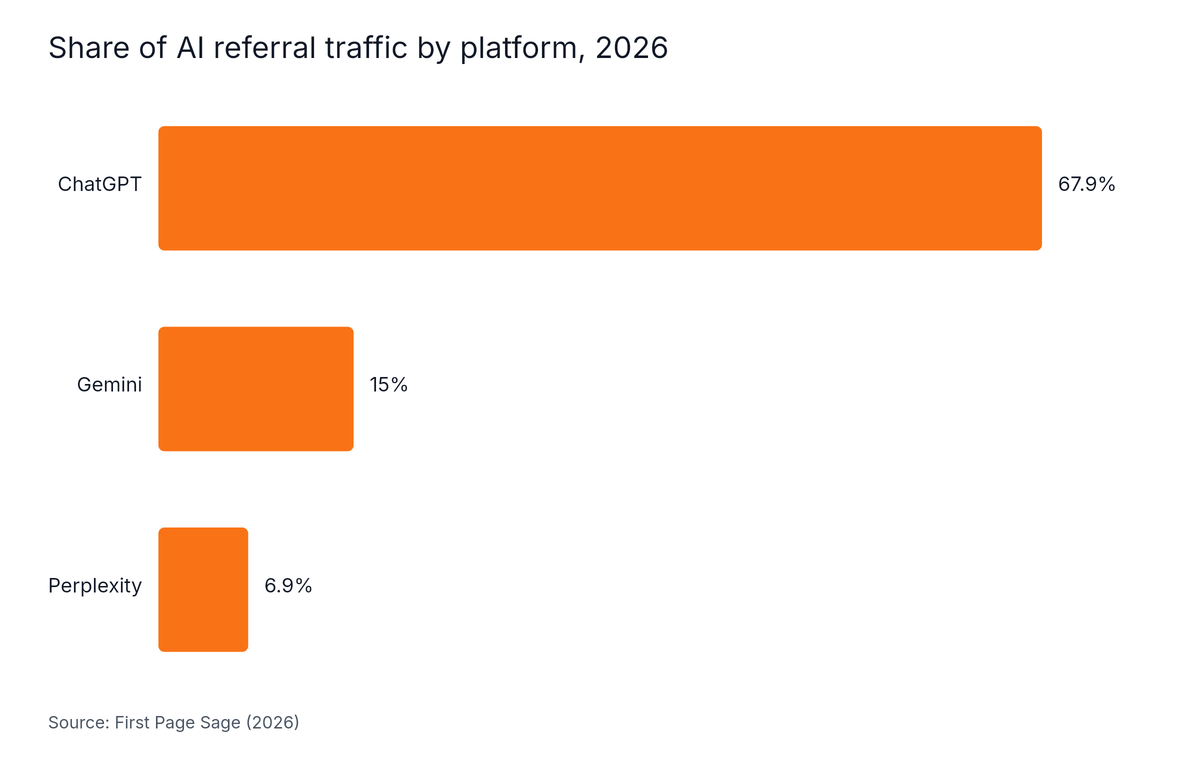
First Page Sage's dataset of 218 client sites, about 3.7 billion sessions, found ChatGPT sends 67.9% of all AI referral traffic, though its share has fallen 16.3 percentage points in two years (First Page Sage, 2026). The firm is an agency reporting on its own clients, so the figures are directional. In the same data, Gemini holds 15% and Perplexity 6.9% of AI referral traffic (First Page Sage, 2026).
Horizontal Bar chart: Share of AI referral traffic by platform, 2026. Highest: ChatGPT at 67.9%.
Pew's browsing data found that users clicked a link inside the AI summary itself in only 1% of visits (Pew Research Center, 2025). Being cited does not equal getting visits, so a consultant should report visibility and pipeline together.
Is GEO consulting worth the spend for a B2B SaaS company?
GEO consulting can be worth the spend for a B2B SaaS company when buyers research categories in AI assistants and a baseline shows the company missing from answers, but the evidence is mixed and mostly vendor-sourced. One agency dataset shows ChatGPT visitors converting to leads at 4.7% versus 1.9% for Google organic (First Page Sage, 2026).
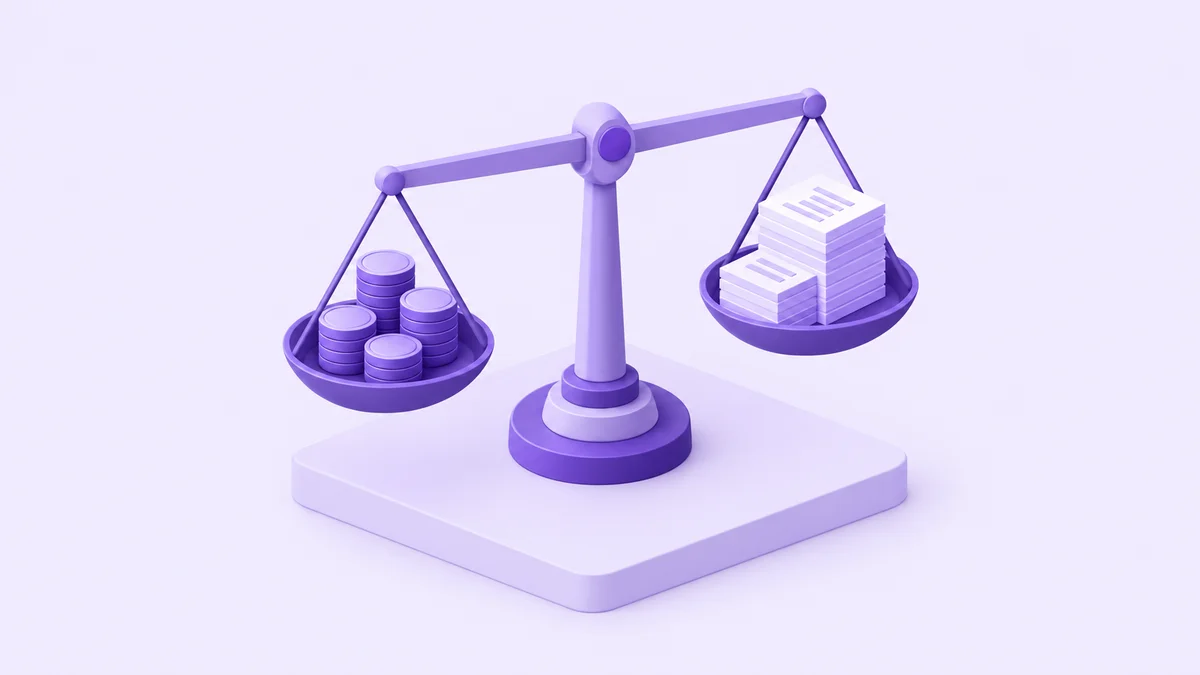
Isometric balance scale weighing a coin stack against a small stack of document blocks
That conversion figure comes from one agency's own client data across 218 sites, so it supports interest, not a forecast. Counterweights exist. Forrester's research found only 36% of B2B buyer respondents felt more confident they made a better-informed decision because they used generative AI (Digital Commerce 360, reporting Forrester, 2026). Forrester's own summary says "Buyers lean on AI for speed and breadth of insight, yet they increasingly validate its output against trusted external sources." (Forrester, 2026). Buyers still check humans and traditional search, so GEO supports sales enablement rather than replacing it.
A practical decision framework:
Start with a pilot. A 3 to 6 month fractional engagement that produces a baseline and a prioritized fix list limits risk.
Compare with in-house capability. A team that already owns technical SEO and content may need only the audit and reporting method.
Budget tooling separately. Trackers cost from about $99 a month into the thousands.
Define success before kickoff. Agree on citation share, description accuracy and AI-referred demos, not a promised position inside an AI assistant.
Who is GEO consulting not for?
GEO consulting is not for B2B SaaS companies whose buyers rarely research vendors before talking to sales, sites with broken SEO fundamentals, or teams that want an assured result. It also fits poorly where nobody can own the content and review-site work. In those cases, fixing crawlability and core pages first usually returns more.
Review-site work is a clear example. G2's 2026 Buyer Behavior Report found review sites (38%) now edge AI chatbots (37%) as the top source shaping shortlists (G2, 2026). A company with no one to manage those profiles will leave much of that influence untouched, whatever a consultant fixes on its own site.
Be aware of the evidence limits too:
G2's buyer figures come from a software review publisher's own surveys.
Forrester's original report is paywalled, so most coverage is secondary.
Pew's click data was contested by Google.
No independent sample exists for how often B2B vendors are cited, so any consultant quoting a precise "AI discovery" percentage should be asked for the sample and method.
What does a GEO consultant actually do for a B2B SaaS company and is it worth the spend?
A GEO consultant audits how AI assistants describe a B2B SaaS company, fixes crawler access, builds third-party and on-site sources worth citing, and reports visibility monthly. It is worth the spend when a baseline shows the company missing from buyer-question answers and the SEO fundamentals are already sound. No consultant can promise a citation outcome.
Which GEO tools help a consulting firm measure and improve its AI visibility across answer engines?
Three tool types help: Google's Search Console Generative AI performance report for Google features, third-party prompt trackers such as Profound or the Semrush AI Toolkit for multi-engine mentions and citations, and analytics filters for AI referral domains. Trackers sample prompts and are not clickstream data, so results should be read as trends.
Is GEO just SEO rebranded?
GEO is partly SEO rebranded and partly new work. Google's guidance says optimizing for its generative AI features is still SEO, so crawlability, quality content and clear pages overlap fully. New work includes off-site citation sources, consistent brand descriptions and tracking several engines that behave differently from one another.
What should a GEO consultant refuse to promise?
A GEO consultant should refuse to promise any citation outcome, assured placement inside AI assistants, or a fixed date for results. AI answers are non-deterministic and vary by engine, settings and country. Credible consultants promise a method: a baseline, a defined set of changes, a monthly report and honest reading of the numbers.
Conclusion
Choosing comprehensive GEO and SEO consulting services for a B2B SaaS site comes down to scope, method and candor.
Ask for a deliverable list that labels each item as existing SEO work or new GEO work.
Require a fixed prompt set, a baseline and multi-engine tracking.
Expect third-party and review-site presence in the scope, not only on-site pages.
Treat visibility and clicks as separate numbers, and budget tools on top of fees.
Walk away from promised citation outcomes or unsourced percentages.
The next step is to take the question table above into one shortlist call and compare the answers side by side. For the wider overlap with search, read what answer engine optimization means for B2B SaaS.
Written by
Ishan Manchanda
Ishan Manchanda is co-founder of GrowthSpree, a B2B SaaS marketing consultancy founded in 2017 that has managed $60M+ in ad spend across 300+ B2B SaaS companies. He focuses on demand generation, go-to-market strategy and pipeline growth, and has been featured in Silicon Valley Times, SaaS Mag and the Unbounce podcast.
 Ishan ManchandaNov 5, 2026