
Blog
What Metrics Matter for AI Search Visibility? A B2B SaaS Guide
The six metrics that matter for AI search visibility in B2B SaaS, how to separate mentions from citations, set per-engine baselines and tie results to pipeline.
Build a generative engine optimization budget for B2B SaaS: split fixed SEO-overlap work from monitoring tools, with sourced price ranges and kill criteria.
 Ishan ManchandaNov 23, 2026

The six metrics that matter for AI search visibility in B2B SaaS, how to separate mentions from citations, set per-engine baselines and tie results to pipeline.

How B2B SaaS teams can structure pages for Google AI Overviews: what Google documents, what CTR studies show, and where to spend effort first.

An LLM optimization platform sits beside an SEO content editor, not in place of it. See the overlap matrix, crawler gaps, costs and decision rules for B2B SaaS.
Request a quote and our experts will contact you within 24 hours with tailored solutions and pricing.
Last updated: Nov 23, 2026
Generative engine optimization (GEO) is the practice of structuring a B2B SaaS site so AI assistants cite it in answers, and its budget splits into a fixed foundation shared with search engine optimization (SEO) and discretionary spend on tools and agencies.
Leadership usually asks one thing: is this a new line or a renamed one? The pressure is real. 51% of B2B software buyers now start research with an AI chatbot more often than with Google, up from 29% about 11 months earlier (G2, 2026; G2 press release, 2026). The risk is overpaying for tools whose measurements are still disputed. This guide separates what the SEO budget already covers from what is incremental, shows sourced price ranges and sets kill criteria for unproven tools. It sits inside the wider guide to getting a B2B SaaS brand cited by AI assistants.
Key Takeaways
- A generative engine optimization budget has two parts: a fixed foundation that mostly overlaps with SEO, and discretionary spend on monitoring tools and agencies.
- Every published GEO price range comes from a vendor or agency, so a B2B SaaS team should build a bottom-up estimate from internal hours and tool seats.
- Google's documentation says no special markup or files are needed for AI Overviews and AI Mode, so schema and llms.txt are not AI citation levers.
- Only monitoring tools and agency retainers are clearly incremental to an existing SEO budget; foundation work mostly overlaps with it.
- Any AI visibility tool should run as a short pilot with written kill criteria before a long contract.
By AEO for B2B SaaS Editorial Team. Last updated 4 November 2026.
A realistic generative engine optimization budget starts with a fixed foundation of crawler access, pages readable without JavaScript and answer-first content structure, most of which already sits in the SEO budget. A small, capped line for monitoring tools comes second. Published price ranges come from vendors, so a bottom-up estimate from internal hours and tool seats is safer.

Fixed foundation is the technical and editorial work that lets any engine read and quote a page. Discretionary spend is optional money on monitoring tools and agencies that can be paused without breaking that foundation. Keeping the two apart is the point of the exercise, because leadership can approve the first as ordinary SEO hygiene and review the second against evidence.
A five-step build works for most B2B SaaS teams:
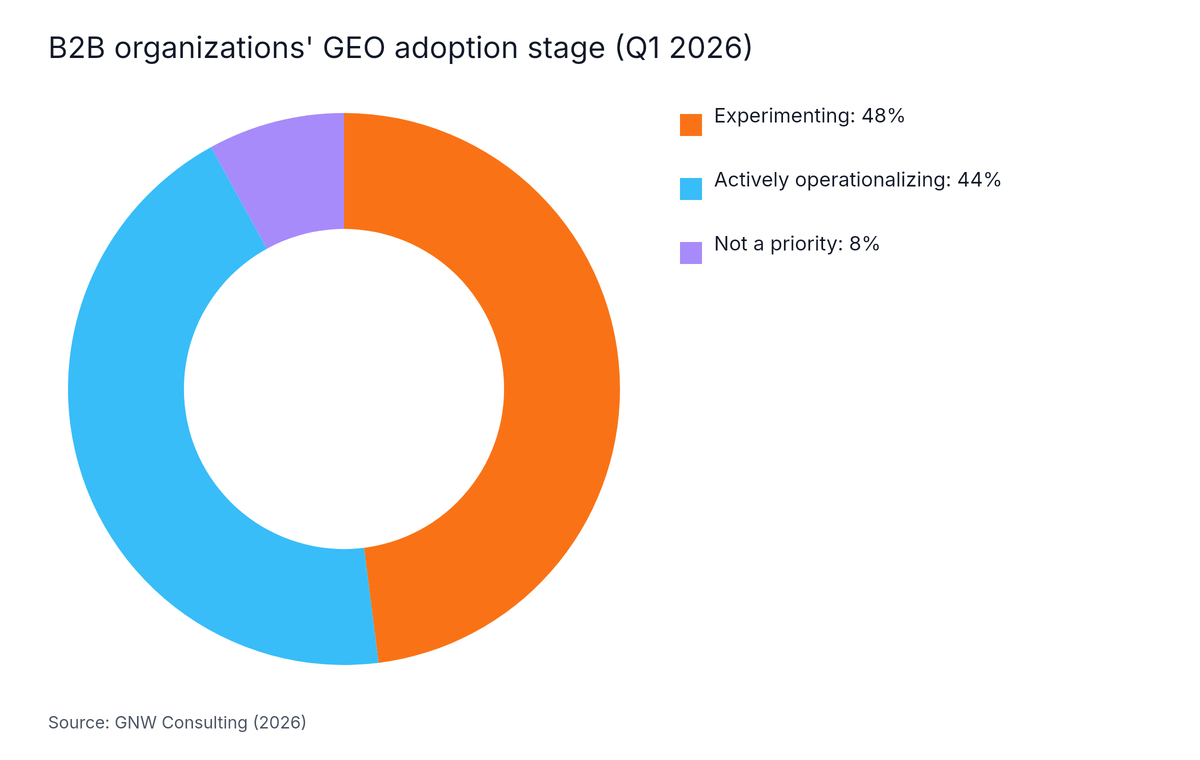
Adoption is moving, though most companies are still early. In Q1 2026, 48% of B2B organizations were experimenting with GEO, 44% were actively operationalizing it and 8% called it not a priority (GNW Consulting, 2026).
Source: GNW Consulting, 2026
Generative engine optimization is mostly an extension of existing SEO spend, not a wholly new line. Omnia's check of five vendors found one that bundles GEO inside an SEO program at $1,000 to $3,000 a month, which shows how much work overlaps with SEO. Only monitoring tools and agency retainers are clearly incremental.

Published GEO retainers across five vendors run from $390 to $10,000 per month (Omnia, 2026). Omnia sells a competing AI visibility product and compiled this sample from vendors' own pricing pages, so every figure drawn from it in this guide is a vendor-compiled number.
The case for funding something is not weak. 69% of software buyers chose a different vendor than planned because of AI chatbot guidance, and 33% bought from a vendor they had never heard of (G2, 2026). G2 is a software review marketplace with a commercial interest in the topic, but the sample was 1,076 B2B software buyers surveyed in March 2026.
Clicks tell a similar story, with a caveat. Click rate on traditional results is 8% when a Google AI summary appears, against 15% when none does (SISTRIX, reporting Pew Research Center, 2025). Pew analyzed 68,879 Google searches from about 900 US adults in March 2025, and Google disputed the methodology.
Our data: The evidence tracked by AEO for B2B SaaS points in two directions. Ahrefs measured that the presence of an AI Overview correlated with a 58% lower average click-through rate (CTR) for the top-ranking page across 300,000 keywords, December 2023 against December 2025 (Ahrefs, February 2026). Seer Interactive reported that CTR on results with an AI Overview rebounded 85% in the first two months of 2026 (Seer Interactive, 2026). Both are measurements with stated samples.
Answer engine optimization (AEO) is the practice of structuring a B2B SaaS site so AI assistants and AI search features cite it when buyers ask category questions. For where AEO and SEO overlap in practice, see AEO vs SEO for B2B SaaS. The table below applies that overlap to budget lines. The classification is an editorial judgment, not a measured result.
| Budget line | Already in SEO budget? | Incremental for GEO? |
|---|---|---|
| Crawler access and robots.txt review | Yes | Small one-off review |
| Content readable without JavaScript | Yes | Only if rendering is broken |
| Answer-first rewrites of key pages | Partly | Editing hours on priority pages |
| Structured data | Yes (SEO value) | No AI-specific lever |
| AI referral filters in analytics | Partly | Small setup time |
| Monitoring tool seat | No | Yes, discretionary |
| Agency retainer | Sometimes bundled | Yes, discretionary |
The fixed foundation of a GEO budget is the technical and editorial work that lets any engine read and quote a page: crawler access, content in raw HTML, and answer-first structure. Google's documentation says no special optimizations are needed for AI Overviews, so this work is mostly standard SEO hygiene, not a separate AI line item.

An engine that cannot read a page cannot cite it. Check robots.txt and bot-protection rules for blocked AI crawlers, and confirm key pages show their content without JavaScript. These checks are cheap, and they were already part of a healthy technical SEO plan.
Direct answers near the top of a page, tables for comparisons and clear headings cost editing time, not software. This is where most of the genuinely new effort sits, but it is also what a good SEO editor already does.
Structured data is markup that describes a page's content in a machine-readable format. Many cost guides budget schema and llms.txt as GEO-specific work. Google's own guidance disagrees. Its AI features documentation states: "There are no additional requirements to appear in AI Overviews or AI Mode, nor other special optimizations necessary" (Google for Developers, 2025). Its May 2026 guide adds: "Structured data isn't required for generative AI search, and there's no special schema.org markup you need to add" (Google for Developers, 2026). Keep structured data in the SEO budget for its search value. Do not count it as a way to win AI citations. For a wider view of how the practice differs, see LLM optimization for B2B SaaS.
Next step: Bring the questions buyers ask about your category and test the plan with a free consultation. Meet with an expert
GEO monitoring tools and agencies are the discretionary part of the budget, and every published price comes from a vendor. Entry-level monitoring runs from $29 to $99 a month, DIY tools from $10 to $1,000+ a month, and agencies from $1,500 to $50,000+ a month. None of these ranges rests on an independent study.
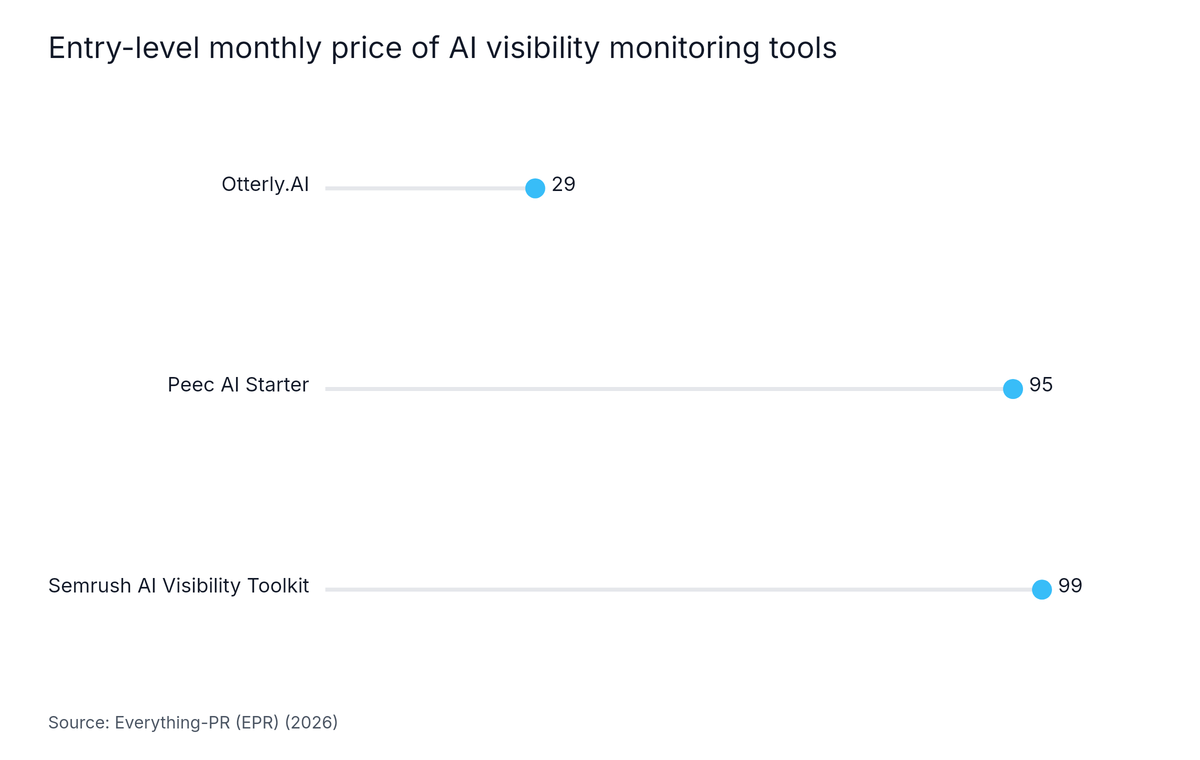
Entry-level AI visibility monitoring starts at $29 a month for Otterly.AI, $95 for Peec AI Starter and $99 a month per domain for the Semrush AI Visibility Toolkit, which covers 25 prompts across four engines (Everything-PR, 2026). Prices change often, so re-check them before buying.
Source: Everything-PR (EPR), 2026
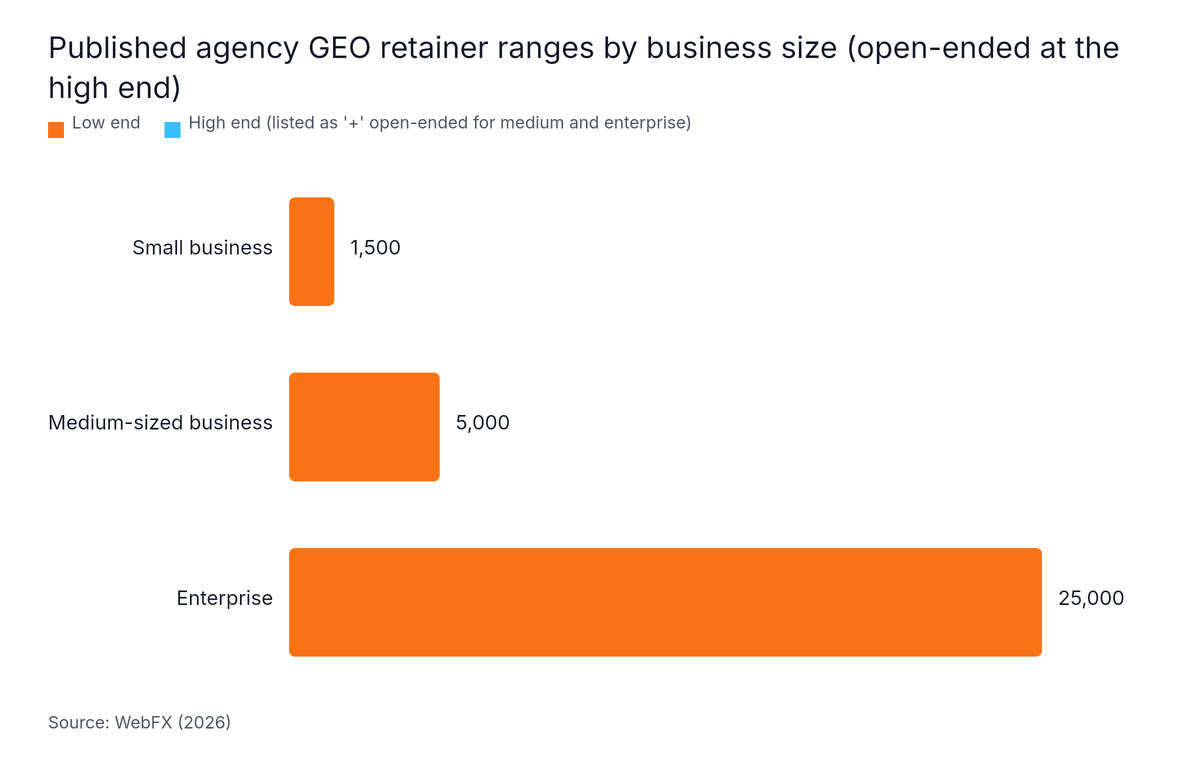
Agency pricing is wider. Published GEO prices run from $10 to $1,000+ per month for DIY tools and $1,500 to $50,000+ per month for agencies, with mid-sized businesses quoted $5,000 to $25,000+ per month (WebFX, 2026). These are agency-published figures, not a market study.
Source: WebFX, 2026
| Option | Published price | Source type |
|---|---|---|
| Entry-level monitoring tools | $29 to $99 per month | Reviewer-read vendor pricing |
| DIY tools | $10 to $1,000+ per month | Agency-published |
| Agency retainers (five vendors) | $390 to $10,000 per month | Vendor-compiled sample |
| Agency retainers (broad range) | $1,500 to $50,000+ per month | Agency-published |
The tool market also moves under buyers' feet. Semrush's Enterprise AI Optimization product drops Microsoft Copilot from its AI visibility tracking on 9 November 2026, which shows that coverage can change during a contract (PPC Land, 2026). Shorter terms and exit clauses are cheaper than lock-in. Compare tool types in this guide to AI search visibility tools.
No independent benchmark exists for the share of marketing spend that belongs to GEO. TripleDart, an agency, suggests 10% to 20% of the organic/SEO budget as a rule of thumb drawn from its own portfolio. Treat it as one practitioner's opinion, and expect most funding to come from reallocating existing SEO and content hours.
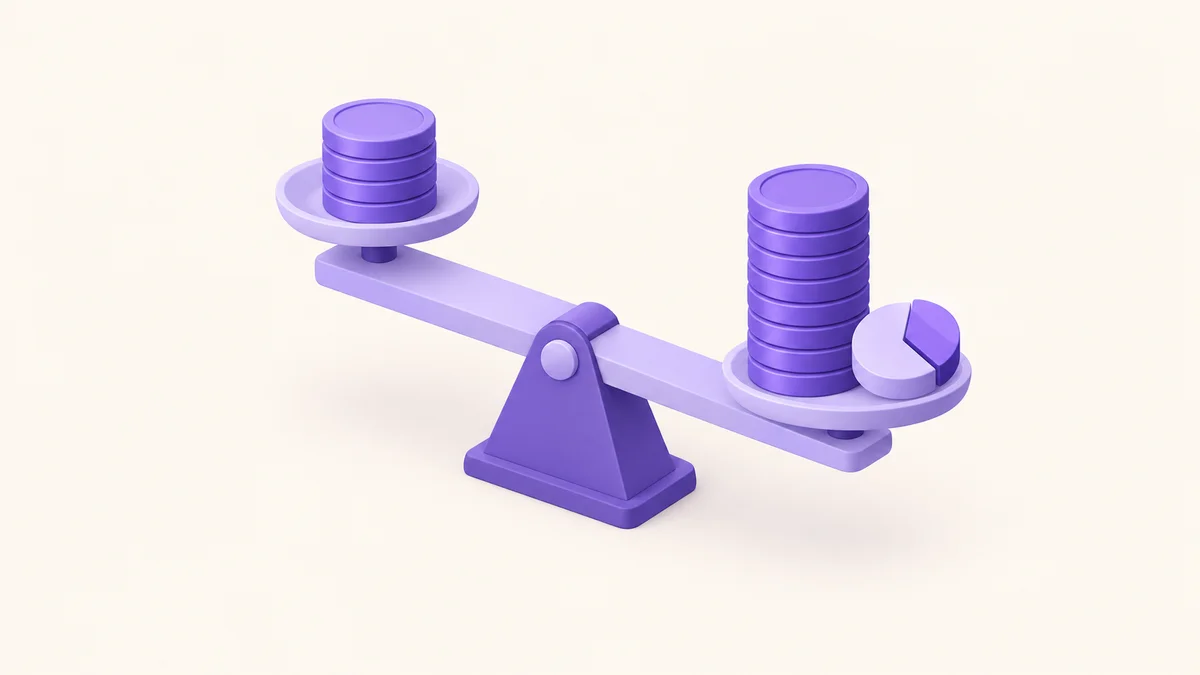
TripleDart's full rule of thumb is GEO at 10% to 20% of the total organic/SEO budget, or 5% to 10% of total marketing spend, with monitoring tools at 10% to 20% of the GEO budget itself (TripleDart, 2026). The agency draws it from its own client portfolio and publishes no dataset.
Budget-planning data suggests money is shifting rather than arriving as a new line. In the Sagefrog 2026 B2B Marketing Mix Report, which surveyed nearly 500 B2B marketers, 30% planned increases for content marketing and 28% for AI tools and applications (Webtonic, quoting Sagefrog, 2026). Webtonic is a secondary re-report, so verify against the original before showing it to a CFO.
| Source | Figure | Type | Caveat |
|---|---|---|---|
| TripleDart, 2026 | 10% to 20% of SEO budget; tools 10% to 20% of GEO budget | Agency opinion | No published dataset |
| Sagefrog 2026 (via Webtonic) | 30% plan content increases; 28% plan AI tools increases | Survey of nearly 500 B2B marketers | Secondary re-report |
| Omnia, 2026 | GEO bundled in an SEO program at $1,000 to $3,000 a month | Vendor pricing page | Vendor-compiled sample |
Use these as bounds for a conversation, not a target. The practical question is which existing SEO or content hours move to GEO tasks.
AI visibility tools are directionally useful but statistically noisy, so test one with a short pilot, a fixed question set and written kill criteria before a long contract. Forbes argued in August 2026 that repeat runs of the same prompt return different brands, yet the numbers remain worth measuring.

Kill criteria are written conditions, agreed before a pilot starts, that trigger cancelling a tool. The Forbes piece makes the case for measuring anyway (Forbes, 2026). That framing suits a budget: spend little, expect noise, and judge the tool by whether it changes a decision.
A pilot plan:
Proposed method: A monthly check of 20+ category questions across five engines is a common baseline proposal for tracking citation rate, description accuracy and competitor presence. It is a proposed method, not a measured result.
For help comparing tool categories before a pilot, see AI search visibility and answer engine optimization tools.
No source reviewed for this guide gives a reliable timeline for generative engine optimization results, so a budget should not promise one. Forbes reported in August 2026 that repeat runs of the same prompt return different brands, so the data is noisy. Judge progress by monthly movement on a fixed question set, not by a deadline.
The Forbes analysis (Forbes, 2026) is also why a single month's change should not trigger a decision. Because no timeline exists, a CFO case works better with checkpoints than with a payback date:
AI referral traffic may be small at first, so report it beside rankings and clicks rather than as a stand-alone return figure.
A generative engine optimization budget built on a fixed foundation plus capped tool spend is not for teams that need a guaranteed citation, a precise ROI figure or an independent price benchmark, because none exist. The best survey evidence is also thin: GNW Consulting collected 310 responses, including partial ones (GNW Consulting, 2026).
Several limits apply. Every price range cited here comes from a vendor or agency, and some of those vendors sell competing products. The G2 figures come from a vendor-adjacent survey of 1,076 buyers (G2, 2026). No source promises a citation or a timeline, and this guide does not either. Companies whose SEO foundation is broken should fix crawler access and rendering first. Those with very large content libraries or complex multi-region sites may need an outside scope assessment that a simple bottom-up estimate cannot give.
No. Google's documentation says no special markup or files are needed to appear in AI Overviews and AI Mode. Structured data that matches visible content still has value for traditional search, so keep it in the SEO budget, but do not fund schema or llms.txt work as a separate lever for AI citation.
No independent study sets a price. Vendor-published ranges run from $10 to $1,000+ a month for DIY tools and $1,500 to $50,000+ a month for agencies (WebFX, 2026), and five vendors' retainers span $390 to $10,000 a month (Omnia, 2026). A bottom-up estimate from internal hours and tool seats is more reliable.
The cheapest start is a free first-party baseline plus a fixed question set. Bing Webmaster Tools opened an AI Performance dashboard in public preview on 10 February 2026. Pair it with a monthly manual check of 20 or more buyer questions across the main engines before paying for any tracking tool.
Start in-house on the fixed foundation, because crawler access, rendering and content structure overlap with existing SEO work. Consider an agency only for a specific gap you can name. Published agency pricing comes from the agencies themselves, so ask for scope and exit terms rather than relying on a headline retainer.
No. A top 10 ranking does not guarantee a citation from ChatGPT or Google AI Overviews. Published overlap between cited sources and top results varies widely by study and engine, and Google says no additional requirements apply to appear in AI Overviews (Google for Developers, 2025). Check citations directly with a fixed question set.
Prove generative engine optimization ROI with checkpoints rather than a payback figure, because AI referral traffic can be small and citation data is noisy. Report citation rate and brand description accuracy on a fixed question set monthly, show AI referrals beside clicks and rankings, and tie each pilot to a keep-or-cancel decision.
No source reviewed for this guide gives a reliable timeline, and no honest budget should promise one. AI visibility numbers also vary between repeat runs of the same prompt. Track monthly movement on a fixed set of buyer questions, and set review dates for each pilot instead of a results deadline.
A generative engine optimization budget is easier to defend when it is split in two. Leadership can approve the foundation as SEO hygiene and review the rest against evidence.
The next step is to list your foundation hours and mark which already sit in the SEO plan. For the wider picture, read which brands are investing in generative engine optimization.
Written by
Ishan Manchanda
Ishan Manchanda is co-founder of GrowthSpree, a B2B SaaS marketing consultancy founded in 2017 that has managed $60M+ in ad spend across 300+ B2B SaaS companies. He focuses on demand generation, go-to-market strategy and pipeline growth, and has been featured in Silicon Valley Times, SaaS Mag and the Unbounce podcast.