generative engine optimization brands innovationbrand visibility ai searchhow to track brand visibility in ai search
What Is Generative Engine Optimization and Which Brands Are Investing in It?
Generative engine optimization (GEO) for B2B SaaS: what it is, how it differs from SEO, which brands invest in it, and how to improve AI search visibility.
Oct 21, 2026
Last updated: Oct 21, 2026
What Is Generative Engine Optimization and Which Brands Are Investing in It?
Request a quote and our experts will contact you within 24 hours with tailored solutions and pricing.
By AEO for B2B SaaS Editorial Team
Generative engine optimization (GEO) is the practice of structuring content so that AI assistants choose to cite it in generated answers - and B2B SaaS brands are investing in it because buyers now ask AI tools for vendor shortlists before talking to sales.
The buying pattern behind this shift is concrete. A prospective customer asks ChatGPT, Perplexity, or Google's AI Overview for a shortlist of tools in a category. If a B2B SaaS brand is not named in that answer, it does not exist in that buyer's consideration set - regardless of where it ranks in traditional search. AI assistants are now documented as answering category and vendor questions directly across ChatGPT, Perplexity, Gemini, Claude, and Google AI Overviews, replacing the list of links with a generated response.
This page explains what generative engine optimization is, how it relates to answer engine optimization (AEO) and search engine optimization (SEO), which types of B2B SaaS brands are prioritising it, and what the first practical steps look like.
Key Takeaways
Generative engine optimization (GEO) and answer engine optimization (AEO) describe the same core discipline: structuring content so AI engines cite it in generated answers.
B2B SaaS brands with category-level buyer questions are most exposed: if an AI assistant does not name the brand, the brand is absent from the shortlist.
An Ahrefs study across 300,000 keywords found a 58% lower average click-through rate (CTR) for top-ranking pages on queries with an AI Overview (December 2023 vs December 2025), making citation valuable even when the click does not arrive (Ahrefs, February 4, 2026).
The first measurable step is a monthly check of 20 or more buyer questions across five engines, tracking which brands get cited and how each product is described.
Technical accessibility matters: AI crawlers cannot cite a page they cannot read.
What GEO Means and How It Differs from SEO
Generative engine optimization (GEO) is the practice of structuring content so that AI assistants - ChatGPT, Perplexity, Gemini, Claude, and Google AI Overviews - choose to cite it when a buyer asks a category or vendor question. It overlaps with search engine optimization (SEO) in technical foundations but differs in content design and measurement: SEO targets a ranked position in a list of links; GEO targets being quoted or paraphrased inside an AI-generated answer.
Abstract 3D sculptural spheres in violet and ink tones representing AI citation signals
Generative engine optimization (GEO) is a term used in research and practitioner contexts for the same set of practices also called answer engine optimization (AEO) or large language model (LLM) optimization. All three refer to making content legible and usable to AI-powered answer systems that generate a response rather than returning a ranked list of links. The terms overlap substantially, and none has a universally agreed definition.
The distinction from SEO is real but partial. Search engine optimization (SEO) targets a ranked position in a list of links. GEO targets being quoted, paraphrased, or linked inside an AI-generated answer. Both share technical foundations - crawlability, structured data, page speed, and canonical signals all matter to both - but they diverge in how pages are written and how success is measured.
Which types of B2B SaaS brands are investing?
The brands prioritising GEO share a common characteristic: their buyers already use AI assistants to research categories and compare vendors before talking to sales. That pattern spans a wide range of sub-verticals.
Brand type
Why GEO is urgent
Category-defining SaaS tools
Buyers ask "what is the best [category] tool" directly to an AI assistant
Niche B2B platforms (sales intelligence, HR tech, RevOps, data infrastructure)
Vendor comparisons are the dominant pre-purchase research pattern
Early-stage SaaS with little search volume
AI citation is an earlier discovery path than ranked organic search
Any brand whose CEO has queried ChatGPT and not found the company
The absence is visible at board level and becomes a funding question
The common trigger is concrete: the chief executive or a board member asks ChatGPT about the category and the company is not named in the answer. That moment - not a traffic report - tends to be what funds the work.
How AEO for B2B SaaS approaches this: AEO for B2B SaaS runs the same technical baseline it recommends - content in raw HTML, schema markup, a sitemap, an llms.txt file, and explicit crawler access in robots.txt - and tracks citation rate monthly across five engines. The site functions as a live worked example of the checklist it covers.
How to Get My Brand Cited by AI Assistants?
Getting a B2B SaaS brand cited by AI assistants requires content that answers buyer questions directly, structured so an engine can extract a single passage without reading the whole page. The core conditions are: a direct answer in the first 40 to 80 words of every page, tables and structured lists, the brand and product named explicitly in every section, and pages readable in raw HTML without JavaScript execution.
Abstract 3D stacked flat planes in violet and off-white representing structured content layers
AI assistants do not browse a site the way a human does. They extract. An answer to a buyer question needs to sit at the top of the page, name its subject clearly, and carry specific, verifiable claims. A page that buries its answer below three paragraphs of context - or that requires JavaScript to render its content - gives an engine nothing usable to work with.
Content practices that support citation
The following factors apply across the major AI engines, though each engine's documented citation behavior differs. These are practical conditions, not guarantees of a citation:
Factor
What it means for a B2B SaaS page
Answer-first structure
Place a direct 40-80 word answer at the top of every page and every major section
Named entities
Name the product, category, and brand in every section, not just once per page
Specific claims
Include verifiable figures, dates, and named sources where they exist
Tables and lists
Structure comparisons, specs, and steps as tables or lists, not in prose
FAQ content
Answer the exact questions buyers ask, one question per H3, answered in the first sentence
Crawlable HTML
Ensure key content is in raw HTML, not dependent on JavaScript to render
Structured data
Use schema markup that matches what is visible on the page
Technical conditions for citation
A page that passes all content tests can still be invisible to an AI engine if it is technically inaccessible. The minimum technical baseline includes:
Content accessible in raw HTML (not requiring JavaScript execution)
AI crawlers explicitly permitted in robots.txt, not blocked by default bot-protection rules
Schema markup present and matching the page's visible content
An XML sitemap that signals content freshness
A reviewed llms.txt file, where relevant
llms.txt is a proposed file convention - not confirmed as a standard by any major engine in their published documentation - that signals to AI crawlers which content on a site is intended for ingestion. Whether major engines act on it is not confirmed in published engine guidance.
How Do I Improve a B2B SaaS Brand's Visibility in AI Search Results?
Improving a B2B SaaS brand's visibility in AI search results means making every page answerable, crawlable, and credible to an AI engine. An Ahrefs study across 300,000 keywords found that the presence of an AI Overview correlated with a 58% lower average click-through rate (CTR) for the top-ranking page, comparing December 2023 against December 2025 (Ahrefs, February 4, 2026). Being cited in the AI-generated answer carries value whether or not a click follows.
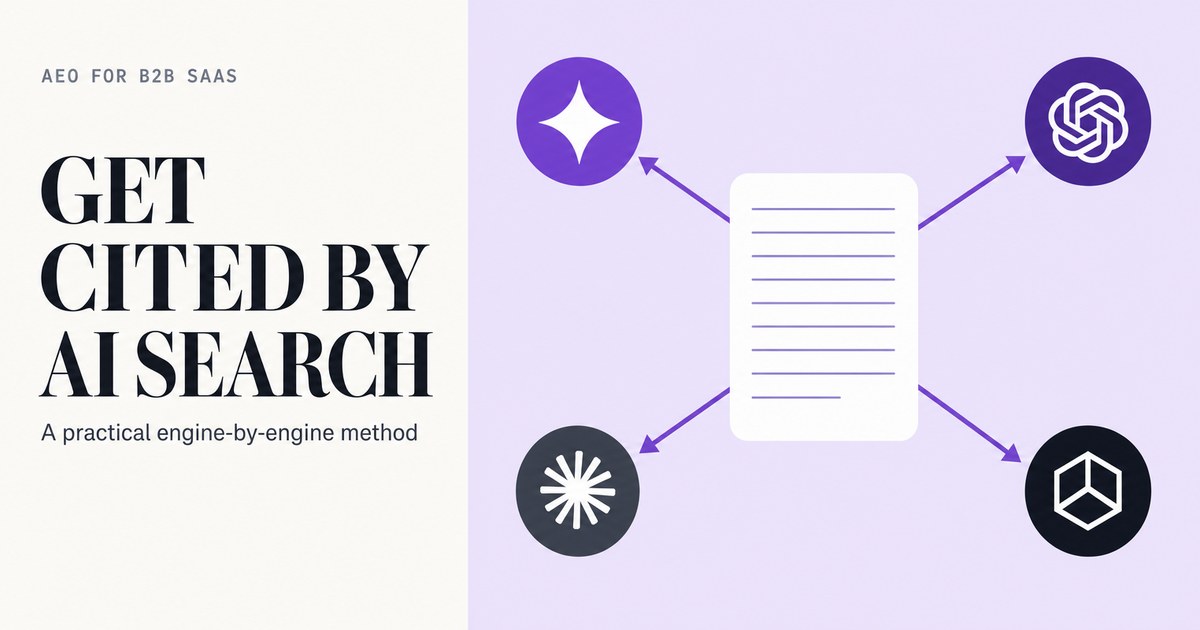
Abstract 3D network of nodes and arcs in violet symbolising AI engine citation connections
For B2B SaaS brands, the implication of the click-through rate data is the same in both directions: a brand that earns the citation is present in the buyer's consideration set even on queries where no click is recorded. A brand that ranks below an AI Overview without a citation is effectively invisible to that buyer.
Priority improvements by page type
Different page types require different approaches to support AI citation:
Page type
Primary citation factor
Common gap
Category or pillar page
Direct definition in the first paragraph, named competitors for comparison
Definition buried below background context
Comparison page
Table with named options and specific attributes
Comparisons written in prose with no structured format
Pricing page
Named tiers with specific figures or ranges
Pricing content gated or absent entirely
Integration page
Named integrations with explicit use cases
Generic integration lists with no buyer context
FAQ page
Each question answered in the first sentence of its section
Questions answered over multiple paragraphs
The role of credibility signals
AI engines draw on credibility signals as well as content structure. These include: content that cites named sources with dates, pages that have been crawled and indexed by traditional search engines, and structured data that matches visible content. None of these guarantees a citation, but each makes the page a more viable source for an engine to extract from.
The measurement side matters too. A practical baseline involves selecting 20 or more category and buyer questions, checking each across five engines monthly, and recording whether the site is cited, how the product is described, and which competitors appear alongside it. This approach - proposed by GrowthSpree blog (2026) - gives a repeatable monthly snapshot without requiring specialist tooling.
How to Get My Brand Cited by AI Platforms?
Getting a B2B SaaS brand cited by AI platforms - including ChatGPT, Perplexity, Gemini, Claude, and Microsoft Copilot - depends on three conditions: the page must be technically accessible to AI crawlers, the content must answer the buyer's question in a form the engine can extract, and the brand and product must be named explicitly. These three conditions apply across all major platforms, though each engine has its own documented crawling and citation behavior.
Abstract 3D concentric rings in ink and violet tones symbolising AI brand visibility measurement
Each major AI platform has published some guidance on how it selects sources. The specifics differ. Perplexity documents that it uses a web index and retrieves sources in response to queries. Google has published guidance on how AI Overviews select sources, including the role of structured data, page quality, and crawlability. OpenAI has published guidance for ChatGPT's web-browsing behavior. The documented rules are not identical across platforms, so a page structured for one engine may still underperform on another.
Cross-platform citation principles
Despite differences in documented behavior, several factors appear consistently across the major platforms' published guidance:
The brand and product name must appear explicitly, not just by implication.
The page must be crawlable: crawler access blocked in robots.txt removes citation opportunity.
Answers must be self-contained: a passage that requires reading the whole page to make sense is harder for an engine to extract and attribute correctly.
Fresh, dated content signals relevance: a last-updated date on every page is a basic freshness signal.
Microsoft Copilot draws from Bing's web index. Claude, Anthropic's AI assistant, retrieves web sources for browsing-enabled queries. Both are distinct from ChatGPT (OpenAI) and Perplexity in their documented retrieval behavior. The practical implication for a B2B SaaS brand is that technical accessibility and answer-first content structure serve all platforms simultaneously, while platform-specific review addresses each engine's individual documented criteria.
Who This Is Not For
Generative engine optimization is not the right priority for every B2B SaaS company. If a site has no content addressing buyer questions, or if the company's buyers do not use AI assistants in their research process, GEO and answer engine optimization (AEO) work sits below more foundational content and technical priorities. A citation that misrepresents a product damages rather than builds trust, so accuracy and structure are prerequisites.
GEO is also not appropriate if a site is technically inaccessible. JavaScript-dependent rendering, blocked crawlers, and absent structured data need resolving before content strategy can deliver citation value. The Ahrefs data showing a 58% CTR correlation on AI Overview queries (Ahrefs, February 4, 2026) can make GEO feel urgent. A pricing page with outdated figures, a comparison page that misrepresents competitors, or a category page that makes unsupported claims can attract a citation that harms rather than helps. Fix accuracy first.
Frequently Asked Questions
How to track brand visibility in AI search?
Tracking brand visibility in AI search starts with a fixed set of 20 or more category and buyer questions, checked monthly across five engines: ChatGPT, Perplexity, Gemini, Claude, and Google AI Overviews. For each query, record whether the brand is cited, how the product is described, and which competitors appear. Separate AI referral traffic in analytics by filtering for domains such as chatgpt.com and perplexity.ai. This gives a repeatable monthly snapshot without specialist tooling.
What is answer engine optimization for B2B SaaS?
Answer engine optimization (AEO) is the practice of structuring a B2B SaaS site and its content so that AI assistants - ChatGPT, Perplexity, Gemini, Claude, Microsoft Copilot - and Google's AI features choose to cite it when a buyer asks a category or vendor question. AEO overlaps with SEO in technical foundations but differs in how pages are written and measured. The term generative engine optimization (GEO) is used by some researchers for the same discipline.
Is GEO the same as AEO or LLM optimization?
Generative engine optimization (GEO), answer engine optimization (AEO), and large language model (LLM) optimization are overlapping terms describing the same core practice: making content legible and usable to AI-powered answer systems. GEO originates in research contexts. AEO is widely used by practitioners. LLM optimization emphasises the model layer specifically. None of the three terms has a universally agreed definition, and the boundaries between them are not fixed.
Do AI Overviews reduce clicks to B2B SaaS sites?
The evidence points in two directions. Ahrefs measured a 58% lower average click-through rate for top-ranking pages on queries with an AI Overview, across 300,000 keywords, comparing December 2023 against December 2025 (Ahrefs, February 4, 2026). For B2B SaaS content, being cited in the AI answer matters regardless of whether a click follows - an absent brand is an absent shortlist entry.
Should AI crawlers be allowed in robots.txt?
Blocking AI crawlers in robots.txt prevents engines from reading and potentially citing a page. If a page is already public and indexed by traditional search engines, blocking AI crawlers reduces citation opportunity without a corresponding benefit. The crawler names used by major AI platforms differ, so robots.txt needs to be reviewed and set intentionally rather than left at a default that may block crawlers by accident. This is a technical decision with direct implications for AI citation.
Start With a Fixed Question Set
Generative engine optimization is the practice of earning a citation in an AI-generated answer, rather than a ranked position in a traditional search result. For B2B SaaS brands, the stakes are direct: if an AI assistant does not name the brand when a buyer asks about the category, the brand is absent from the consideration set.
The content and technical conditions that support citation are practical and measurable. Answer-first structure, named entities, specific claims, structured data, and crawler access form the baseline. Tracking citation starts with a fixed question set checked monthly across five engines: ChatGPT, Perplexity, Gemini, Claude, and Google AI Overviews.
The Ahrefs study across 300,000 keywords found a 58% CTR correlation with AI Overview presence. What that finding does not contradict is that the citation itself carries value, whether or not the click follows. Be the answer, not the tenth blue link.
The next step is defining the buyer questions a brand should own, then checking each one across the major engines. That baseline is the foundation for everything that follows.
Meet with an expert. A free consultation. Bring the questions buyers ask about your category and brainstorm how to get cited. Book a session at AEO for B2B SaaS.