What Content Structure Gets a B2B SaaS Page Cited in AI-Generated Answers?
best content strategies to get cited by ai modelshow to get cited by aiwhat makes content get cited by ai models
What Content Structure Gets a B2B SaaS Page Cited in AI-Generated Answers?
Content strategies to get cited by AI models: what the evidence says about question match, early answers, freshness, schema and llms.txt for B2B SaaS pages.
Request a quote and our experts will contact you within 24 hours with tailored solutions and pricing.
What Content Structure Gets a B2B SaaS Page Cited in AI-Generated Answers?
By AEO for B2B SaaS Editorial Team. Last updated November 4, 2026.
The best content strategies to get cited by AI models for a B2B SaaS page are to match the buyer question in the title and paragraphs, put the direct answer first, and make the page easy to retrieve. That is the working core of answer engine optimization (AEO), covered in what answer engine optimization means.
Teams feel the pressure in clicks. Ahrefs measured that an AI Overview correlated with a 58% lower average click-through rate (CTR) for the top-ranking page across 300,000 keywords, December 2023 vs December 2025 (Ahrefs, February 2026). This guide separates tactics backed by controlled experiments from those backed only by correlation, then maps the advice to B2B SaaS page types.
Key Takeaways
A B2B SaaS page is cited more often when its title and paragraphs match the buyer question, according to an October 2026 arXiv preprint.
A page must be retrieved before it can be cited, and a source's position in the retrieved set shifts its chance of citation.
Heading hierarchy and freshness are correlated with citation in vendor datasets, but those datasets do not prove cause.
Google's May 2026 guide says structured data is not required for generative AI search and that llms.txt is not needed.
ChatGPT, Perplexity and Google AI Overviews cite different source types, so B2B SaaS teams need on-site structure and off-site presence.
What content structure gets a B2B SaaS page cited in AI-generated answers?
A B2B SaaS page gets cited in AI-generated answers when its title and paragraphs match the buyer question, the direct answer comes early, and the page is easy for an engine to retrieve. In an October 2026 preprint, the study authors found that "pages whose title and paragraphs match the questions people ask are cited more" (Study authors, arXiv, 2026).
Content strategist marking up a printed B2B SaaS page with a highlighter at a bright desk
A citation is a named source link or mention inside an AI-generated answer. A controlled experiment changes one factor and holds the rest fixed. A correlation only shows that two things appear together. The table sorts common advice by the strength of its evidence.
Tactic
Evidence type
What the source shows
Match title and paragraphs to the buyer question
Controlled experiment (preprint)
Lifts citations within a site
Earn an early position in the retrieved set
Controlled experiment (preprint)
Sources shown first are cited more than sources shown last
A practical order of work follows from that evidence:
Write the buyer question as the heading, in the buyer's own words.
Put a 40 to 80 word direct answer under it, before any image or list.
Add the specifics an engine can lift: figures, named entities, tables.
Keep headings in a clean H1, H2, H3 order.
Refresh commercial pages when the facts change, and show the real date.
An AI Overview is a Google-generated summary shown on the results page, with links to the sources it draws on. Click evidence on AI Overviews points both ways.
What the click data shows: Ahrefs (February 2026) measured a 58% lower average CTR for the top-ranking page when an AI Overview was present, across 300,000 keywords, December 2023 vs December 2025.
Seer Interactive reported that CTR on results with an AI Overview rebounded 85% in the first two months of 2026. It also found informational results without one rose from 2.93% to 3.97% CTR across 901 million impressions in 2025.
Both readings are measurements, not predictions.
Why does retrieval come before citation?
Retrieval is the step where an answer engine gathers candidate pages for a question, and citation selection is the step where it chooses which candidates to name. A page can only be cited after it is retrieved. In a controlled experiment, the same source was cited in 60% of ChatGPT's answers when shown first, against 43% when shown last (arXiv preprint, 2026).
Eight printed source cards laid out in a row on a table, with one card pulled to the front
The experiment showed 8 real sources for each of 100 questions in all 8 orders, which produced 9,600 answers. It is a preprint and has not been peer-reviewed. The gap was 17.6 points, so position inside the retrieved set matters about as much as page content.
A second preprint, published in May 2026, tested 18 content factors across six large language models (LLMs). Its authors concluded that "topical relevance and list position are the biggest drivers of being cited first" (Study authors, arXiv, 2026).
Two practical points follow:
Ranking is not the gate. AirOps reported that roughly 60% of Google AI Overview citations come from URLs not ranking in the top 20 organic results (AirOps, 2025). This is a vendor dataset, so read it as a direction.
A link is not guaranteed. An engine can name a brand from model memory without citing a page. Pages still matter, but they are one input.
Which structure tactics have evidence behind them?
Two structure tactics have controlled evidence behind them: matching titles and paragraphs to the buyer question, and earning an early position in the retrieved set. Heading hierarchy and freshness rest on vendor correlations. AirOps found that 68.7% of pages cited in ChatGPT follow logical heading hierarchies (AirOps, 2025), which shows a pattern, not a cause.
Two colleagues reviewing a printed outline of headings and a short checklist
Do headings and schema raise citation rates?
AirOps also reported 2.8× higher citation rates for pages with sequential headings and rich schema (AirOps, 2025). That figure is a correlation, and it bundles the two effects together. Treat clean headings as good practice, not as a proven lever.
Schema markup is structured data added to a page that describes its content to machines. Google's guidance is direct: "Structured data isn't required for generative AI search, and there's no special schema.org markup you need to add." (Google Search Central, 2026). The October 2026 preprint found that FAQ blocks, structured data, summary boxes and page speed show effects only across websites, not within a site.
Does llms.txt help?
The llms.txt file is a proposed convention, not a standard adopted by any major engine, meant to signal which site content is intended for AI ingestion. Google's May 2026 guide says llms.txt and content "chunking" are not needed (Google for Developers, 2026), and Search Engine Journal reported the same in 2026.
How often should B2B SaaS pages be refreshed?
AirOps found that more than 60% of commercial citations surface pages refreshed within six months (AirOps, 2025). Refresh when facts change, such as pricing or integrations. A changed date without changed content adds nothing a reader can verify.
A free consultation can help turn this into a page-by-page plan. Meet with an expert: bring the questions buyers ask about your category and brainstorm how to get cited.
How do ChatGPT, Perplexity and Google AI Overviews differ for B2B SaaS pages?
ChatGPT, Perplexity and Google AI Overviews cite different kinds of sources for B2B SaaS questions, so one page cannot cover every engine. VisibleIQ found that 74.6% of ChatGPT (GPT-5.4) product and comparison citations went to vendor websites (VisibleIQ, 2026), while Perplexity supplied more than 71% of the citations G2 earned in a separate study (Overthink Group, 2026).
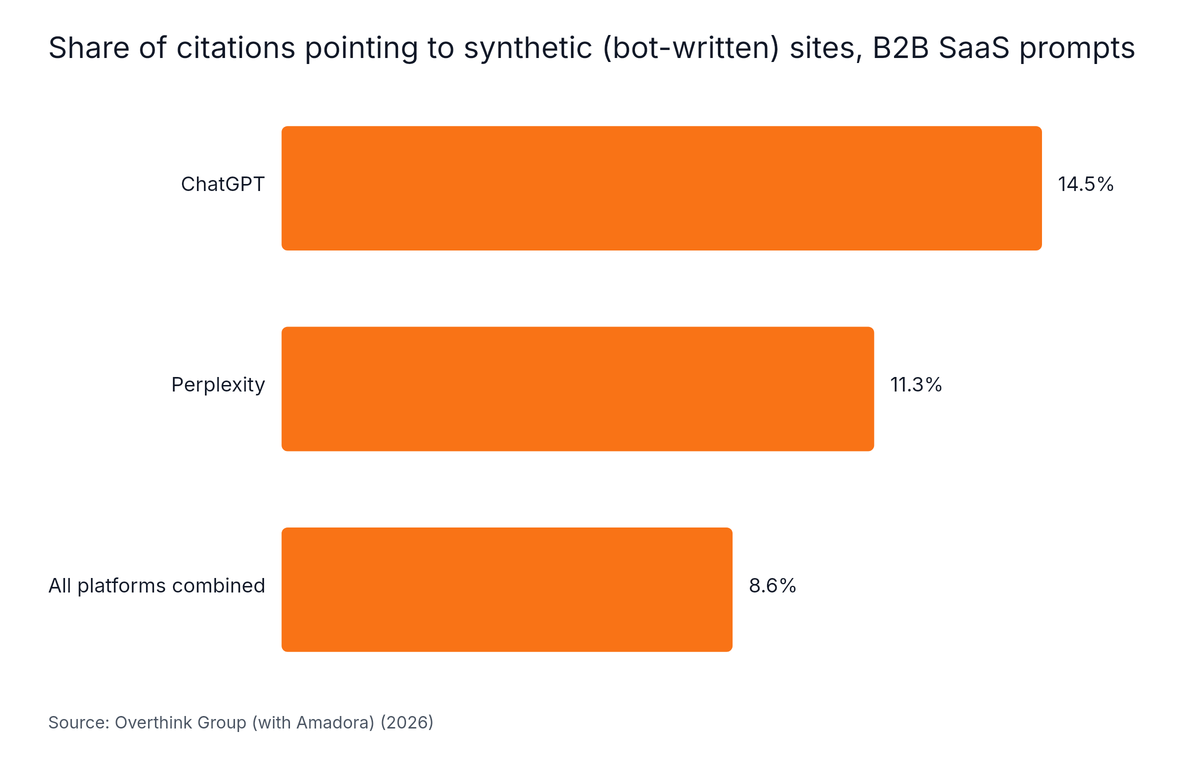
Horizontal Bar chart: Share of citations pointing to synthetic (bot-written) sites, B2B SaaS prompts. Highest: ChatGPT at 14.5%.
The Overthink Group study ran 1,263 solution-aware B2B SaaS prompts for one business week. It found that 14.5% of ChatGPT citations and 11.3% of Perplexity citations pointed to synthetic sites (Overthink Group, 2026). Citation does not always reward quality.
Engine
Documented pattern
Source and sample
ChatGPT (GPT-5.4)
Most product and comparison citations go to vendor websites
VisibleIQ, 2,391 citations, 75 B2B SaaS queries, March 2026
Perplexity
Supplies most of the citations G2 earns
Overthink Group, 1,263 prompts, one business week, 2026
Google AI Overviews
A large share of citations come from outside the top 20 organic results
AirOps vendor dataset, correlational, 2025
Google AI Overviews and Gemini
Lean toward citing vendors
Overthink Group, 2026
Overthink Group's and VisibleIQ's findings differ in scope, because the studies use different prompts and methods. Overthink Group summarized its result this way: "Google AIOs and Gemini are far more likely to cite actual vendors than ChatGPT and Perplexity" (Overthink Group, 2026). Both are small prompt sets, so read them as directional.
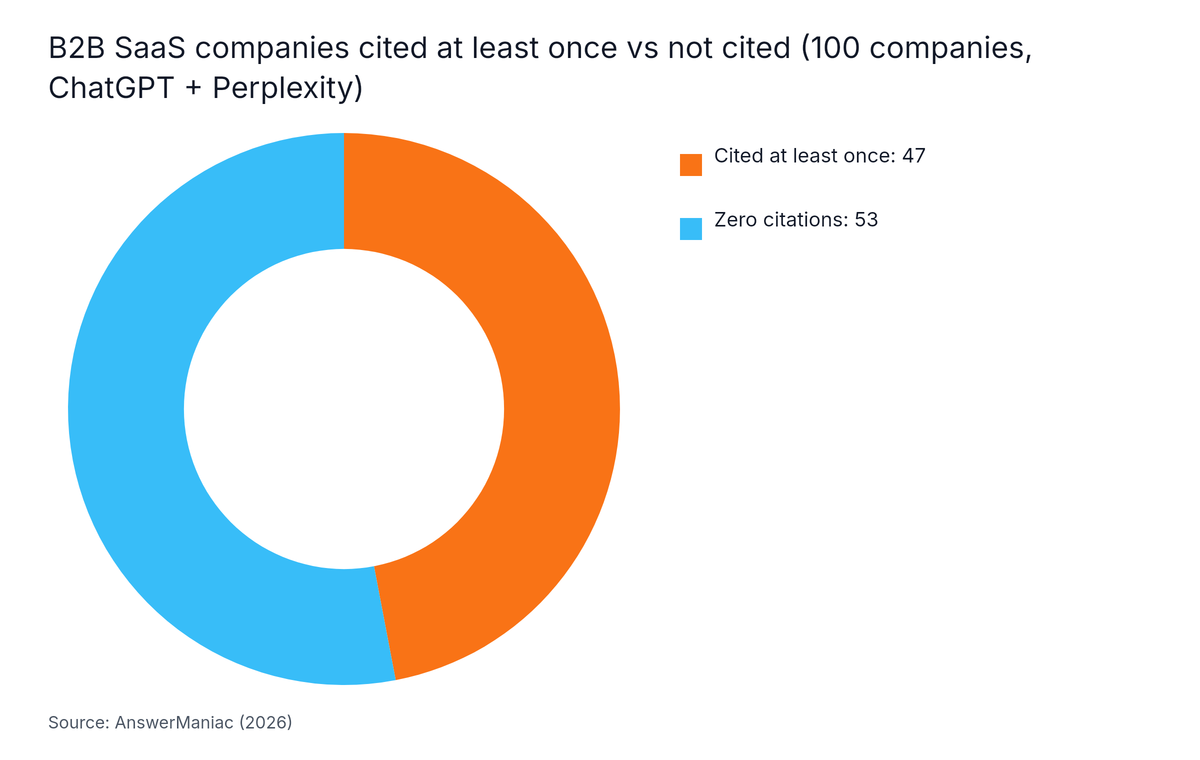
The baseline is low. In the AnswerManiac Q2 2026 report, 53 of 100 B2B SaaS companies received zero citations across ChatGPT and Perplexity, and 47 were cited at least once (AnswerManiac, 2026). The test used 42 buyer-intent queries, once each.
Donut chart: B2B SaaS companies cited at least once vs not cited (100 companies, ChatGPT + Perplexity). Highest: Zero citations at 53.
The practical lesson is to pair on-site structure with off-site presence, such as review-site listings. That also answers a common founder question: when an AI assistant names competitors and not your product, thin retrieval position and thin third-party presence are likelier causes than a missing file. For engine-specific detail, see how to get cited by Gemini.
How should B2B SaaS page types be written to be cited?
B2B SaaS page types should each open with the buyer question and a direct answer, then give the facts an engine can lift: a table for comparisons, exact figures for pricing, named tools for integrations. Vendor pages are worth structuring because ChatGPT cited vendor websites for most product and comparison queries in the VisibleIQ study (VisibleIQ, 2026).
Marketer comparing printed answer pages from different AI assistants side by side
No study tests structure by page type yet, so the table below is editorial guidance built on the question-match finding, not a measured result.
Page type
Open with
Structure that gives engines something to lift
Comparison or alternatives page
The buyer question, such as "Which tool fits a team of this size?"
A table with stated criteria and honest trade-offs
Pricing page
The price range and what it includes
Exact figures, plan limits, billing terms
Integration page
The named tool and what the integration does
Setup steps, supported data, known limits
Case study
The result and the customer's size
Specific figures labeled as the company's own data
Third-party "best X" lists reportedly win more citations than self-promotional ones, but this packet holds no verified primary measurement of that. A vendor's own "best X" page should therefore state its criteria and admit trade-offs. The same question-match logic applies: write each page for one buyer question, not for a keyword cluster.
Who is this guidance not for, and where is the evidence thin?
Guidance on content structure for B2B SaaS pages does not fit teams that want a guaranteed citation, because no engine publishes one, and the evidence is thinner than most guides imply. The strongest result is a preprint, not yet peer-reviewed, and the AnswerManiac benchmark tested 100 B2B SaaS companies once each (AnswerManiac, 2026), so treat every figure as directional.
Researcher reading a thick printed report with sticky notes marking cautions
Specific limits to keep in mind:
Preprints. Both arXiv papers are preprints. Their controlled designs are strong, but peer review has not confirmed them.
Vendor data. The AirOps figures come from a vendor's own composite dataset and are correlational. Heading and schema effects are bundled together.
Small samples. The AnswerManiac study ran each query once. Single runs are noisy, so repeat tests matter.
Engine drift. Engines change. A finding about GPT-5.4 in March 2026 may not hold for a later model.
No promises. Following this guidance does not guarantee a citation or set a date for one.
Does schema markup help a B2B SaaS page get cited in AI answers?
Schema markup has no documented special role in AI citation. Google Search Central states "Structured data isn't required for generative AI search, and there's no special schema.org markup you need to add." (Google Search Central, 2026). Structured data that matches visible content still supports rich results, so keep it accurate without expecting it to drive citations.
Do I need an llms.txt file to be cited by AI models?
A B2B SaaS site does not need an llms.txt file to be cited by AI models. The file is a proposed convention, not a standard adopted by any major engine, and Google's May 2026 guide says llms.txt is not needed (Google for Developers, 2026). Time is better spent on direct answers, crawler access and refreshed pages.
Do question-style headings and first-paragraph answers increase AI citations?
Question-style headings help when the title and paragraphs genuinely match the buyer question. An October 2026 arXiv preprint found that question-matching titles and paragraphs lift citations within a site (arXiv, 2026). The match is what counts, so the first paragraph under each heading should answer that question directly.
Do I need to rank in Google's top 10 to appear in AI Overviews?
A page does not need a top 10 Google ranking to appear in AI Overviews. AirOps reported in 2025 that roughly 60% of Google AI Overview citations come from URLs not ranking in the top 20 organic results (AirOps, 2025). Rank and citation are separate outcomes, so a lower-ranked page with a precise answer can still be cited.
Why does AI recommend my competitors and not my B2B SaaS product?
AI assistants often skip B2B SaaS vendors entirely. AnswerManiac found in 2026 that 53 of 100 B2B SaaS companies received zero citations on ChatGPT and Perplexity (AnswerManiac, 2026). Common causes in the evidence are pages that do not match the buyer question, weak retrieval position and thin off-site presence such as review sites.
Is generative engine optimization different from SEO?
Generative engine optimization (GEO) is an overlapping term for the work answer engine optimization describes, and Google's May 2026 guide treats both as part of search engine optimization (SEO), as Search Engine Journal reported in 2026. The shared base is crawlable, useful pages; the difference is mostly in how pages are written and measured.
Conclusion
The evidence points to a short list of moves for B2B SaaS teams:
Match each page's title and paragraphs to one buyer question.
Put the direct answer first, since position in the retrieved set shifts citation odds.
Keep headings clean and refresh commercial pages when facts change, treating both as correlated, not proven.
Skip llms.txt and special schema as citation tactics; Google says neither is needed.
Pair on-site structure with off-site presence, because engines cite different source types.
The next step is small: pick the 20 buyer questions that matter most in your category, check which pages answer them in the first 80 words, and rewrite the weakest first. To see how the work compares with SEO, read LLM optimization for B2B SaaS. Be the answer, not the tenth blue link.
Written by
Ishan Manchanda
Ishan Manchanda is co-founder of GrowthSpree, a B2B SaaS marketing consultancy founded in 2017 that has managed $60M+ in ad spend across 300+ B2B SaaS companies. He focuses on demand generation, go-to-market strategy and pipeline growth, and has been featured in Silicon Valley Times, SaaS Mag and the Unbounce podcast.
 Ishan ManchandaNov 9, 2026