Is Answer Engine Optimization Worth It for B2B SaaS? ROI, Costs, and When to Start
is answer engine optimization worth itgeo vs seo agency roi b2b saasaeo vs seo for b2b saas content
Is Answer Engine Optimization Worth It for B2B SaaS? ROI, Costs, and When to Start
Is answer engine optimization worth it for B2B SaaS? Measured evidence on clicks and ROI, agency and tool costs, and the trigger events that justify starting.
Request a quote and our experts will contact you within 24 hours with tailored solutions and pricing.
Is Answer Engine Optimization Worth It for B2B SaaS? ROI, Costs, and When to Start
Answer engine optimization (AEO) for B2B SaaS is the practice of structuring pages so AI assistants cite them in answers, and it is worth funding in measured steps. Leadership teams ask a fair question: is answer engine optimization worth it, or is it search engine optimization (SEO) renamed? The evidence points both ways. Buyers use AI to research vendors, yet clicks fall when AI summaries appear and AI visitors convert only modestly. This page covers returns, costs, agency tests, trigger events and limits, building on the AEO vs SEO overlap.
Key Takeaways
Answer engine optimization for B2B SaaS is backed by buyer behavior: a G2 press release reported that 51% of B2B software buyers now start research in an AI chatbot (G2, via Morningstar, 2026).
Measured returns are modest: AI visitors to B2B SaaS sites converted at a 1.05x median against organic (Siege Media, 2026).
GEO and AEO retainers have a median of $6,850 a month against $4,740 for traditional SEO in one dataset (First Page Sage, 2026), while AI search visibility software starts near $29 a month (RankScope, 2026).
Falling clicks with steady rankings, or absence from AI shortlists, are the clearest triggers to start answer engine optimization.
Answer engine optimization is a poor fit for B2B SaaS teams that need revenue within a quarter or whose pages crawlers cannot read.
By the AEO for B2B SaaS Editorial Team. Published and last updated November 4, 2026. Method note: every figure names its source, year and sample where one is available, and predictions are not presented as measurements. Pricing sources are agency or vendor authored and are flagged as such.
Is answer engine optimization worth it for B2B SaaS companies?
Answer engine optimization is worth funding for B2B SaaS companies as a measured, limited investment, not a bet on traffic. A G2 press release reported that 51% of B2B software buyers now start research in an AI chatbot (G2, via Morningstar, 2026). Direct session returns are small, so the case rests on shortlist influence.
Brass balance scales weighing a stack of coins against a glowing violet orb
The evidence points both ways. This table sets the main measured findings side by side.
Generative engine optimization (GEO) is an overlapping term for the same discipline, so a vendor selling either label is selling a similar service. A large language model (LLM) is the AI system behind assistants such as ChatGPT. For a plain definition of the practice, see what AEO means for B2B SaaS. For the GEO label, see which brands invest in it.
Is the return from generative engine optimization better than traditional SEO spend?
The measured evidence does not show that generative engine optimization returns more than traditional SEO for B2B SaaS. Siege Media's 78-site study found AI-referred visitors converted at a 1.26x median against organic, and 1.05x for B2B SaaS (Siege Media, 2026). Any extra return comes mainly from influence on vendor shortlists, which session data does not capture.
The same study found AI traffic was roughly 0.2% to 3% of total sessions on most sites (Siege Media, 2026). ROI promises built on session conversion deserve suspicion.
The stronger argument is influence. Semrush's survey of 600+ US business professionals found 66% regularly use AI to research vendors and solutions (Semrush, 2026). That describes buyer behavior. It does not prove that any one program pays back.
Measuring influence takes leading indicators. Pair a separate AI referral segment in analytics with sales-call notes on "ChatGPT told us". Add a fixed question check. The practical starting point for getting cited covers the page changes.
Our data: AEO for B2B SaaS proposes a monthly check of 20+ category questions across five engines as a measurement baseline. This is a proposed method, not a measured result.
Should B2B SaaS teams prioritize AEO or SEO when clicks fall while rankings hold?
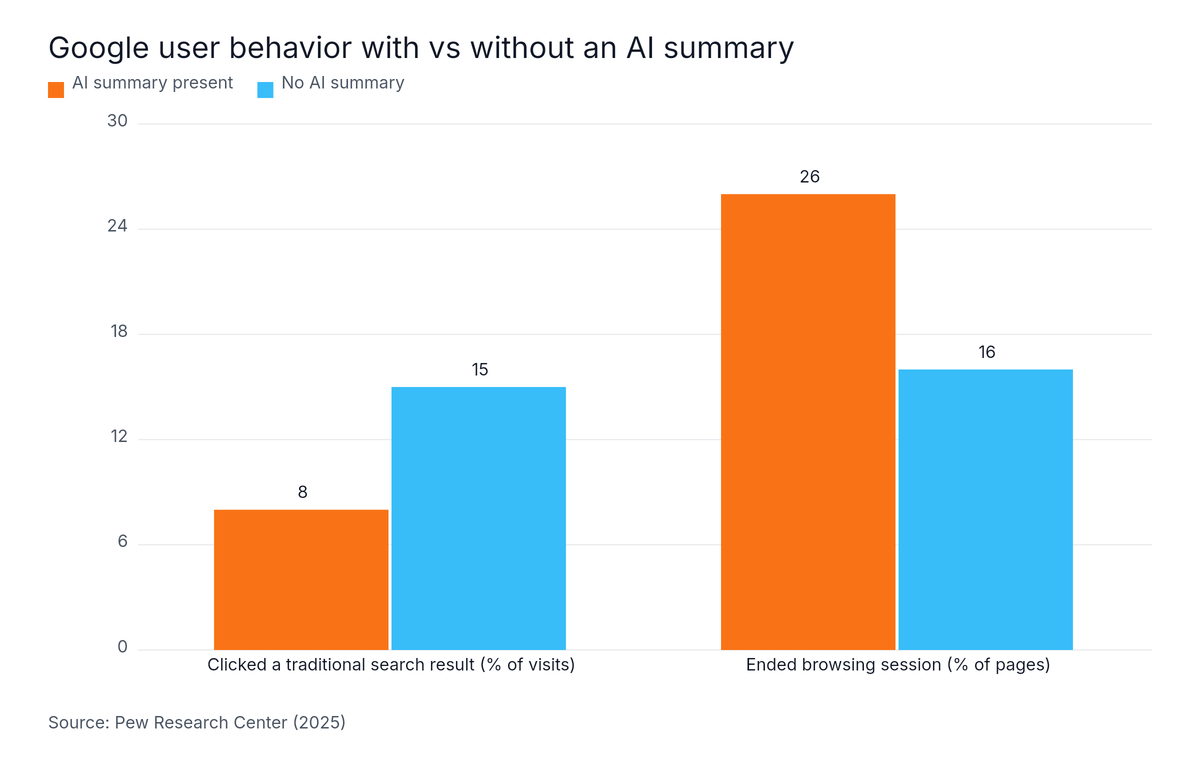
B2B SaaS teams should keep search engine optimization as the foundation and add answer engine optimization on top when clicks fall while rankings hold, because answers now appear on the results page. Pew Research Center found users clicked a traditional result in 8% of visits with a Google AI summary, against 15% without (Pew Research Center, 2025).
Grouped Bar chart: Google user behavior with vs without an AI summary. Highest: Ended browsing session (% of pages) at 26.
An AI Overview is the AI-generated summary Google can show above traditional results. Click-through rate (CTR) is the share of visits that end in a click on a result. Pew's wording is plain: "Users who encountered an AI summary clicked on a traditional search result link in 8% of all visits." (Pew Research Center, 2025)
Two more Pew figures matter for budgets. Only 1% of visits clicked a link inside the AI summary itself. Sessions ended on 26% of pages with a summary, against 16% without (Pew Research Center, 2025). A citation is therefore mostly a visibility win, not a traffic win.
The sample is real browsing: "This analysis is a snapshot of what real Google users are doing in their day-to-day browsing." (Athena Chapekis, Pew Research Center, via Yahoo Tech, 2025) It covers 900 US adults across all topics, not B2B queries alone. Read the numbers as direction, not a forecast for one site.
What does GEO consulting cost compared with SEO?
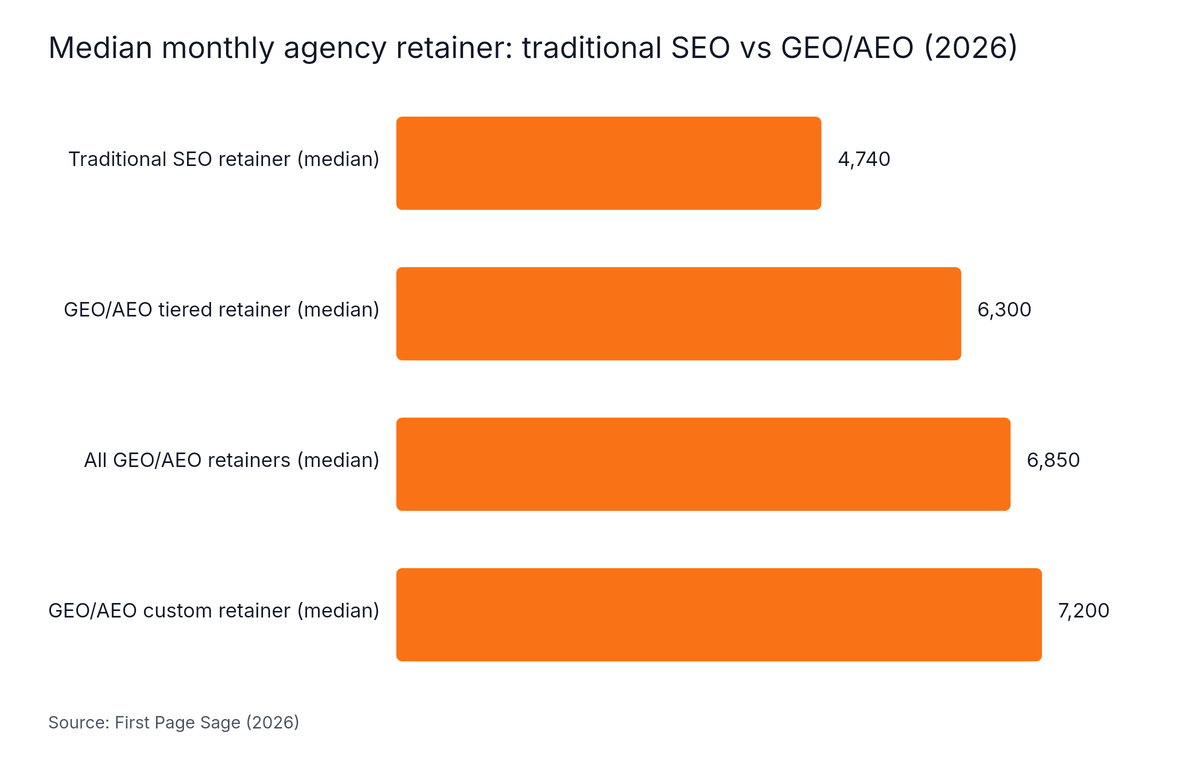
GEO consulting costs more than traditional SEO in one agency-side dataset: the median GEO and AEO retainer is $6,850 a month against $4,740 for SEO, about 45% more (First Page Sage, 2026). AI search visibility software costs less, from $29 to $699 a month on published plans (RankScope, 2026).
A paper price list beside a calculator and a small violet pin on a desk
A retainer is a fixed monthly fee for ongoing agency work. The table below puts the published ranges in one place.
Item
Published range
Source and caveat
Traditional SEO retainer
$4,740 median
First Page Sage, 2026; agency-side data, sample size not shown
The chart shows the same First Page Sage medians: $4,740 for traditional SEO, $6,300 for tiered GEO and AEO retainers, $6,850 across all GEO and AEO retainers and $7,200 for custom ones. Treat every row with care. The publishers sell SEO services or software, and the sources conflict. The Red Engage range has a lower floor and a much higher ceiling than the First Page Sage medians. Other published comparisons reach the opposite conclusion, with GEO priced below SEO, so the direction of the gap is not settled.
How much do AI search visibility platforms cost?
AI search visibility platforms cost from about $29 a month for entry plans, such as a 15-prompt Lite tier, up to $699 a month on published plans, and enterprise tiers are quoted individually (RankScope, 2026). RankScope is itself a tool vendor, so verify prices on each vendor's own pages before budgeting.
How do you evaluate an agency or platform for generative AI search optimization?
A B2B SaaS company should evaluate a generative AI search optimization agency on evidence, not promises: ask for the tracked query set and its history, separate audits from retainers, and require pipeline reporting. Published GEO agency retainers run $3,000 to $20,000+ a month and audits $1,500 to $5,000 (Red Engage survey, via Derivatex, 2026).
A checklist on a clipboard with several items ticked in violet ink
What tests separate a capable agency from a weak one?
Use these questions in a first call. They apply equally to an SEO partner with B2B SaaS and technical depth.
Test
What a good answer looks like
Warning sign
Tracked query set
A fixed list of buyer questions, checked on a schedule, with history
One lucky screenshot
Pricing structure
Audit priced apart from retainer; deliverables listed
A very low retainer with no named work
Outcome reporting
Citations, AI referrals and CRM pipeline reported together
Rankings or traffic only
Technical review
Crawler access, rendering and structured data checked first
Content volume as the whole plan
Promises
Honest limits on what can be timed
Guaranteed citations
Which tools are built for B2B SaaS, and which suit agencies with many clients?
Few AI search visibility tools are built only for B2B SaaS, and most serve any category. For agencies, some platforms sell multi-client plans and some general SEO suites sell per-domain AI add-ons. Most comparisons are vendor-written, so check client limits, tracked-prompt caps and per-domain pricing on each vendor's page.
When should a B2B SaaS company start answer engine optimization?
A B2B SaaS company should start answer engine optimization when a concrete trigger appears: clicks falling while rankings hold, a CEO asking an AI assistant about the category and not finding the company, AI referrals showing in analytics, or a competitor appearing in AI Overviews. Semrush found 66% of buyers have spotted vendors absent from AI results (Semrush, 2026).
A wall calendar with several dates circled in violet marker and a pen beside it
The strongest triggers, in rough order of urgency:
Organic clicks fall while rankings hold. The Pew click data above shows why this pattern appears as AI summaries spread.
A CEO or board member asks an AI assistant about the category and the company is not named.
AI assistant referrals begin to appear in analytics, even at a small share.
A competitor shows up in AI Overviews for the core category query.
A new category launches with no search volume, so citation becomes a main discovery path.
A website rebuild prompts a review of crawler access and rendering.
Waiting has a cost, but so does starting early. The editorial view here, not a measured result, is to begin with a baseline: a fixed buyer-question set, checked monthly, and a technical review of crawler access and rendering. That is cheap, and it gives leadership a number before any retainer is signed.
Who is answer engine optimization not for?
Answer engine optimization is a poor fit for B2B SaaS teams that need revenue inside a quarter, have pages crawlers cannot read, or expect direct traffic gains. AI traffic is roughly 0.2% to 3% of sessions on most sites, and B2B SaaS conversion sits near parity with organic (Siege Media, 2026).
Be cautious in these cases:
Broken foundations. If key pages need JavaScript to show content, or crawlers are blocked, fix that first. Engines cannot cite a page they cannot read.
Short payback windows. No source here supports a payback period, and no citation can be promised or timed.
Sales-led, low-research categories. Where buyers rarely compare vendors before a call, the case is weaker.
The evidence has limits too. No measured figure with a stated sample was found for B2B citation rates. Pew's data covers US adults across all topics. Siege Media's window was January to May 2026. Most pricing data comes from agencies or vendors.
Frequently Asked Questions
Is AEO just SEO renamed?
Answer engine optimization is not SEO renamed, but the two overlap heavily. Search engine optimization targets ranked links, while answer engine optimization targets citations in AI-generated answers. Technical foundations such as crawler access and structured data are shared. Page writing and measurement differ, because AEO tracks citations and AI referrals beside clicks. Treat it as an extension of SEO work.
How do I find an SEO partner with genuine B2B SaaS and technical depth?
A B2B SaaS company can test an SEO partner by asking for a tracked query set with its history, not one screenshot, and for pipeline reporting tied to the CRM. Check that the retainer funds real delivery, and keep one-time audits, quoted at $1,500 to $5,000 in a 2026 survey of 20 agencies (Derivatex, 2026), separate from ongoing work.
Which AI and SEO tools are built specifically for B2B SaaS marketing teams?
Few AI search visibility tools are built only for B2B SaaS. Most serve any category, and published plans ran from about $29 to $699 a month in a 6 October 2026 snapshot (RankScope, 2026). Because most tool comparisons are written by vendors, check features and pricing on each vendor's own pages before choosing.
Are there answer engine optimization platforms built for agencies managing multiple B2B SaaS clients?
Some answer engine optimization platforms offer agency or multi-client plans, and some general SEO suites sell per-domain AI add-ons. Coverage is dominated by vendor-written comparisons, so verify client limits, tracked-prompt caps and per-domain pricing on vendor pages, then compare totals against the $29 to $699 monthly range (RankScope, 2026) reported for single-site plans.
How much do AI search visibility platforms cost?
AI search visibility platforms cost about $29 to $699 a month on published plans, with enterprise tiers quoted individually, according to a snapshot of vendor pricing pages taken on 6 October 2026 (RankScope, 2026). RankScope is itself a tool vendor, so confirm current prices on each vendor's own pricing page.
What should B2B SaaS leaders do next?
Answer engine optimization for B2B SaaS is worth a measured, staged investment: start with a baseline and technical fixes, then add retainers when a trigger appears. Buyers do use AI for research, since a G2 press release reported 51% start in an AI chatbot (G2, via Morningstar, 2026). Yet B2B SaaS conversion from AI visitors sits near 1.05x (Siege Media, 2026).
Four points to carry forward:
Judge ROI by shortlist influence and citations, not session conversion.
Expect agency fees that may sit above traditional SEO, and software from about $29 a month.
Fix crawler access and rendering before anything else.
Start when a trigger appears, with a monthly question check.
Meet with an expert: A free consultation. Bring the questions buyers ask about your category and brainstorm how to get cited.
Written by
Ishan Manchanda
Ishan Manchanda is co-founder of GrowthSpree, a B2B SaaS marketing consultancy founded in 2017 that has managed $60M+ in ad spend across 300+ B2B SaaS companies. He focuses on demand generation, go-to-market strategy and pipeline growth, and has been featured in Silicon Valley Times, SaaS Mag and the Unbounce podcast.
 Ishan ManchandaNov 8, 2026