Blog
Generative Engine Optimization Budget for B2B SaaS: What to Fund and What to Skip
Build a generative engine optimization budget for B2B SaaS: split fixed SEO-overlap work from monitoring tools, with sourced price ranges and kill criteria.
The AI search visibility metrics B2B SaaS teams should track: citation rate, share of voice and GA4 AI referrals, with a monthly 20-question baseline.
 Ishan ManchandaNov 18, 2026

Build a generative engine optimization budget for B2B SaaS: split fixed SEO-overlap work from monitoring tools, with sourced price ranges and kill criteria.
The six metrics that matter for AI search visibility in B2B SaaS, how to separate mentions from citations, set per-engine baselines and tie results to pipeline.
How B2B SaaS teams can structure pages for Google AI Overviews: what Google documents, what CTR studies show, and where to spend effort first.
Request a quote and our experts will contact you within 24 hours with tailored solutions and pricing.
AEO for B2B SaaS
Last updated: Nov 18, 2026
By AEO for B2B SaaS Editorial Team. Last updated November 4, 2026.
AI search visibility metrics are the measurements that show whether answer engines cite, mention and send traffic to a B2B SaaS site, and they work alongside rank and click data rather than replacing it. A team can hold position one and still lose half its clicks, then face a plain board question: are we showing up in AI answers or not? Rank reports cannot answer that. This guide sets out which metrics to track, a monthly baseline protocol, a GA4 method for isolating AI referrals, and a one-page scorecard for leadership. For background on what answer engine optimization means, start there.
Key Takeaways
- AI search visibility for a B2B SaaS site is measured with citation rate, mention rate, AI share of voice, description accuracy, AI referral sessions and assisted pipeline, not with rank alone.
- A monthly baseline of 20 or more buyer questions across five answer engines, with repeat runs, gives a B2B SaaS team a trend line it controls.
- AI answers vary run to run: SparkToro found ChatGPT and Google's AI returned the same brand list less than 1% of the time, so single spot-checks mislead.
- Google Analytics 4 added a native AI Assistant channel on May 13, 2026, but it only catches visits that carry a referrer.
- Peer benchmarks for AI referral traffic differ widely, so a B2B SaaS team should benchmark against its own baseline.
The core AI search visibility metrics for a B2B SaaS site are citation rate, mention rate, AI share of voice, brand description accuracy, AI referral sessions and assisted pipeline. They matter because 66% of surveyed B2B professionals regularly use AI to research vendors (Semrush, 2026). Standard rank-tracking tools do not measure the first four.
AI search visibility metrics are the measurements that show whether answer engines cite, mention and send traffic to a B2B SaaS site. They cover answer engine optimization (AEO), the practice of structuring pages so AI assistants and Google's AI features choose to cite them. Some writers call the same discipline generative engine optimization (GEO) or large language model (LLM) optimization. The names matter less than using one definition consistently. For how this differs from classic search work, see AEO vs SEO for B2B SaaS.
| Metric | What it tells you | How to measure it | Where the data lives |
|---|---|---|---|
| Citation rate | How often engines link your domain | Cited runs divided by total runs | Manual or tool-based answer log |
| Mention rate | How often engines name your brand | Named runs divided by total runs | Same answer log |
| AI share of voice | Your standing against a fixed competitor set | Your citations divided by all brand citations | Same answer log |
| Description accuracy | Whether the product is described correctly | Reviewer marks each answer accurate or not | Same answer log |
| AI referral sessions | Visits that arrive from AI assistants | GA4 channel plus custom regex | GA4 |
| Assisted pipeline | Deals where AI played a role | Self-reported attribution and sales-call notes | CRM and forms |
Three definitions need to be written down once, because mixing them is the most common reason monthly numbers cannot be compared.
Position inside an AI answer is noise. List order changes between runs, so the stable figure is presence across many runs, not rank in one answer.
Evidence on clicks: No measured B2B citation-rate figure with a stated sample was found, so none is used here. The click evidence points both ways. Ahrefs (published February 4, 2026) measured a 58% lower average click-through rate (CTR) for the top-ranking page when an AI Overview was present, across 300,000 keywords, comparing December 2023 with December 2025. Seer Interactive (April 24, 2026) reported that CTR on results with an AI Overview rebounded 85% in the first two months of 2026. No sample is stated for that rebound figure.
AI answers matter for B2B SaaS because buyers use them before they talk to sales. In a Semrush survey of 600+ US business professionals, 66% regularly use AI to research vendors and solutions, and another 29% do so occasionally (Semrush, 2026). Presence in the answer is therefore a measurable part of the shortlist.
Semrush's survey, published July 8, 2026, describes the pattern directly: "Buyers use them to scope categories, compare solutions, and build shortlists before they ever talk to sales." (Semrush, 2026). The survey is vendor-run, so read it as a signal, not a census.
The same survey found AI use at every stage: 72% in early research, 62% when comparing vendors, 48% to narrow the shortlist and 45% to support the final decision (Semrush, 2026). Those four stages are a useful frame for building the question set later.
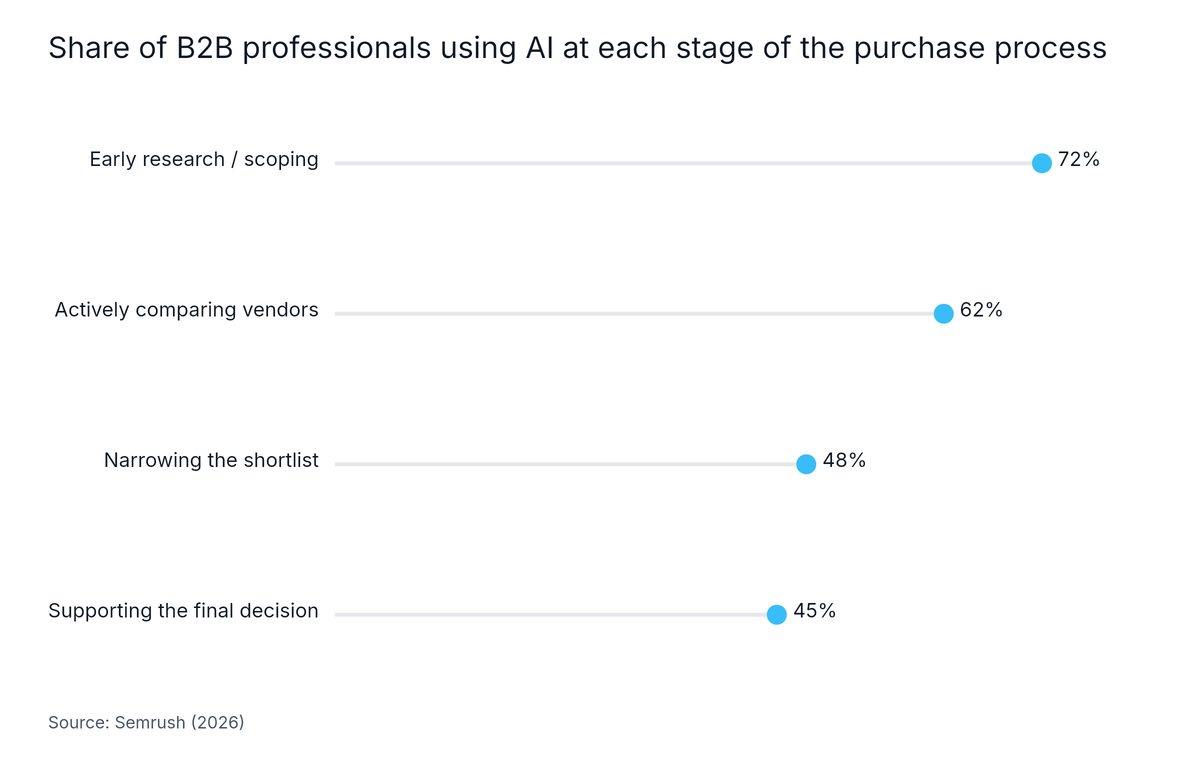
Source: Semrush, 2026
G2 points the same way. Its 2026 report says: "When AI shapes the shortlist, brands that aren’t represented are eliminated before they realize the buyer was looking for them." (G2, 2026). If that holds for a given category, a missing citation costs pipeline the team never sees.
Position one no longer guarantees a click when Google shows an AI summary above the results. Pew Research Center's browsing study of 900 US adults found users clicked a traditional result in 8% of visits with an AI summary, against 15% without one (Pew Research Center, 2025). Rank reports can look healthy while visibility moves into the answer itself.
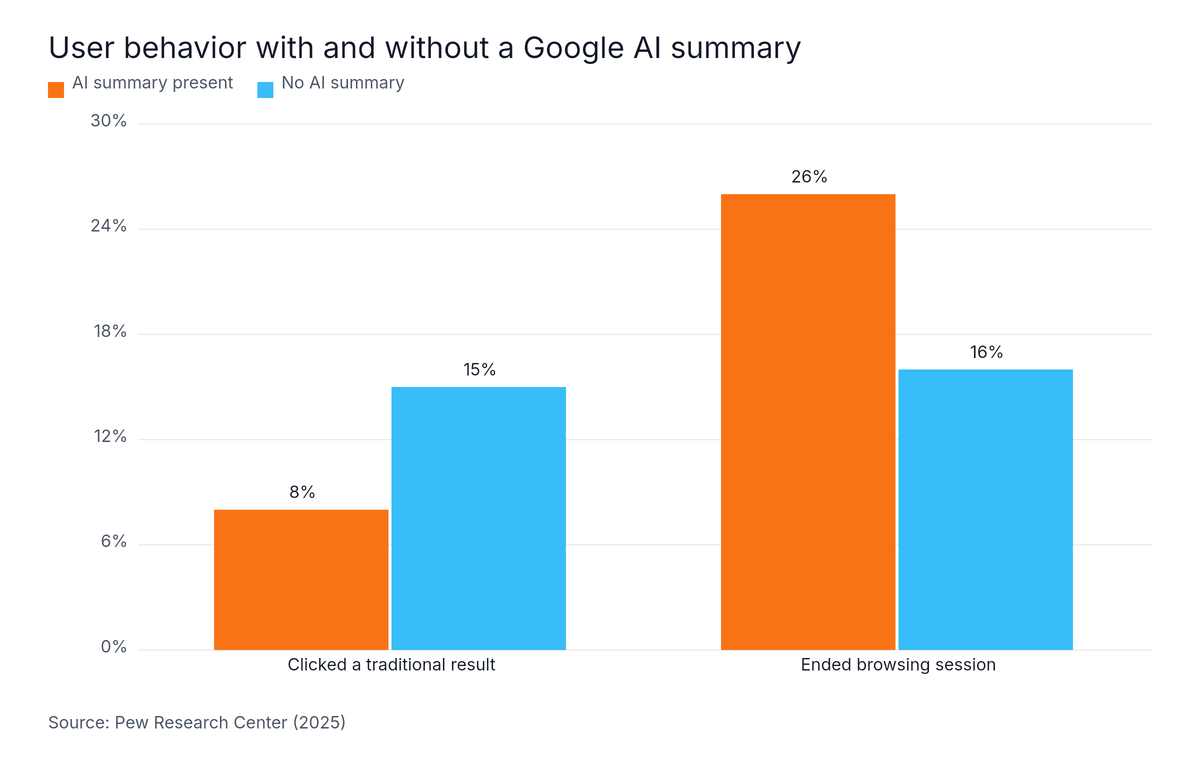
Source: Pew Research Center, 2025
Pew's summary line is blunt: "Google users who encounter an AI summary are less likely to click on links to other websites than users who do not see one." (Pew Research Center, 2025). The study covered March 2025 browsing and 68,879 Google searches. Users also ended their browsing session after an AI summary 26% of the time, against 16% without one (Pew Research Center, 2025).
A note on sourcing: the 15% comparison figure and the 26% versus 16% session figures were confirmed through secondary coverage of the Pew study, not on the Pew page itself. Check the Pew page before reusing them.
Links inside the AI summary were clicked in only 1% of visits (The Register, 2025). That is why citation cannot be measured by clicks alone. A brand can be cited often and see almost no session lift. Google disputed Pew's methodology in a statement to The Register, so the figure belongs in a range of evidence, not at the top of a slide.
Other measurements disagree on size and direction. The table separates the figures by source and sample.
| Source | Finding | Type and sample |
|---|---|---|
| Ahrefs (February 4, 2026) | AI Overview presence correlated with a 58% lower average CTR for the top-ranking page | Measured, 300,000 keywords, December 2023 vs December 2025 |
| Seer Interactive (April 24, 2026) | CTR on results with an AI Overview rebounded 85% in the first two months of 2026 | Measured, sample not stated |
| Seer Interactive (2025 data, reported April 2026) | Informational results without an AI Overview rose from 2.93% to 3.97% CTR | Measured, 901 million impressions |
| Pew Research Center (July 22, 2025) | Traditional result clicked in 8% of visits with an AI summary, 15% without | Measured, 900 US adults, 68,879 searches |
CTR moved both ways depending on the panel and the period. That is the case for adding citation and AI referral data beside clicks, not instead of them.
A monthly citation-rate baseline means running a fixed list of 20 or more buyer questions across five answer engines, repeating each question several times, and logging whether the domain is cited, mentioned or absent. Repeat runs matter because SparkToro found ChatGPT and Google's AI returned the same brand list less than 1% of the time (Search Engine Journal, 2026).
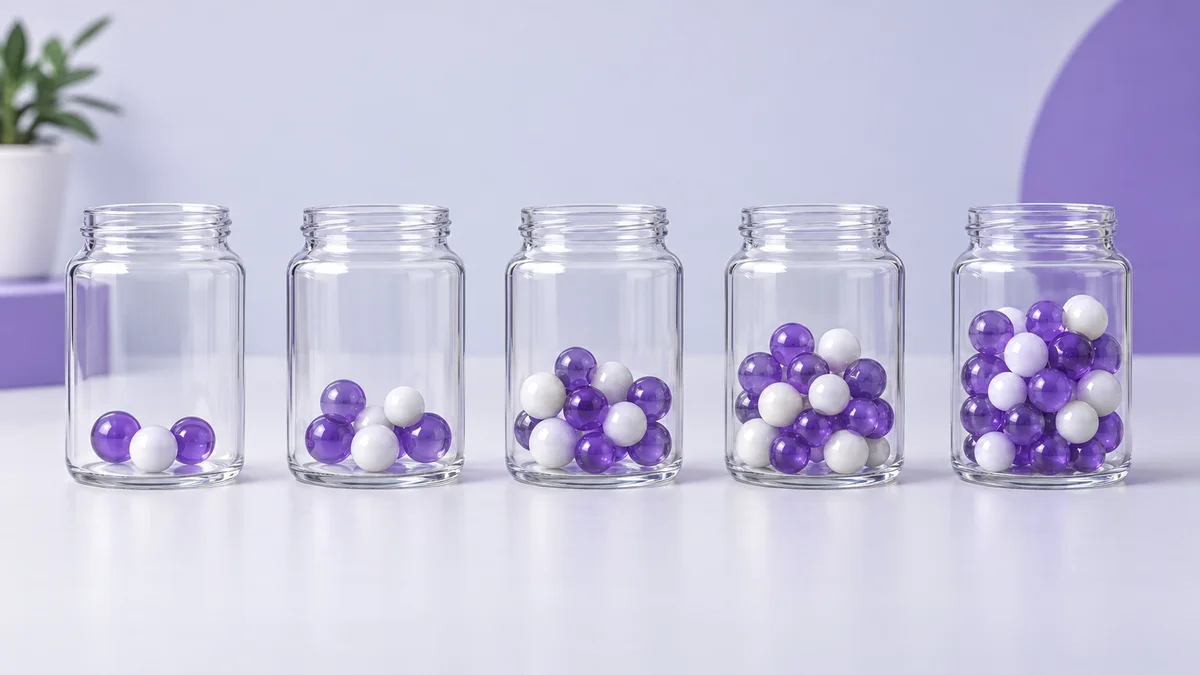
The monthly check of 20+ category questions across five engines is a method proposed in a 2026 GrowthSpree blog post. The run counts and logging schema below are editorial design choices, not measured benchmarks. The result is a manual or semi-manual protocol, not a plug-in dashboard. For the software side, see tools for tracking AI visibility.
SparkToro's research, reported in January 2026, states: "If you ask an AI tool for brand/product recommendations a hundred times nearly every response will be unique." (Search Engine Journal, 2026). The study ran each prompt 60 to 100 times per platform. Few teams can match that, so the reported figure should be a rate across runs, not a yes or no.
Wording matters less than expected for the top names. Top brands in a headphone test appeared in 55% to 77% of AI answers even though 142+ respondents phrased prompts very differently (Spyglasses Research, 2026). That figure is SparkToro's finding reported second-hand by an AI-visibility vendor. It supports tracking presence over a question set, not exact prompt wording.
| Field | Example value | Why it is logged |
|---|---|---|
| Date and engine | 2026-11-04, Perplexity | Separates engine behavior and time |
| Question and run number | Q07, run 3 | Lets repeat runs be counted |
| Cited (yes or no) | Yes | Feeds citation rate |
| Mentioned (yes or no) | Yes | Feeds mention rate |
| Description accurate | No, wrong pricing model | Catches wrong product descriptions |
| Competitors named | Three listed | Feeds share of voice |
| URL cited | Pricing page | Shows which page earns the citation |
A spreadsheet with these seven columns is enough for a first baseline. Because links inside the summary were clicked in only 1% of visits (The Register, 2025), this log is where citation presence shows up at all. For how pages earn the citation, see how to get cited by AI assistants.
Google Analytics 4 (GA4) separates AI referral traffic with a native AI Assistant channel, added on May 13, 2026 (Search Engine Journal, 2026), plus a custom regex on source domains for anything the native channel misses. The native channel only captures visits GA4 can identify through the referrer, so the result is a floor, not a total.
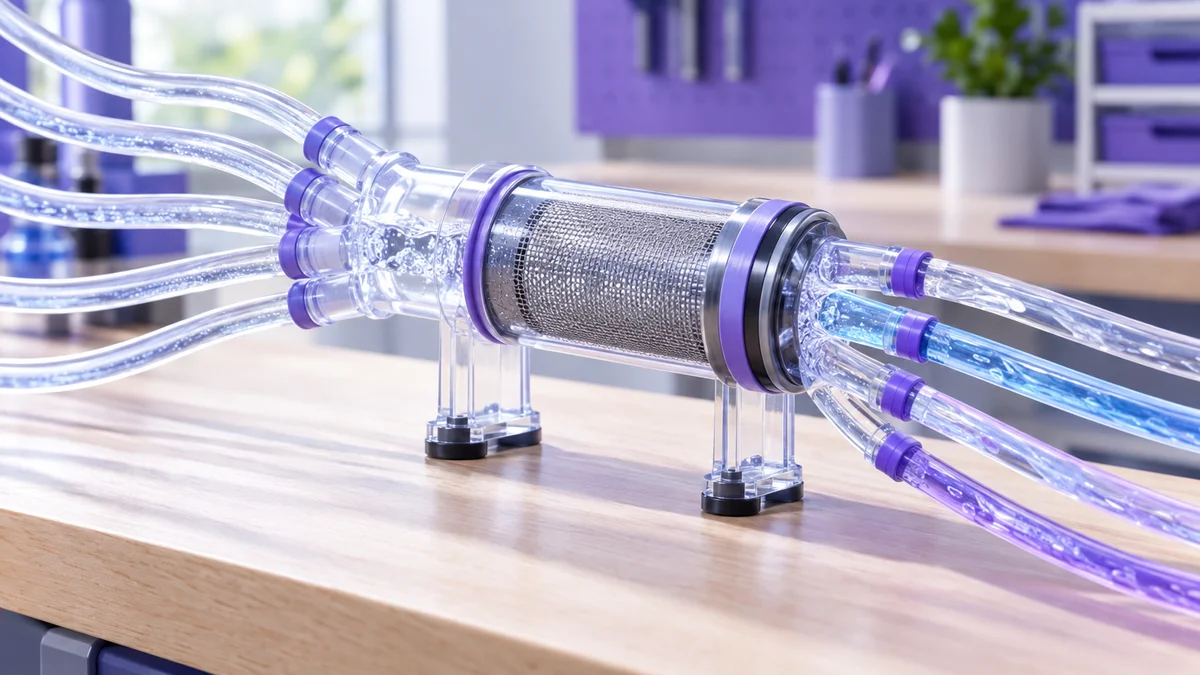
AI referral traffic is the set of site visits that arrive from an AI assistant or answer engine and carry a referrer that analytics can identify. The goal is a measured number, not an inferred one. Exact GA4 menu paths vary, so the steps below describe the method, not the clicks.
Dark AI traffic is AI-driven traffic that arrives without a referrer and lands in Direct. Because GA4 only captures what it can identify through the referrer (Search Engine Journal, 2026), some AI visits are invisible by design. Report the GA4 number as a floor.
AI referral traffic is still a small share of total visits, and published benchmarks disagree. SE Ranking's 2026 study put AI platforms at 0.32% of all website traffic, up from 0.24% in 2025 and 0.02% in 2024 (SE Ranking, 2026). Other panels report higher averages, so peer figures are directional at best.
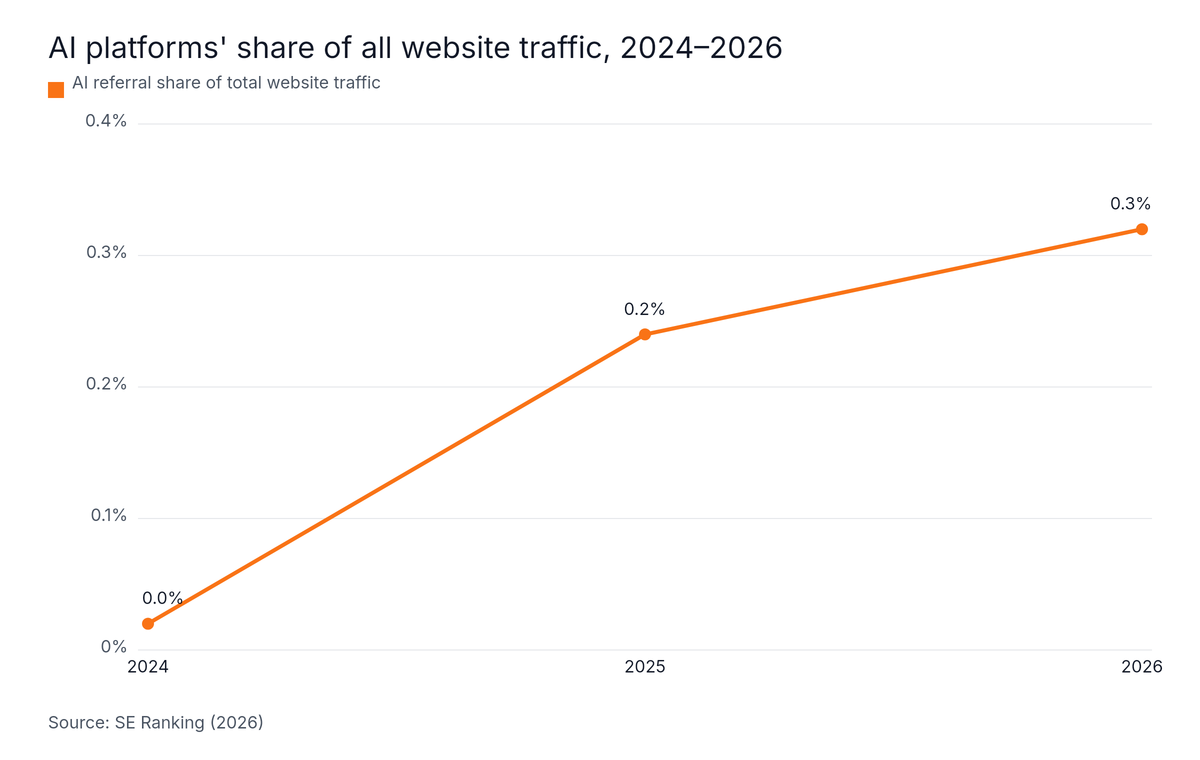
Source: SE Ranking, 2026
SE Ranking's growth is roughly 16 times in two years (SE Ranking, 2026), yet the 2026 share is well under 1%. The 2026 figure covers January to April 2026 across 101,574 websites. SE Ranking is a vendor with a stated panel, and its publish date should be checked before reuse.
| Source | Figure | Sample and caveat |
|---|---|---|
| SE Ranking (2026) | AI platforms 0.32% of all website traffic | 101,574 websites, January to April 2026 |
| Conductor, as reported by EGGKNITE (2026) | 1.08% average share of total traffic | Reported as 13,770 enterprise domains, sampled May to September 2025; a critique (Ekamoira, 2026) says the figure came from 1,215 domains |
| SE Ranking (2026) | ChatGPT 74.78% of AI referrals, down from 79.74% in 2025 | Same panel as above |
| Four 2026 studies compiled by Altus Marketing (2026) | ChatGPT 62.6% to 95.1% of AI referrals | Agency compilation; the 95.1% upper bound, from a September 2026 BrightEdge release, was not checked against the original |
The Conductor average is an enterprise-weighted, high-end reference with a disputed sample size. It should not be read as a target for a typical B2B SaaS site.
In SE Ranking's data, ChatGPT's share of AI referral traffic fell from 79.74% in 2025 to 74.78% in 2026 (SE Ranking, 2026). Referral volume is concentrated in one engine but diversifying.
The range of 62.6% to 95.1% across four 2026 studies (Altus Marketing, 2026) shows that the panel changes the answer. The practical rule: benchmark against your own GA4 data, month on month.
A board report on AI search visibility fits on one scorecard: citation rate, AI share of voice, AI referral sessions, Search Console CTR on AI Overview queries and assisted pipeline, each with its monthly change. The business case is the shortlist: G2's 2026 Buyer Behavior Report found 80% of chatbot-using buyers stayed with their initial shortlist in at least three of five recent purchases, versus 65% of others (G2, 2026).

| Scorecard line | This month | Last month | Read it as |
|---|---|---|---|
| Citation rate by engine | Rate with range | Rate with range | Direction, not precision |
| AI share of voice | Share of fixed set | Share of fixed set | Standing against named rivals |
| AI referral sessions (GA4) | Count | Count | A floor, not a total |
| CTR on AI Overview queries (Search Console) | Percent | Percent | Whether clicks fall while rank holds |
| Assisted pipeline | Deals with AI noted | Deals with AI noted | Self-reported and sales-call mentions |
Pairing the first four lines answers the paradox. If rank holds, CTR falls and citation rate rises, visibility is moving into the answer. If citation rate is flat or low, the page is losing on both counts.
Assisted pipeline is the weakest line, and it should be labeled that way. Add an open-text how-did-you-hear-about-us field to demo forms, log AI tool mentions on sales calls, and watch branded search for lift. None of these proves cause. Together they show whether AI visibility and revenue move in the same direction.
The measured evidence on clicks points both ways, as the Ahrefs and Seer Interactive results above show. A board does not need a forecast. It needs a baseline, a fixed method and a month-to-month trend before it funds the work. For tool options once the manual baseline runs, see tracking tools for B2B SaaS.
Meet with an expert
A free consultation. Bring the questions buyers ask about your category and brainstorm how to get cited.
The monthly AI citation baseline described here is not for teams that want a live dashboard, a guaranteed number or a precise benchmark. The baseline is manual or semi-manual, and answer engines vary run to run: SparkToro found the same brand list appeared less than 1% of the time (Search Engine Journal, 2026). It gives a trend line you control, not an industry score.

Teams that see clicks fall with rank steady, or whose CEO asks ChatGPT about the category and finds the company missing, have enough reason to start. A rough baseline beats none. For the next step after measuring, see how to get your site cited by AI search engines.
A B2B SaaS team should start with 20 or more buyer questions covering category, comparison, pricing and integration topics. That is a proposed baseline, not a measured benchmark. Spread the questions across the stages buyers use AI for, from early research to shortlisting, and keep the list fixed so month-to-month changes mean something.
Citation rate is the share of answer runs that link your domain. Mention rate is the share that names your brand, linked or not. AI share of voice is your citations or mentions divided by all brand citations or mentions across the same questions and a fixed competitor set. Pick one counting rule and keep it constant.
AI answers vary because answer engines generate each response fresh. SparkToro and Gumshoe.ai found ChatGPT and Google's AI returned the same brand list less than 1% of the time across repeated runs. A single spot-check is unreliable, so the stable measure is the percentage of runs in which a brand appears.
Standard rank-tracking tools do not measure AI citation presence. They report where a page sits in a list of links, while an AI answer has no fixed list or position. Citation tracking needs repeated question runs across answer engines, logged by hand or by a dedicated tool, alongside Search Console and GA4 data.
A spreadsheet works for a first baseline. Twenty questions across five engines with repeat runs can be logged manually, and the result is enough to show leadership a starting number. Paid tools mainly save time at higher volume. Whichever route is used, the question list, run count and citation definition should stay fixed.
AI search visibility metrics give a B2B SaaS team an answer to the board question that rank and click reports cannot. The method is plain and manual at first, and it improves with consistent repetition.
Start with the question list and the written definition of cited. For a wider look at how pages earn those citations, read how to get your B2B SaaS brand cited.
Written by
Ishan Manchanda
Ishan Manchanda is co-founder of GrowthSpree, a B2B SaaS marketing consultancy founded in 2017 that has managed $60M+ in ad spend across 300+ B2B SaaS companies. He focuses on demand generation, go-to-market strategy and pipeline growth, and has been featured in Silicon Valley Times, SaaS Mag and the Unbounce podcast.