Request a quote and our experts will contact you within 24 hours with tailored solutions and pricing.
Which AI Search Tool Grows B2B SaaS Visibility Over Time?
By AEO for B2B SaaS Editorial Team. Last updated November 4, 2026.
No single AI search tool grows B2B SaaS visibility over time: monitoring tools measure citations, while crawler access and indexing, the controls engines actually document, decide whether pages can be cited at all. That distinction matters because 66% of B2B professionals regularly use AI to research vendors and solutions (Semrush, 2026, a vendor survey of 600+ US business professionals). Teams buy a dashboard, see a score, and wonder why nothing compounds. This guide sorts the tool categories used in answer engine optimization (AEO) by what each engine has confirmed and what vendors only assert. It builds on the pillar guide to getting cited by AI assistants.
Key Takeaways
AI visibility monitoring tools for B2B SaaS measure whether a brand is cited; they do not create citations.
Crawler access and indexing are the controls that Google and OpenAI document as requirements for appearing in their AI features.
Google states that no special structured data or AI text files are needed for its generative AI features (2025 and 2026 documentation).
ChatGPT's share of AI referrals differs widely by panel, so a tool's own share figures should be checked against first-party analytics.
Durable AI visibility shows up as repeated-run citation share across several engines, not a single score.
Which AI search tool grows visibility over time?
No single AI search tool grows B2B SaaS visibility over time, because the tools split into three categories with different jobs: monitoring, structured data validation and crawler-access checking. Only crawler access and indexing are documented by the engines as requirements. The choice matters, since 66% of B2B professionals regularly use AI to research vendors and solutions (Semrush, 2026).
Three brass instruments on a pale desk representing monitoring, validation and crawler checks
The matrix below sorts each category by what engines have documented, as read on November 4, 2026. "Vendor-asserted" means the claim comes from tool sellers, not from the engine.
Tool category
What it does
Engine-documented?
Vendor-asserted or unknown
AI visibility monitoring
Runs buyer questions and records citations
Google offers its own report; OpenAI documents no scoring
Google says no special markup is needed for AI features
Citation lift from schema; no OpenAI or Perplexity documentation for ordinary pages
Crawler-access checker
Tests robots.txt, firewall and fetch access
OpenAI documents OAI-SearchBot; Google requires indexing and snippet eligibility
Claims that allowing a crawler guarantees citation
llms.txt generator
Creates a proposed AI text file
Google says AI text files are not needed
Any ingestion benefit from engines
Read the table as a filter. A capability in the "documented" column is a control. A capability in the last column is a hypothesis worth testing, not a promise.
A proposed baseline: a monthly check of 20+ category questions across five engines. This is a proposed method, not a measured result.
What do AI visibility monitoring tools actually measure?
AI visibility monitoring is the repeated checking of buyer questions across answer engines to record whether a brand is cited. These tools measure citations; they do not cause them. Vendor data from Searchable, covering 3,627 tracked brands, shows the median brand was named in 93% of answers to branded prompts but only 7% of unbranded ones (Searchable, 2026).
Six translucent glass dice showing different faces under one lamp
Why a single score misleads
That 93% versus 7% gap (Searchable, 2026) means a tool that blends branded and unbranded prompts overstates reach. Buyers shortlisting vendors ask category questions, which are unbranded. The figure covers tracked brands only, in the 30 days to September 18, 2026, so it is vendor research, not a market benchmark.
Volatility is the second problem. An April 2026 arXiv paper (2026) argues AI visibility is probabilistic, not a rank, and recommends repeated runs. Search Engine Journal reported (2026) that almost all citation trackers showed a drop when ChatGPT released model 5 in August 2025. A drop in a dashboard can be a model change, not a content problem.
Why clicks are a weak substitute
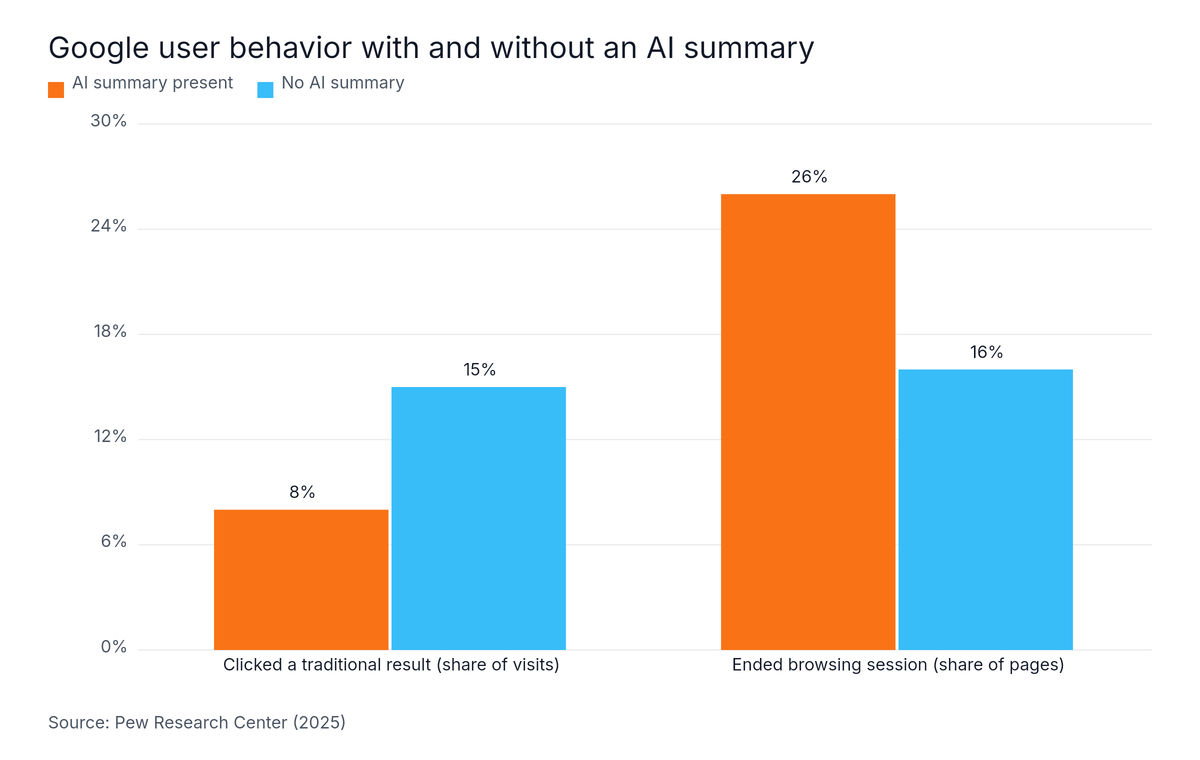
Clicks do not fill the gap. Pew Research Center found "Users who encountered an AI summary clicked on a traditional search result link in 8% of all visits." (Pew Research Center, 2025). In the same study, users ended their browsing session on 26% of pages with an AI summary versus 16% of pages with only traditional results (Pew Research Center, 2025). The sample was 900 U.S. adults in March 2025.
Grouped Bar chart: Google user behavior with and without an AI summary. Highest: Ended browsing session (share of pages) at 26%.
Click-through rate (CTR) is the share of impressions or visits that end in a click on a result. CTR alone therefore undercounts AI visibility, so monitoring should be paired with AI referral data from analytics.
Does a structured data validator help AI search visibility?
A structured data validator checks that markup is valid, but Google's documentation does not make markup an AI requirement. Google Search Central states "Structured data isn't required for generative AI search, and there's no special schema.org markup you need to add." (Google Search Central, 2026). Validators remain useful for rich-result eligibility, not as a citation lever.
Structured data is machine-readable markup, such as schema.org types, that describes what a page contains. Google's separate AI features documentation goes further: "You don't need to create new machine readable files, AI text files, or markup to appear in these features." (Google Search Central, 2025). That wording also covers llms.txt, which is a proposed convention for telling AI crawlers which content a site intends for ingestion. No major engine documents it as a requirement.
Page content still matters at every buying stage. Semrush's vendor survey found 72% of respondents use AI during early research and 62% when comparing vendors (Semrush, 2026). Those are moments when a page's text, not its markup, is what an engine lifts.
OpenAI and Perplexity have no public documentation on schema for ordinary pages, as of this article's research. Some controlled studies of schema and citations exist, but they could not be verified and are not linked here. A validator therefore sits in the "hygiene" bucket. Keep markup accurate and matched to visible content, and do not budget for it as a growth driver. Page structure, covered in the guide on how to get cited by AI search engines, matters more.
Do crawler-access checkers matter for ChatGPT and Google AI Overviews?
A crawler-access checker tests whether robots.txt, firewalls and rendering let AI crawlers fetch a page, and it is the one tool category tied to documented engine requirements. OpenAI states "Please use OAI-SearchBot in robots.txt for managing Search opt outs and automatic crawl." (OpenAI Developers, 2026). Google requires a page to be indexed and snippet-eligible.
A closed server-room door with a gap of light beneath it
What the engines document
OAI-SearchBot is the OpenAI crawler documented for ChatGPT search. OpenAI's documentation says "To help ensure your site appears in search results, we recommend allowing OAI-SearchBot in your site’s robots.txt file" (OpenAI Developers, 2026). It treats GPTBot, the training crawler, as a separate setting, so blocking one has a different effect from blocking the other.
For Google, the documentation says "a page must be indexed and eligible to be shown in Google Search with a snippet" (Google for Developers, 2025) to appear in AI features. Access matters at the shortlist stage too: 48% of respondents in the Semrush vendor survey use AI to narrow the shortlist (Semrush, 2026).
Where simple checkers fall short
Many checkers only audit robots.txt. A web application firewall can still block a bot that robots.txt allows, and OpenAI notes that user-initiated ChatGPT-User fetches may not follow robots.txt. The proper log check verifies IP ranges. A checker that cannot test firewall behavior can give a false pass.
Allowing a crawler is necessary, not sufficient. Neither company documents that access produces a citation.
Are free first-party reports enough to track AI visibility?
Google's Search Console Generative AI performance report is a free first-party monitoring option, but it does not cover ChatGPT or Perplexity. Google describes its report as a way "to help you understand your site's visibility within generative AI features on Search" (Google for Developers, 2026).
The Generative AI performance report is a Search Console report on a site's visibility in generative AI features on Google Search and Discover. Google's announcement describes impressions, pages, countries and devices as reporting dimensions (Google for Developers, 2026). It does not show clicks or conversions for every engine.
Bing Webmaster Tools is also reported to offer an AI Performance view. This article could not verify its fields against Microsoft documentation, so treat that claim as unconfirmed. Microsoft is reported to describe its own visibility tools as for "directional monitoring," according to a secondary report by PPC Land (2026). The same report notes that Semrush's AI Visibility Index 2026 publishes no formula for its 0 to 100 score.
The practical reading: start with the free Google report. Add a paid monitoring tool only to cover engines it misses. The explainer on what AEO means for B2B SaaS covers why multi-engine coverage is part of the discipline.
How do you monitor AI search visibility over time?
Monitoring AI search visibility over time means running a fixed set of buyer questions on a schedule, across several engines, and comparing citation share between runs. One-off scores mislead because the engine mix shifts: ChatGPT's share of AI referral traffic fell from 84.2% in 2024 to 67.9% in 2026 in one agency panel of 218 client sites (First Page Sage, 2026).
A wooden hourglass with violet sand half run through
Why referral-share numbers disagree
Panels differ by sample and method, so ChatGPT's share ranges widely. Treat each as directional.
92.4% of trackable standalone LLM referral traffic
6.77 million sessions across 166 GA4 properties; secondary re-report
The spread is the lesson. Use first-party GA4 data as the baseline and treat any vendor's share figure as context. Goodie's report shows ChatGPT's share of measurable B2B referrals fell 26.55 percentage points in eight months, so a single-engine tracking plan ages quickly (Goodie, 2026).
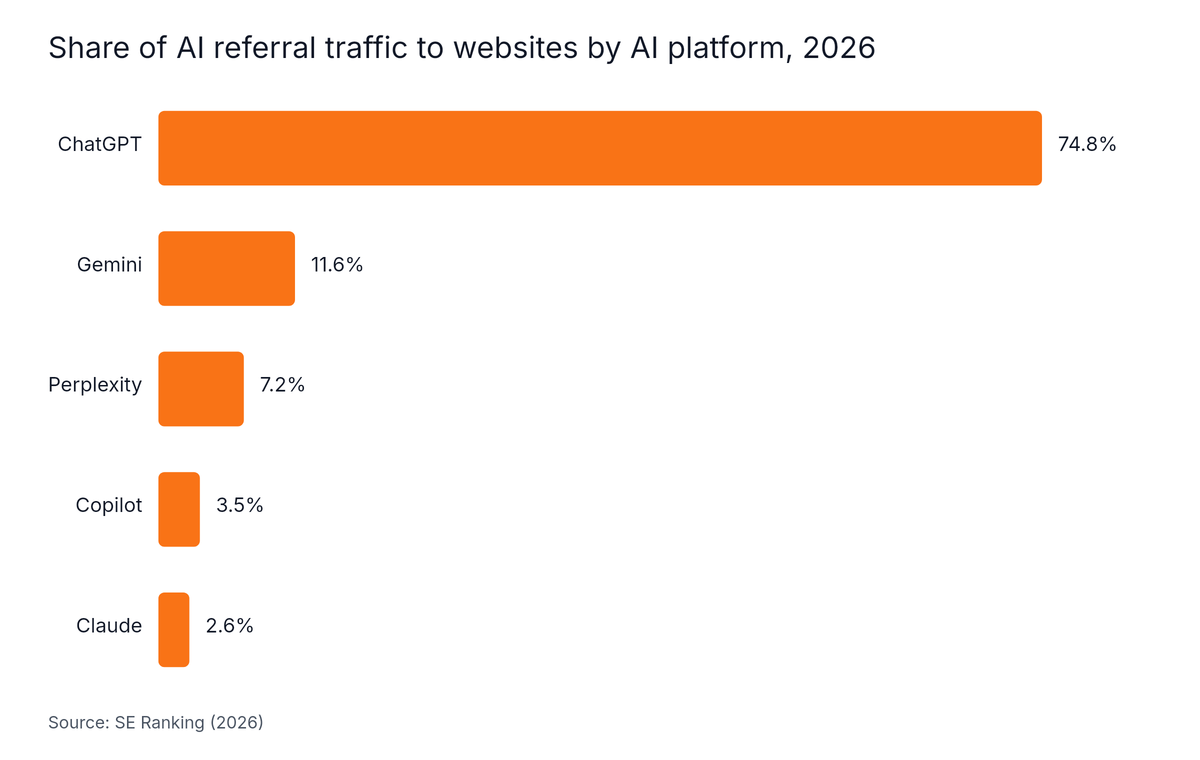
Horizontal Bar chart: Share of AI referral traffic to websites by AI platform, 2026. Highest: ChatGPT at 74.8%.
SE Ranking reports ChatGPT at 74.78% of AI referral traffic in 2026, with Gemini at 11.56%, Perplexity at 7.23%, Copilot at 3.51% and Claude at 2.62% (SE Ranking, 2026). Single-engine monitoring therefore misses about a quarter of AI referrals. SE Ranking's study says Perplexity's US share fell from 11.42% in 2025 to 6.85% in 2026 (SE Ranking, 2026), so monitoring coverage must keep up with the engine mix.
Volume is rising too. SE Ranking, which sells SEO and AI-visibility tools, reports AI search traffic grew 16x from 2024 to 2026 (SE Ranking, 2026). That is a vendor study showing growing volume, not evidence that any tool caused a brand's gains.
Durable metrics to track, month over month:
Citation share across repeated runs of a fixed buyer question set, per engine.
Branded and unbranded prompts reported separately.
AI referral sessions in GA4 as a trend, not a single month.
AI visibility tools are a poor fit for B2B SaaS teams whose pages are not yet crawlable, indexed or written for citation, because measurement cannot fix access. PPC Land reported that Lorelight's founder shut down his AI visibility tracking tool on October 31, 2025, after customers churned because the data did not change what they did (PPC Land, 2025).
A single unlit lantern on an empty stone step at dusk
Three limits apply before any purchase:
Monitoring-only value is unproven. The Lorelight case is a secondary report and a single example, but it shows the risk of buying data without a plan to act on it.
ROI claims need caution. A 2026 Marketing Science study, as reported by Growleads (2026), found AI traffic converted 18% better than organic overall, yet worse than organic on 37% of sites. The dataset was 973 ecommerce websites, so it is only indirectly relevant to SaaS.
Buyers still validate. Gartner's survey of 645 B2B buyers (August to September 2025) reported that 45% used GenAI, per a reprint of the release (Gartner via Biz Tech Reports, 2026). Visibility is one input to the shortlist, not the whole path.
If crawler access, indexing and page structure are unfinished, fix those first. The article on generative engine optimization (GEO) shows how other brands sequence that work.
Frequently Asked Questions
Do AI visibility trackers cause growth, or do they only measure it?
AI visibility trackers measure whether a brand is cited in answer engines; they do not cause citations. Growth comes from changes to pages, crawler access and content that the tracker then reveals. A Lorelight shutdown in October 2025, reported by PPC Land, shows what happens when tracking data does not change what customers do.
Does schema markup help a B2B SaaS site get cited by AI search?
Google states that structured data is not required for generative AI search and that no special schema.org markup is needed. Markup that matches visible content remains useful for rich-result eligibility. OpenAI and Perplexity have no public documentation on schema for ordinary pages, so any citation effect there is unconfirmed.
Should a B2B SaaS site allow OAI-SearchBot and block GPTBot?
OpenAI recommends allowing OAI-SearchBot in robots.txt for ChatGPT search, and it treats GPTBot, the training crawler, as a separate setting. Allowing one and blocking the other is therefore possible. Which choice fits depends on the company's policy on model training, not on any documented citation benefit.
Does a B2B SaaS site need an llms.txt file to appear in AI search?
Google states that site owners do not need new machine readable files or AI text files to appear in its AI features. No major engine documents llms.txt as a requirement for citation. A B2B SaaS site can publish one, but should not expect a documented effect.
Conclusion
The tool that grows B2B SaaS visibility over time is not a tool category but the work it points to. Five takeaways:
Monitoring measures citations; it does not create them.
Crawler access and indexing are the documented controls.
Structured data validators are hygiene, because Google says no special markup is needed.
The free Search Console report covers Google before any paid spend.
Compounding shows up as repeated-run citation share, tracked across engines and checked against first-party GA4 data.
Next step: pick a fixed set of buyer questions, confirm crawler access, and record a baseline before buying anything. The full guide to B2B SaaS citations in AI assistants covers the page-level changes that follow.
Next step: Meet with an expert. A free consultation. Bring the questions buyers ask about your category and brainstorm how to get cited.
Written by
Ishan Manchanda
Ishan Manchanda is co-founder of GrowthSpree, a B2B SaaS marketing consultancy founded in 2017 that has managed $60M+ in ad spend across 300+ B2B SaaS companies. He focuses on demand generation, go-to-market strategy and pipeline growth, and has been featured in Silicon Valley Times, SaaS Mag and the Unbounce podcast.
 Ishan ManchandaNov 12, 2026